Brussels
RyanAir don’t make it easy for their customers. The only flight to Brussels from Edinburgh is at 7.00am, with check-in from 5.00am onwards. The taxi came at 5.10am. The driver had never been to Belgium. I found myself pompously delivering a mini-lecture; the country dates from 1830, and for the first hundred years the political power and the wealth were concentrated in the south, in French-speaking Wallonia, with all the coal-mines and the steel mills. Now the situation is largely reversed, with Wallonia missing out against the hard-working and more dynamic Flemings in the northern part.

Boarding was very punctual, and we waited on the tarmac in plastic poly-tunnels. The flight was uneventful. The queue for the airport shuttle bus at Charleroi moved quickly, and the bus dropped us off at the back of the Gare du Midi. There was time to buy a pair [another pair ! red this time] of reading glasses from Hema before meeting David in the Bistro facing Porte de Hal. We ate a very Belgian meal, carbonnades de boeuf with chips followed by dame blanche as David brought me up to date with their story. And then it was time to visit Jane in her stroke patient unit in a specialist clinic out behind Erasmus metro. Thankfully she was looking a great deal better than when I last saw her in Glasgow.
I was staying with John and Susie, in their apartment out beyond La Chasse. John told me about his recent surgery, about which I knew nothing; and we caught up with news about Holy Trinity and about shared friends. By 10.30pm I was more than ready for bed. And I slept like a log.
Maredsous
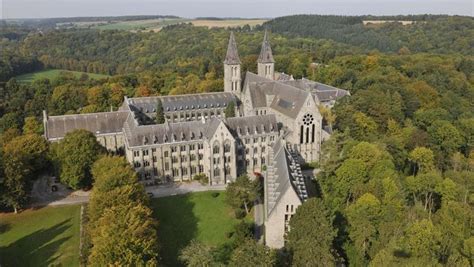
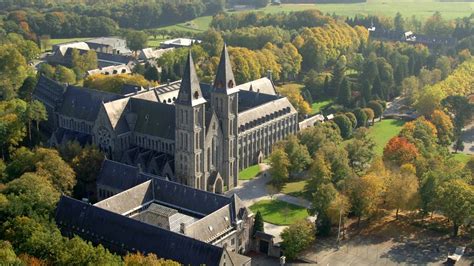
Maredsous Abbey occupies an enormous set of neo-Gothic buildings set on top of a wooded plateau, above the Molignée valley in the Ardennes, in the province of Namur. The Benedictines came here in the 1870s, I believe from Germany, building a huge chapel, and a set of cloisters flanked by accommodation blocks, a refectory etc. In addition to their daily Office, the monks are involved in teaching, computer technology, and theological research. And there is a Visitors’ Centre, comprising a cafeteria and shop selling Maredsous beer and cheese. The Centre is always very busy as Christmas approaches.
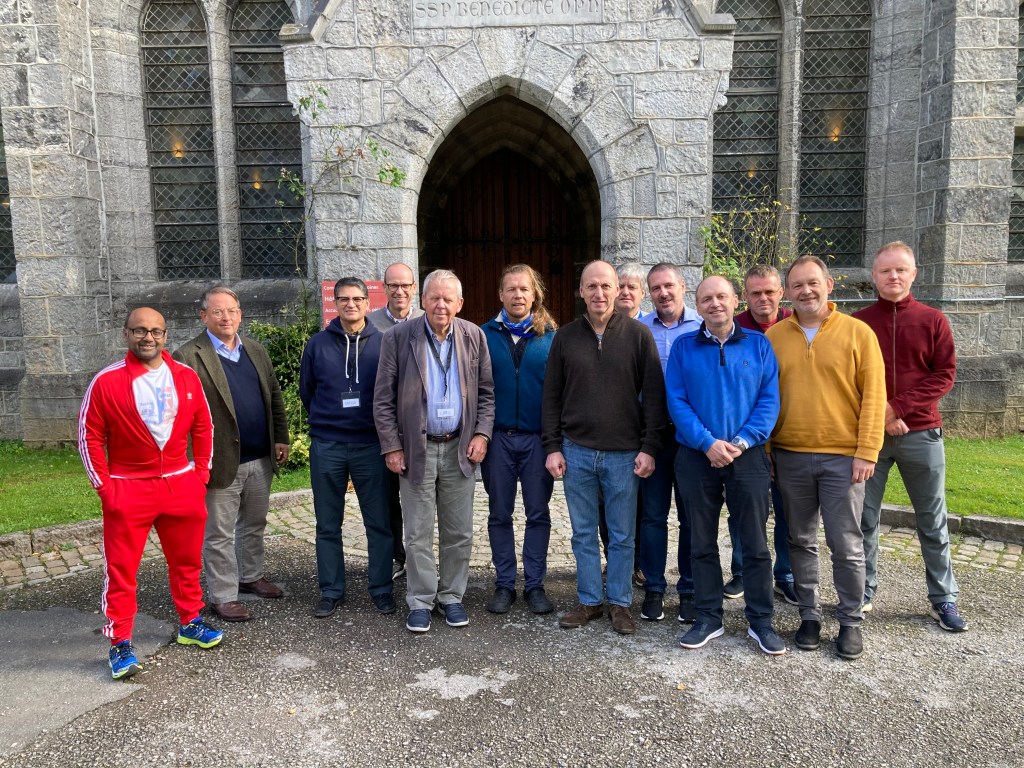
There were slightly fewer men this year, in part as a result of clashing with Bishop Sarah’s visit to Holy Trinity. [She is the Patron, and the church is starting to look for a new Chancellor.] But the dynamic worked well with the slightly smaller group. Armin and Frank and Philipp had once again done all the hard work planning.
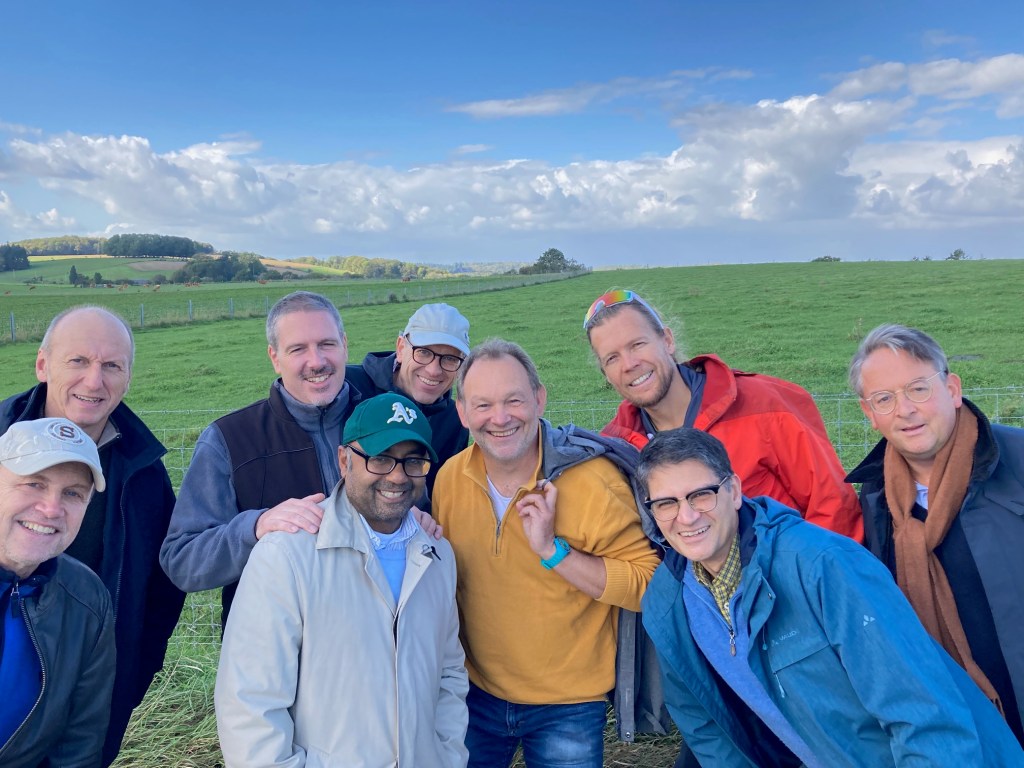
The theme this year was Living with the Psalmist. My once-upon-a-time training Rector Dennis Lennon used to say that the Christian life is lived at the point where our learnt Christian faith comes into contact [and into conflict] with the reality of everyday life. ‘Where the Rubber hits the Road’. Certainly the palmist is honest and up-front with God about his sufferings and his frustrations. We looked in some detail at Psalms 23 and 73 and 150; living with fearfulness, living with doubt, and living with gratitude. And in small groups we wrote psalms of lament and of praise, which were incorporated into the Sunday morning eucharist. An innovation that worked well. The weather forecast had promised rain, but we enjoyed a splendid Saturday afternoon walk in autumn sunshine.
Bloodshed and butchery in the Middle East
Bloody Israel ! Joe Biden and Rishi Sunak and Emanuel Macron are all queuing up to shake hands with Israeli leaders and assure them that we all stand with them following the savage attack by Hamas at the start of the month. Well they don’t speak for me. President Benjamin Netanyahu is a devious crook, who has held power in Israel for much of the past three decades, but who is widely disliked and distrusted by the majority of his own people. Of course the Hamas attacks were savage, as they killed civilian men, women, and children indiscriminately.. But, as António Guterres has made plain, the attacks did not take place in a vacuum. They are a consequence, perhaps inevitable, of Israeli policies towards the Palestinians in recent years. The Gaza Strip is a tiny enclave on the shore of the Mediterranean, some twenty five miles long and six miles wide, inhabited by some two million Palestinians, mainly Sunni Muslims. Many of the inhabitants are descendants of the Palestinians who were evicted from what is now Israel following the Arab-Israeli War in 1947-48. The strip is entirely dependent on Israel for supplies of water, electricity, and medication – all of which have now been cut off; and is separated by Israel from the West Bank, the other [larger] half of the territory under the Palestinian Authority. The plight of the Palestinians has been largely ignored for the past decade by successive right-wing Israeli administrations – and by most world leaders.
Whose Promised Land ?
Modern Zionism was in part a reaction to Jewish persecution in Russia in the late nineteenth century. Jews could not be assimilated in the countries in which they were scattered. The solution was to be the establishment of a Jewish state. Argentina, fertile and thinly populated, was one possible country. But Palestine was felt to be their historic homeland. The Zionist Congress in Basle in 1897 adopted the creation of such a state in Palestine as part of its programme. “A land without a people for a people without a land” was a potent slogan. And a seductive lie.
Britain’s role was complex. In November 1917 Arthur Balfour, the British Foreign Secretary, wrote to Lord Rothschild, to give British support to the creation of a Jewish national home in Palestine, which was then still part of the Ottoman Empire. He did this partly to secure support from Jews in Britain and American in the Allied war against Germany. Partly to try and avoid a large influx of Jewish refugees into Britain. Arthur Koestler described the Balfour Declaration as “a document in which one nation solemnly promises to a second nation the country of a third nation”.
Unfortunately, in 1915, Sir Henry MacMahon, the British High Commissioner in Egypt, had already written to Sherif Hussein of Mecca, to support after the war [and the dismemberment of the Ottoman Empire] the establishment of an Arab State in all territories of the Arabian Peninsula, Iraq, Syria, Jordan, Lebanon, and Palestine. And that Britain would guarantee such a state against all external aggression. In racing parlance, Britain had sold the same horse twice.
Jewish immigration to Palestine grew in the 1930s, in response to persecution by the Nazis. By 1947 the Jews numbered 31% of the population and owned 6% of the land. Most of it purchased from absentee landlords. In 1947 Britain announced it was giving up its mandate over Palestine. A United Nations commission drew up plans for a two-state solution. Under heavy diplomatic pressure from the USA, the United Nations plan proposed the establishment of a Jewish state with 52% of the land alongside an Arab state with the remaining 48%. Jerusalem and the surrounding area would be an international zone. In effect the Palestinian Arabs were paying the price for western [European and American] guilt about the Holocaust.
The UN Partition Plan was accepted by the Jews in Palestine, and flatly rejected by the Palestinian Arabs. In 1948 Dr Chaim Weizmann raised the flag of David and proclaimed the new state of Israel. Which has been in a state of uneasy peace and intermittent war with its Arab neighbours for the past seventy years.
I’ve been going back to this story by re-reading Colin Chapman’s 1983 book Whose Promised Land ?. Chapman taught university students in Egypt and in the Lebanon back in the 1970s and the 1980s, and was later on the staff of Trinity College, Bristol. [Susie and I talked to him when I was thinking to apply to Trinity, Bristol. And he advised us to stay put in Woodstock and for me to apply to Wycliffe Hall.] The book is a generation out of date. But is worth reading for Chapman’s careful assessment of Biblical prophecies and promises.
Family matters
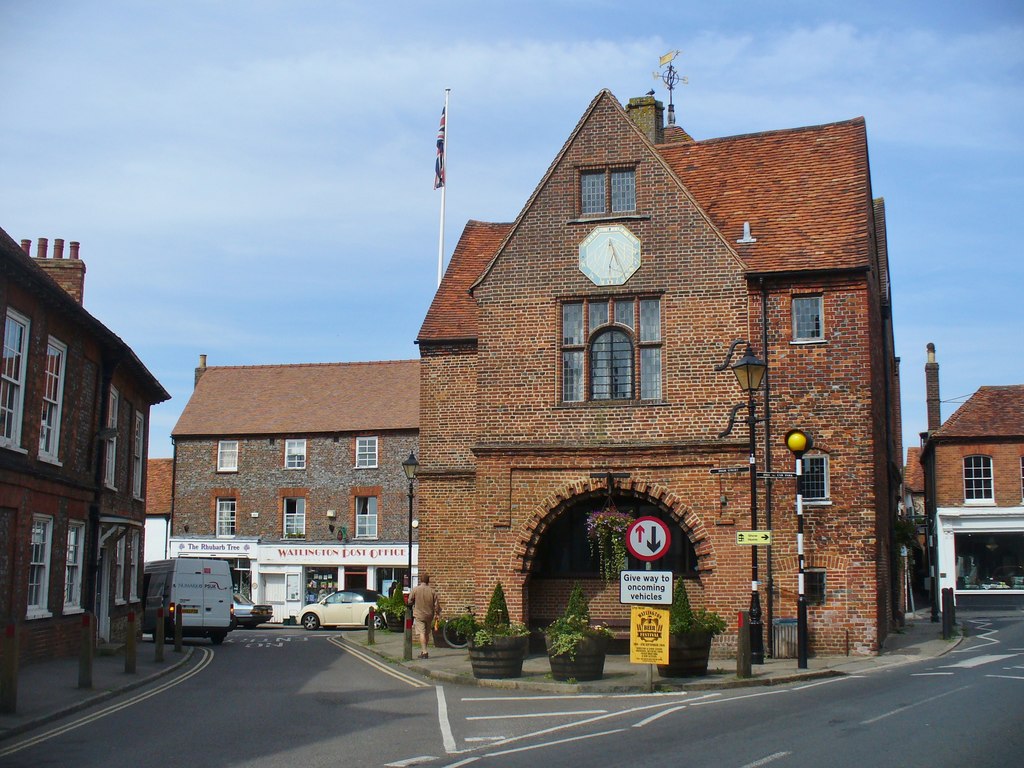
Susie and I have been in Watlington and Wycombe for a week with family, being not very useful during half-term. It is good to see the children and grand-children; and I even managed lunch in Leamington Spa with my brother and both sisters-in-law. But it is easy to be more aware of Joanna’s absence when we are down south. This is the first time I have stayed in Wycombe since before she was ill. Next weekend we go home to Edinburgh. And start to think about Chantilly …
October 2023
 Through a glass darkly