Down in Wycombe
“You’re a lovely old man”, the girl at the check-in desk said to me. I’m not sure if it was a compliment. This was at Heathrow on the return journey. Of which more below.
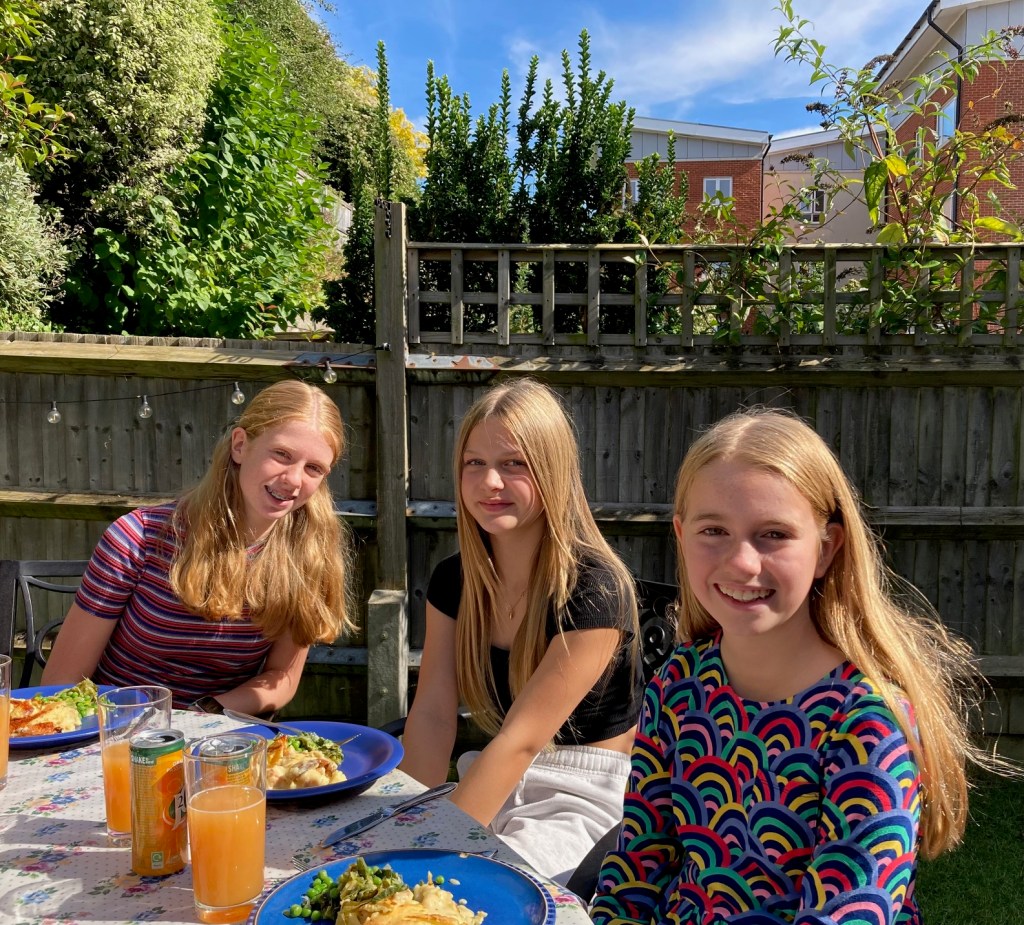
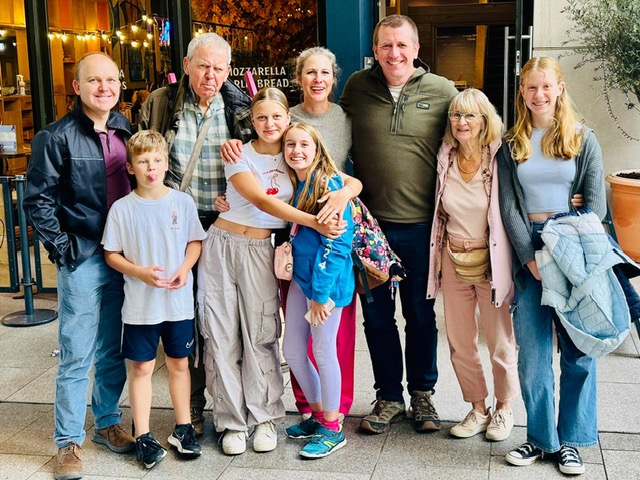
We are just back from ten days down in Wycombe. Craig was away for a week walking the Ridgeway, an ambitious six days of moderately heavy walking. In his absence Susie and I were looking after the girls. We are both struggling a bit with mobility issues; Susie walks with two poles because of arthritic hips, and I have caught it from her and walk with one pole. So – it wasn’t totally clear who was looking after whom. But it was very good to spend some time with the children and grand-children, whom we don’t according to Susie see often enough.
I am not sure how often you are meant to see grand-parents. When I was a child my paternal grand-parents lived about two minutes walk away, on the other side of the Plaza, the Southfields cinema. But they both died before I was ten, so my memories of them are a bit limited. Grandma was often in bed in a back room as I recall. The bed was protected by a screen covered with cigarette cards. And in the adjacent room she had a treadle sewing-machine and a bottle of smelling salts.
My maternal grand-parents lived in Minety, in Wiltshire, until 1953. My grand-father, Fa, was the station master of a GWR station that was like something out of Thomas the Tank Engine. As small children Paul and I had the run of the station [Health and Safety would have been horrified], and we were indulged by the two porters and, rather less, by the three signalmen and by some of the train drivers. In days when we all wanted to drive steam trains, it was a huge privilege. But in 1953 my grand-parents retired to Bradford-on-Avon, complete with a Saxon church, a chapel on the bridge, a medieval tithe barn, and a river [the Avon] congested with reject Spencer-Moulton tennis balls. We missed the steam trains. But it was a magical place in the 1950s. And, because my father was a primary school teacher, with school holidays, we stayed with Nanny and Fa several times a year.
Wycombe is an attractive place when the sun comes out. Though ruined by the advent of the motor car. My father recalled driving up the A40 in the 1920s to visit my mother’s family in central Wales, and the road went straight through places like Beaconsfield and High Wycombe. And straight through Oxford, over Magdalen Bridge and up the High Street, and then down past Oxford station out towards the toll bridge at Eynsham. The centre of Wycombe now is part-pedestrian with a big 1970s [?] shopping centre. The Wycombe by-pass must have been built in the very early 1960s, the very first stretch of what is now the M40.

We sat in the garden in the sun to eat with the children and grand-children. Which was very good. And my brother and both sisters-in-law, Paul and Jean, and Alice, came down from Birmingham and from Leamington Spa on the train, and we had lunch in a very reasonable Kerala/South Indian restaurant in the centre of town
The Iolaire tragedy
I spent a bit of time reading a book that I had bought in the very good bookshop in Portree back in June. When I heard the bell is a beautifully written account of the Iolaire tragedy, by John MacLeod, a Gaelic speaking journalist and historian. The book was written to mark the ninetieth anniversary of the disaster, and was shortlisted for the Saltire Book of the Year award.
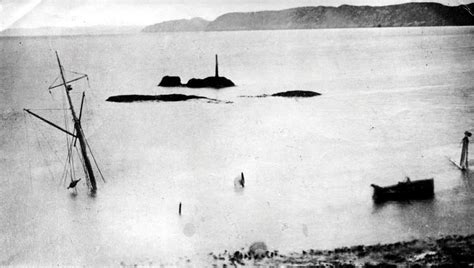
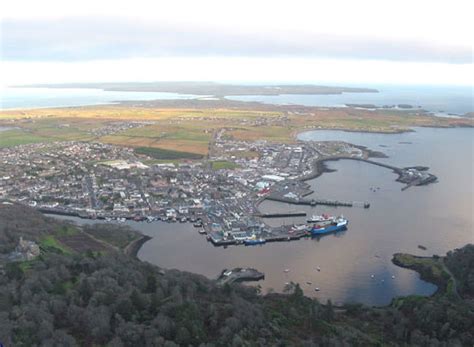
On 31 December 1918, His Majesty’s Yacht Iolaire sailed from Kyle of Lochalsh for Stornoway, bringing home to the Hebrides nearly 300 military and naval veterans of the Great War. She never made it. At two in the morning, the ship ran aground on a notorious reef, the Beasts of Holm, close by the mouth of Stornoway harbour, where the quay was already jammed with friends and relatives. Over 200 men drowned, from middle-aged veterans to boys in their teens, in what remains Britain’s biggest peacetime disaster at sea since the loss of the Titanic – devastating the Isle of Lewis and scarring a generation. Only eighty of the men on board survived.
MacLeod is good on the context of the disaster; he wants us to know that in 1914 Scotland was one of the richest parts of the British Empire, with its wealth built on the production of raw materials – coal, steel, and shale-oil – skilled heavy industry, the building of ships and trains, and textiles. The Isle of Lewis, he tells us, was the richest part of the West Highlands, with Stornaway supporting a strong retail economy, a thriving cultural scene, and a considerable herring fishery, all set about a magnificent and sheltered harbour. He points to the tightly-knit village communities and the very high number of those who volunteered to fight in the war. In 1915, in the community of North Tolsta, which had boasted a population of 853 in the 1911 census, 400 males and 453 females, 189 men were fighting for their country, that is 47% of the entire male population. By the time of the Armistice 41 men were dead – 41 from a village with a population of fewer than 900.
Did alcohol play any part in the tragedy. It was New Year’s Eve, and there was an insistent suspicion that the officers of the Iolaire were not sober. MacLeod notes that temperance was a huge issue in Scotland at the time, not least on Lewis. But the Royal Navy report, which was produced within a matter of weeks, declared that these rumours were untrue and without foundation. Four officers and twenty-three crew had sailed the Iolaire. All four officers were drowned, and only the bodies of two engineers were recovered. Of the twenty-three crew, only seven survived. Those who died included Private Herbert William Head, whose girlfriend was expecting their baby and whose wedding was scheduled for Stornaway on New Year’s Day.
The Royal Navy report was unable to explain how the accident occurred. Although Kyle of Lochalsh to Stornaway was an established shipping route, MacLeod stresses that the Minch is a challenging and capricious piece of water, and that the journey calls for responsible seamanship and an alert, experienced master. The only aids available were charts, compasses, and a handful of lighthouses. The officers of the Iolaire were not local men. The available deck-officers, Richard Mason and Leonard Cotter, had shipped into Stornaway before, but not often and never by night. Macleod’s hypothesis is that Commander Mason simply mixed up the lighthouses, and was centring the Iolaire not on Arnish Light at the mouth to the harbour but on Tiumpan Head, the lighthouse at the end of the Eye Peninsula, the most easterly point of Lewis.
The survivors of the disaster found themselves marked men. Like other Great War veterans they were distanced from the bereaved, distanced from their own families. Those who came ashore received not a penny from the Ioalaire Disaster Fund. Some emigrated. Some left for the mainland, never to return. The last survivor of the tragedy, Donald Morrison of Port of Ness, died in July 1990.
British Airways
We flew down south to Luton with EasyJet and back with British Airways from Heathrow. It wasn’t British Airways finest hour. Susie and I had requested passenger assistance, as we are both struggling with arthritic hips. The girl at the assistance desk [wheelchairs] was friendly. But the service was overrun by passengers on an adjacent flight to Islamabad. We waited for over an hour. After our flight was [should have been] called we were rushed through by two friendly pushers. In the rush I lost my best reading glasses [red frames with a black case, if you have seen them] in the security section. We then waited three hours at the boarding gate for our flight to be called, as British Airways had scheduled a plane but no cabin crew. There were announcements but no explanations. British Airways staff agreed it was no way to run an airline. When the flight was finally called, our friendly pushers had long gone so we limped onto the plane. Back in Edinburgh our taxi-driver said that ‘Its always like that with British Airways on Sunday evenings’.
Customer service may be a thing of the past. British Airways doesn’t want to speak to customers. Which I can fully understand. The chatbot sent me round in circles and drove me mad. I have written to British Airways to complain, but I’m not holding my breath.
September 2024
PS
Sambre
The river Sambre is not the prettiest part of France, passing through a mining and industrial area before flowing into Belgium to join the Meuse at Namur. And Sambre – anatomy of a crime, a French television series,sounded pretty grim. This is the fictionalised story of France’s most notorious serial rapist who attacked women in this area over a period of some thirty years. Six free-standing episodes focused on six different characters, the victim, the investigating judge, the mayor, the scientist, the policeman, and, eventually, the rapist; and spanned the years 1988 to 2018.

The series was directed by Jean-Xavier de Lestrade and popped up on successive Saturday nights on BBC Four. With sub-titles. I found it a fascinating look at a small-town community. And a devastating indictment of the casual sexism of the French police. Well worth a look. Its available on I-Player for anyone who is interested.
 Through a glass darkly