Advent 2 How long ?
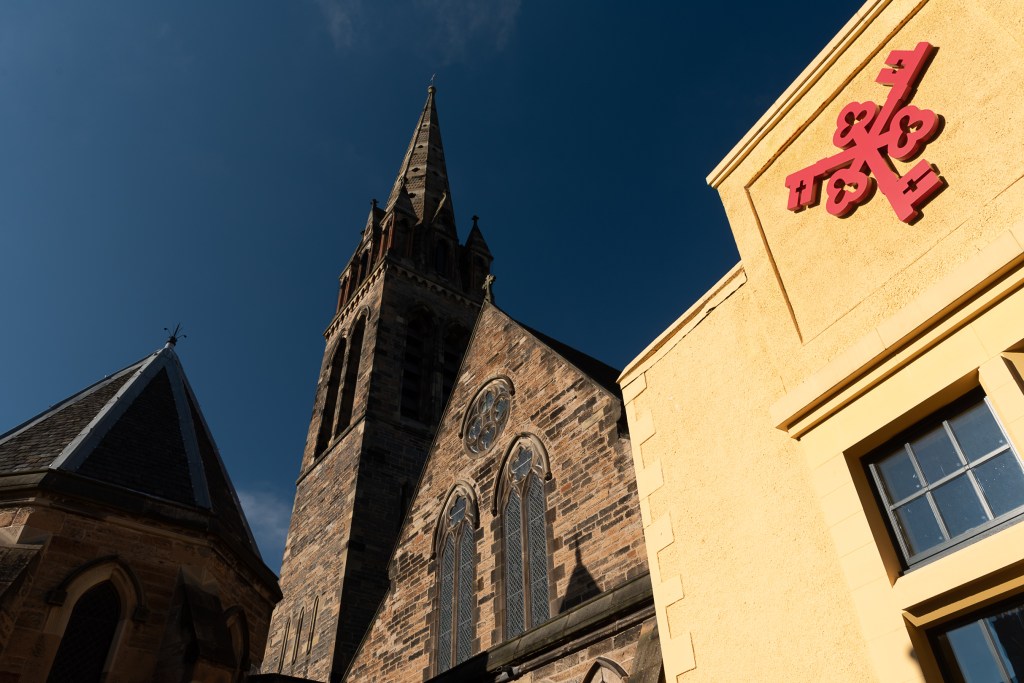
I very rarely put anything consciously religious on this blog. So, as a corrective, here is more-or-less the sermon that I preached at St Peter’s, Lutton Place, last Sunday morning, the second Sunday in Advent. The readings were from Malachi 3 and Luke 3. It was the first time I had preached there since All Saints Day, 2021. The photos of the church are by David Healey.
Prelude
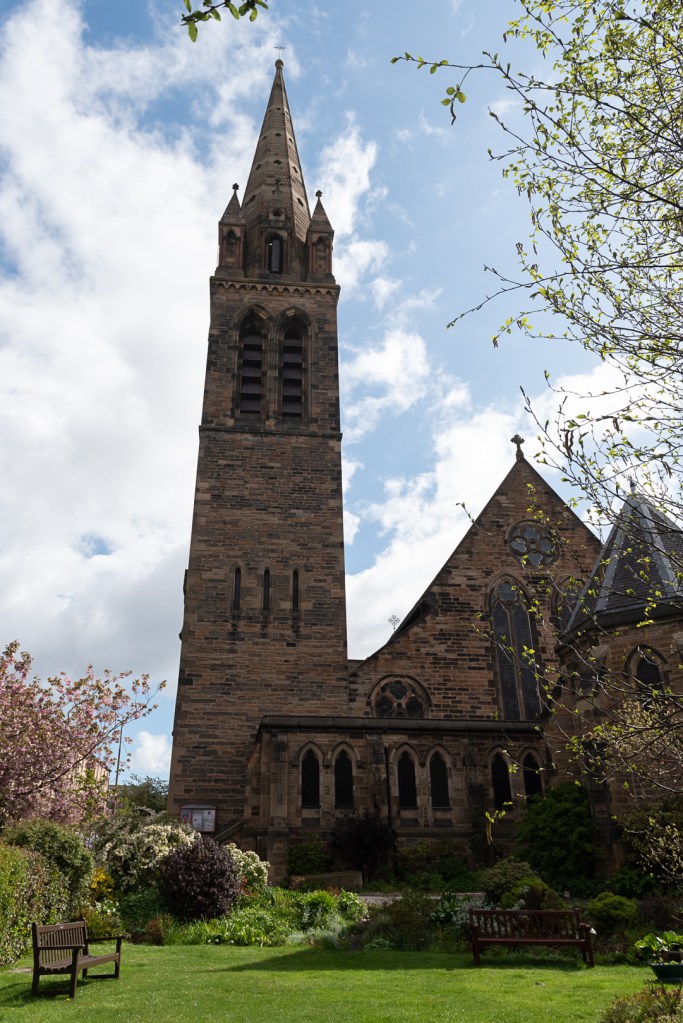
As Sue said at the start of the service, today is the 2nd Sunday of Advent, the season of preparation for Christmas, the coming of the Word made Flesh. As we saw last week, Advent is both about looking back and looking forward. It is about looking back to the Incarnation, the first coming of Jesus, whose birth we will celebrate on Christmas Day. But it is also about looking forward to Christ’s Second Coming, the Eschaton, the Last Days.
For the benefit of any visitors or anyone who is very short sighted, I am not the Rector. Who is a significantly younger man. And who is currently away on sabbatical leave, probably in a warmer climate. But in homage to Nick, I’d like to tell you about the first West End musical I ever saw. Back in the summer of 1959 at Her Majesty’s theatre in London.
It was West Side Story. Which as you know is the story of Romeo and Juliet transposed to Upper West Side, New York in the 1950s, amid gang warfare between the Jets and the Sharks. In Act 1, Tony, the best friend of Riff, the leader of the Jets, sitting as I recall on top of a step-ladder, sings Something’s Coming. He has not met Maria. But he has become disillusioned with gang warfare and looks forward to a better future. He is leaving the Jets but agrees to to go to a dance that evening. The Dance in the Gym.
Could it be ? Yes, it could
Something’s coming, something good, if I can wait
Something’s coming, I don’t know what it is
But it is gonna be great … …
Who knows ? Its only just out of reach
Down the block, on a beach
Maybe tonight, maybe tonight
Maybe tonight, maybe tonight
I have never seen this song in a Christian hymn book. But it is obviously suited to Advent. Essentially it is about a sense of anticipation, of waiting. But with an edginess, a sense of foreboding. But the question then is What exactly ? And, above all, When ?
How long, O Lord … is the great cry of Advent:
* before there is peace in the Middle East ?
* before there is an end to the war in Ukraine ?
* before nations learn to live in partnership and peace ?
* before God’s Kingdom comes upon us
Or, closer to home:
- before I see my grandchildren again ?
- before I can get a hospital appointment ?
Malachi 3: 1-14 God’s messenger
Malachi is an unfamiliar book to many of us. [Though this passage recurs next year; it is the Old Testament lectionary reading for February 2nd, the Presentation of our Lord in the Temple.] The book is probably anonymous, as Malachi means ‘my messenger’ in Hebrew. There are two main themes: the failures of priests, 1:6 – 2:9; and the failures of the people, 3: 6-12, in their religious duties. [NB Older men are criticised for discarding their ageing wives in order to marry attractive young foreign women ! But I don’t think that is an issue here at St Peter’s.] The prophet foretells the Day of Yahweh, the Day of the Lord, which will purify the priesthood, consume the wicked, and secure the triumph of the upright. The book probably dates from around 450 BC, after the Babylonian exile.
v.1 The coming of the Lord will be preceded by his messenger
v.2 no-one will be able to resist the day of his coming
v.3 he will be like the refiner’s fire; to refine and to purify
The image is of God as a smelter of ore. So here is God in the foundry. The pot heats up and into it he dumps the ore. [The people ?] And up to the top floats all the slag – all the bad stuff. And God skims it off with a ladle. A little at a time until its all gone. And what is left? Pure gold! Beautiful, precious, shining yellow perfect gold – 24 carat!
On that day all the proud and evildoers will be set ablaze [v.19].
But God knows his people, whose names are written in his book, and he has good things in store for them.
Luke 3 John the Baptist
As Christians we believe that Malachi’s prophecy is fulfilled [partially fulfilled] in the coming of the enigmatic figure of John the Baptist [the Baptiser]. John is in some ways a bridge between the Old and New Testaments; he lives on the edge of the desert, dressed in a coat of camel hair with a leather belt. He eats locusts and wild honey. And his message is that people need to repent [turn their lives around] and to be baptised for the forgiveness of their sins

Isaiah 40 A message of comfort
The Old Testament quotation in Luke 3 is not from Malachi, but from Isaiah. Who is the great prophet of Advent and Christmas; who offers us a vision of the greatness and the majesty of God without parallel in Scripture, with the possible exception of the book of Revelation.
Isaiah stands with the Jewish people in exile in Babylon, far from their homeland, from the Jerusalem Temple, and seemingly far from their God. And his message in Chapter 40, the passage quoted in our gospel reading and following, is one of comfort for God’s people:
- comfort, comfort my people [v.1], who are bruised and potentially broken
- their time of punishment is over [v.2], coming to the end of the Babylonian exile
- make straight a path in the desert [vv.3-4] We are familiar with Presidents and important people riding in impressive motorcades; in black limos with police outriders. In ancient times slaves would create a kind of desert highway for the emperor. So too for the arrival of God among his his people. [When the Edinburgh City Council fills in all the potholes, will we know that the Lord’s return is imminent ?]
- tell the messengers to cry out [vv.8-9] The watchmen who keep guard on the city walls are to be on the alert. It is their job to rouse the people; to proclaim to them “Here is your God”.
- for God is coming [vv.10-11] Not just in power, as any mighty prince … But like a shepherd, gently gathering the flock in his arms.
But these verses were written [and Isaiah is notoriously difficult to date] perhaps 500 years before the birth of the Messiah. It was a long wait for the people of Israel. From the prophecies of Isaiah to the narrative of Luke 3 is perhaps 500 years; as remote from us today as are the Battle of Bosworth Field and the accession of Henry Tudor. [And Wolf Hall which will be on our television screens again this evening.]
Luke 3 John the Baptist
vv.1-2 Herod the Great died in 4 BC; the kingdom was divided between his 3 sons. Archelaus was deposed for misconduct; Judea was ruled by Roman procurators, one of whom was Pontius Pilate.
vv.3-6 John the Baptist is a prophet in the OT tradition.
Sees himself as fulfilling the prophecy of Deutero-Isaiah.
John’s essential task is to prepare the way. Something in common with Isaiah, from whom he quotes in our Gospel reading. His is in effect “a voice of one calling in the desert, Prepare the way for the Lord”.
But his tone is rather different from Isaiah. Where Isaiah chose to emphasise the Messiah as a bringer of comfort, here John’s emphasis is on the need for repentance. Which is not just a matter of saying Sorry. But more a turning around of lives. A determination to start living life in a new way.
vv.7-14 His message is one of coming judgement. As we will no doubt see next week. The need for repentance. For changed behaviour
v.15 The people are wondering: Can this be the Messiah, the Christ ?
Preparing people for the coming of Jesus ? Is this the right way ?
How can we in today’s post-Christendom, and largely post-Christian, culture help people to focus on, to prepare for the coming of the Messiah ? It is a question with which church leaders are struggling. [When they can get their minds away from historic child abuse.]
The secular world merely throws money at the Christmas preparations. As one cynic comments: ‘Using money we haven’t got to buy presents they don’t want for people we don’t much like.’ Against that the church tries to insist that Advent is a time for quiet; for contemplation of the bigger things; for repentance; and for prayer. But I am not convinced that John the Baptist’s message of condemnation is the right model for our times.
Preparing people for the coming of Jesus ? cont.
Denis Lennon, the best week in, week out preacher I’ve ever heard, used to say … ‘There are always [very odd] people who like to go to church to be condemned for their sins.’ But I’ve never thought that was my job, the preacher’s job. I think there is a better way to point people to God and to Jesus. It is our task, our calling, our privilege as Christian men and women to model something of the nature of Jesus, of his integrity and his goodness and his compassion. And its is our task as a Christian community to model something of Christian love and forgiveness. And to help people to see that there is a better way of living. Better than lying politicians and greedy bankers.
I want this Advent to hold in mind a bigger picture.
I want to have in my mind and my prayers this morning the 80 year old Ukrainian man, living 8 kilometres from the Russian forces in eastern Ukraine, in a house damaged by shelling, living with a wife who has dementia;
I want to have in my mind and prayers the 50 year old Palestinian woman, four of her children killed by the Israeli defence force, she hasn’t seen her husband for eight months; and she and her remaining children are now homeless and hungry;
I want to be aware of my Edinburgh neighbour whose much loved child has been taken into a hospice, and may not live until Christmas Day.
And I want to pray for them in the words of my favourite Advent hymn.
How long before You drench the barren land?
How long before we see Your righteous hand?
How long before Your name is lifted high?
How long before the weeping turns to songs of joy?
Lord, we know Your heart is broken
By the evil that You see,
And You’ve stayed Your hand of judgement
For You plan to set men free.
But the land is still in darkness,
And we’ve fled from what is right;
We have failed the silent children
Who will never see the light.
But I know a day is coming
When the deaf will hear His voice,
When the blind will see their Saviour,
And the lame will leap for joy.
When the widow finds a Husband
Who will always love His bride,
And the orphan finds a Father
Who will never leave her side.
How long before Your glory lights the skies?
How long before Your radiance lifts our eyes?
How long before Your fragrance fills the air?
How long before the earth resounds with songs of joy?
© Stuart Townend 1997
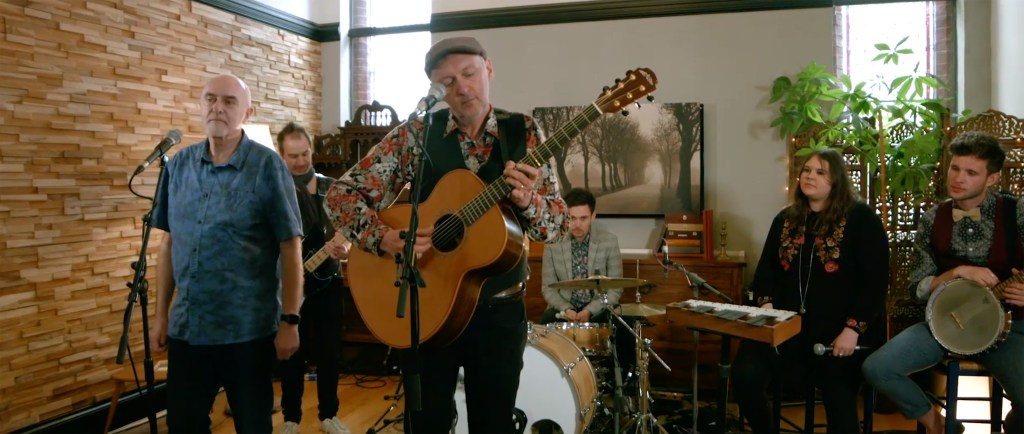
How long ? Maranatha. Come quickly, Lord.
Amen
December 2024
 Through a glass darkly