Christmas into New Year
That was Christmas that was. We were delighted to have Jem and Anna, Freya and Oskar, with us in Edinburgh for a week. It was the first time since I retired that we have had family here over Christmas. [We have been variously in High Wycombe and Watlington, in Ankara, Kiev, and Chantilly.] Jem and Anna did most of the heavy lifting, with the limbless turkey, roast potatoes, sprouts etc. The weekend papers told us to drink new world Cabernet Sauvignon with the turkey. But we didn’t have any. And drank Chilean Pinot Noir instead.

Now it is New Year, and Edinburgh is dry, sunny, and very cold. Some neighbours came in for mulled wine on New Year’s Eve. Susie and I had a brief excursion into the centre of town on New Year’s Day. Beyond that I have walked in the park. And have finished a book that I began to read back in Kaunas at the end of October.
David Smith’s God or Mammon: The Critical Issue confronting World Christianity was published last year by Langham Academic. David is a friend of some thirty-plus years; onetime Pastor of Eden Chapel, Cambridge, Principal of Northumbria Bible College when we were in Duns, Co-Director of the Whitefield Institute in Oxford, and Course Tutor when I did an MTh in Mission in an Urban World at ICC, Glasgow in 2006-8. He has published nine books, all well worth reading, including Mission after Christendom [2003], Seeking a City with Foundations [2011], and Stumbling towards Zion: Recovering the Biblical Tradition of Lament [2020].
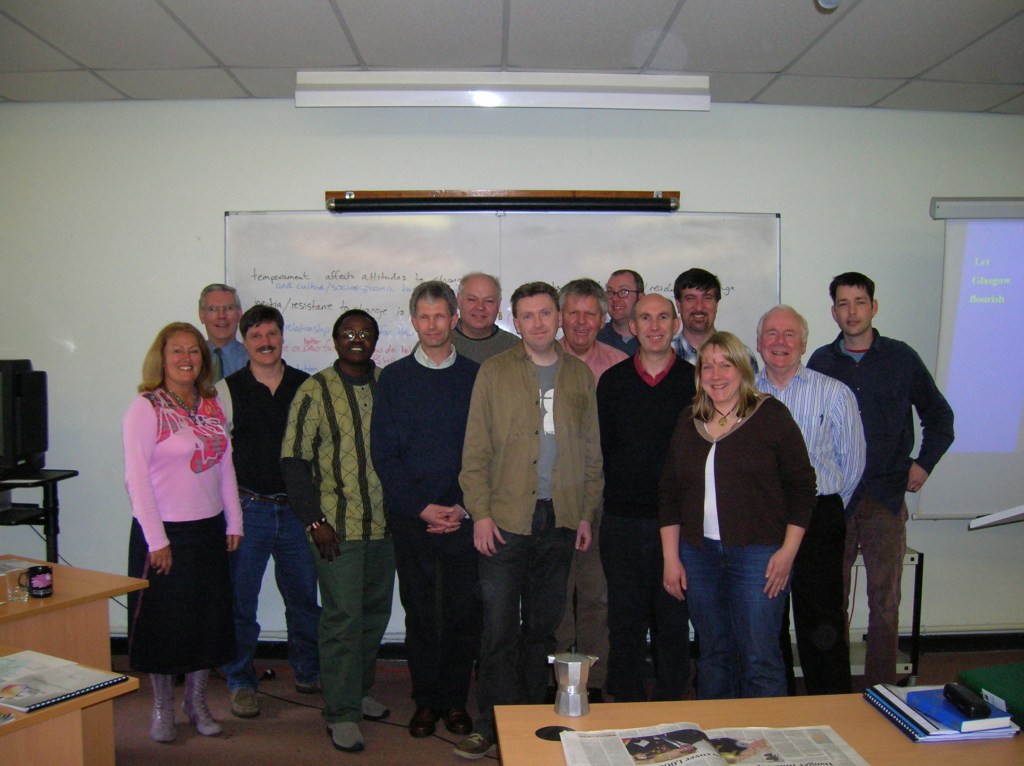
David Smith with the MTh cohort, ICC, Glasgow, 2006
David Smith: God or Mammon
God or Mammon is his most recent and most ambitious book. It is prefaced by a quotation from Albert Camus: “The question of the twentieth century is … how to live [in a world] without grace and justice ?” Camus’ 1971 book L’homme revolté,is a secular lament over a broken world from which both normative ethics and an agreed understanding of the meaning of existence have been lost. Tony Judt charted the post-War social reforms. But his later book strikes a concerned note: “Something is profoundly wrong with the way we live today. For thirty years we have made a virtue out of the pursuit of self-interest.” In consequence British and Americans assume that inequality is a natural condition of life. About which we can do very little. David Smith rescues the biblical word Mammon to describe the materialistic world view which dominates our society. And asks how Christian belief and practice can counter this obsessive desire for individual material prosperity.
Biblical Roots
In the first part of the book David looks at the Old Testament, at the biblical roots of the struggle between God and Mammon. As the tribes of Israel gather at Shechem, they are given a choice: either to serve Yahweh or to embrace the way of life of the cities that they have overthrown [Josh. 24: 14-15]. [[They must resist what Dennis Lennon called ‘the urge to merge’.] Walter Brueggemann insists that the Torah reveals Yahweh as a God “committed to the establishment of … …sociopolitical justice in a world of massive power organised against justice”. But the demand for a king, with the consequent centralisation of power, the need for taxation to fund the royal lifestyle, and widening socio-economic divisions, resulted in the erosion of the values of the Torah.
The pre-Exilic prophets exposed the corruption and apostasy of Israel. Deutero-Isaiah, the great prophet of the Exile, declared that the Servant would recover and renew the Mosaic concern for justice; his ultimate aim would be to “to bring justice to the nations” [Isa. 42: 1-4]. Ecclesiastes, written towards the end of biblical Israel, acknowledges that their return from exile had not triggered the spread of glory through the earth. Trito-Isaiah acknowledges the disappointment of the returning people [Isa. 59: 9-10]. Qoheleth [The Preacher] anticipates Camus; he sees a world gone amiss, a culture in which concern for money and possessions creates an idolatrous system. Which creates division, isolation, and despair. Qoheleth can no longer understand the purpose of the universe.
Moving to the New Testament, Palestine was part of the fertile crescent; with plentiful harvests of wheat, grapes, and olive oil; abundant fruit and abundant fish in the sea of Galilee. But the introduction of a new system of land ownership and the imposition of new forms of taxation created an impoverished rural population. And a widening gulf between the wealthy elite and the rest. Herod’s expensive building projects were mainly in the south, funded by heavy taxation.
David Smith concentrates on Luke’s Gospel. Jesus’ public ministry began with his sermon in the synagogue at Nazareth [Luke 4: 14-3], with what has become known as the Nazareth Manifesto. In Nazareth, which was essentially a Jewish settler community, Jesus is walking a tightrope between the imperial power of Rome and the emergence of a growing ethnic nationalism. In this situation he tells of another kind of country, another kind of kingdom.
The disciples struggle with the challenges posed by Jesus. For much of Christ’s teaching “has to do with the dangers of wealth, the blessedness of the poor, and the need to follow his example in the renunciation of home, property, and death”. [Sean Freyne]
In the Book of Acts we move from the village culture of Palestine to the urban world of the Roman Empire. The early chapters of Acts describe a shared life, in which the power of Mammon is broken, and the emergence of a new Messianic community within which “the Mosaic dream of a society shaped by love and justice was becoming a reality”. The seductive power of money is dramatically illustrated in the story of Ananias and Sapphire [Acts 5]. The distribution of food to the widows in Jerusalem causes tensions, but becomes an integral part of the Christian mission. In Philippi [Acts 16] the exorcism of the slave girl threatens the finances of her owners and causes an uproar. Here is a clear link between pagan religion and material gain.
In Ephesus the people of the Way consisted of both Jews and Gentiles. Who become “members together of one body, and share together in the promise of Jesus Christ”. [Eph. 3: 2-6] In Paul’s Farewell to the Ephesian elders, he testifies that he has not taken money from them; and he tells them that it is their responsibility to help the weak [Acts 20: 33-35]. For Paul the Collection [of money for the Christians in Palestine] was important. On trial before Felix, Paul says he has returned to Jerusalem “to bring my people gifts for the poor” [Acts 24:27]. Paul returns to the theme in 2 Corinthians 8. Concern for the poor is not just charity, but is rooted in the example of Jesus Christ who “though he was rich … became poor …” [2 Cor 8:9]. This collection is not just a one-off event. But is to be an on-going way of life, in order to support poorer brothers and sisters. Modern scholars make little of the Collection. But it is a concept which could be a very significant Christian counter to a global culture built on greed and in thrall to Mammon.
Historical Struggles
One of the distinctive features of Christian mission was a changing attitude towards wealth and power. “… we who once took most pleasure in the means of increasing our wealth now bring what we have into a common fund and share with everyone in need …” writes Justin Martyr in the mid-2nd century. Alan Kreider notes that early Christian leaders well understood the need for converts not just to embrace new ideas, but to transform their values and their way of life. Christian teaching challenged the underlying economic assumptions of the Roman empire. Including the notion of private property. St John Chrysostom [who became bishop of Constantinople in 398] argued that economic injustice was a betrayal of God’s purpose in creation. And that the very basis of human society is mutual need. With different regions trading their produce.
I don’t have the time, and any readers may not have the energy, to follow the story through in detail. David Smith looks at the rise of monasticism, and the way in which monastic communities challenged the imperial culture and were champions of the poor. He traces the role of lay-led revival movements, such as the Humiliati, who fed and clothed the poor and cared for the sick, giving special attention to lepers. He acknowledges that the thirteenth and fourteenth centuries, when Europe was struck by famine, recurrent plagues including the Black Death, and the ravages of the Hundred Years War between England and France, saw a great increase in millenarian excitement. There was a deep longing for a better world, for the coming of the kingdom of God.
The sixteenth century brought a significant rise in the population of Europe, the dominance of certain European countries, the rise of the modern capitalist system – and the beginning of the spread of Christianity. In the Americas mission went hand in hand with violent military conquest. Some European Christians were appalled by the violence and oppression visited on the native populations. Thus Bartolomé de las Casas [1484-1566]: “God made all the peoples of this world … they are among the poorest people on the face of the earth; they own next to nothing and have no urge to acquire material possessions”. Fifty years later the French Protestant missionary Jean de Léry contrasted the culture of the indigenous people with that of post-Reformation Europe: “… not only would a savage die of shame if he saw his neighbour lacking in what was in his power to give, but also … they practise the same liberality towards foreigners who are their allies”.
The Chilean theologian Pablo Richard, writing on the 500th anniversary of the arrival of Europeans in the Americas wrote that, in 1492 “death came to this continent, the deaths of human beings, the death of the environment, death of the spirit, death of indigenous religion and culture”. [He was of course writing before the coming of Donald Trump and the MAGA movement,]
What was the relationship between the Christian faith, mission, and imperialism ? William Carey, one of the founders of the modern missionary movement, asked questions about the culture of Imperial Britain. Carey’s followers were culturally sensitive, and stressed their priority was to learn. Early Baptist missionaries determined not to profit materially from their mission, and reflected the pattern of primitive Christianity of Acts.
Thomas Guthrie [1802-73] was aware of the social problem of the big Scottish cities; snd believed that the yawning guy between rich and poor was contrary to the gospel. Edward Miall [1809-81] was a clear critic of the hardening class structure of 19th century Britain, which was reflected in denominational divisions. Guthrie lamented “a system of trade which offers up our children in sacrifice to the Moloch of money”, while Miall deplored the “national exultation of pound sterling”. The Church failed to champion the poor, the weak, the friendless, the oppressed.
The challenge for today’s world
Camus lamented the absurdity of a culture in which God appeared to be dead. We have good reason to be apprehensive about “the earth delivered into the hands of power without principles”. [Trump. Putin. Et al.] David Smith asks “can the message of the gospel provide an alternative, liberating vision for the future of the human family ?” The ideology of the free market has become embedded as political orthodoxy. Western ideas and modernity are presented as the way forward for new nations. In the modern world there is an insatiable lust for money and power. The world is a business; money is the measure of all things. This is called the culture of economism. The human being is a consumer. No more, no less.
The market society has resulted in a widening gap between rich and poor, creating both millionaires and paupers. A small elite have become unimaginably rich. Professing Christians have not been able to resist the attractions of consumerism. Peter Berger has argued that modern religious institutions do not generate values different from the wider society; they ratify and sanctify the secular culture.
Terry Eagleton believes that religion has a role as a critique of all such politics. “Our forms of life must undergo radical dissolution if they are to be reborn as just, compassionate communities. The sign of that dissolution is a solidarity with the poor and powerless. It is there that a new configuration of faith, culture, and politics might be born”. Andrew Walls recognised that, while western Christendom was entering a significant period of recession and decline, the liberating message of Jesus Christ was bearing rich fruit in indigenous communities across the Global South. The African theologian Jean-Marc Ela argues that it is in the Third World that Jesus Christ is made visible. We must abandon the notion that Christianity is linked to an American way of life.
After the Second World War, Johann Metz found himself asking whether German Christianity was anything more than a bourgeois religion – devoid of any messianic future. Christians were speaking the language of conversion. But the radical change of heart essential to a life of genuine discipleship was not happening. Metz argued for a Second Reformation; a new kind of Christianity that would liberate us, not from poverty and misery, but from our wealth and our excessive prosperity. Liberation from the consumerism, which is consuming ourselves.
David Smith concludes by calling for new prophets who might challenge the cruel and destructive idolatry of the contemporary world. Who might articulate what a just and human community would look like. Not just a simple return to the world of Acts 2 and Acts 4, but the application of those principles that underlay the primitive apostolic community in a new and visionary way for the 21st century. A vision that may be shaped significantly by the culture and dreams of poor Christians from the Global South, which have become the heartlands of this liberating religion.

This is a carefully written, wide-ranging, and challenging book. Which challenges the direction and concerns of church life. [In his farewell sermon in Edinburgh in 2000, in St Mary’s Cathedral, Dennis Lennon said that ‘one of the tragedies of the current church is that it has become an institution rather than a movement.’] But the book challenges too the way in which we individually use our time and money, and the focus of our prayers. As a very new Christian back in the late 1970s, I was very struck with the picture of the nascent Christian community in the Book of Acts. I guess that vision has faded a bit down the years. But for the sake of our children and grand-children we need to work and to pray for a better world, one that is shaped by values of the Kingdom.

“Thy Kingdom come …”
January 2026
 Through a glass darkly
Helpful, Chris. Thank you.
Best wishes, Richard
LikeLike