I made the mistake, a few years ago, of buying a book that got rave reviews in the Church Times. The book was The Nazareth Manifesto by Sam Wells, the prolific and very effective Vicar of St Martin’s in the Fields. It was a disappointing book, but two things stay with me. One was a matrix that looked something like this:
Doing for … l Being for …
_______________________________________
Doing with … l Being with …
If I remember correctly, Wells argues that Christian worship is essentially about Being with God and that Christian mission is ultimately about Being with the poor and disadvantaged. And somewhere in there, I don’t have the book any longer, is a reference to another book that I have just been re-reading at the back end of Lent.
God’s Hotel
Victoria Sweet is an American doctor. [She shares her name with an international porn star. Which complicates things if you look her up on the internet.] God’s Hotel, first published in the States in 2012, tells the story of her work and her journey of discovery at a hospital in San Francisco. It is a wonderful book, written in the same tradition as medical people like Oliver Sacks.
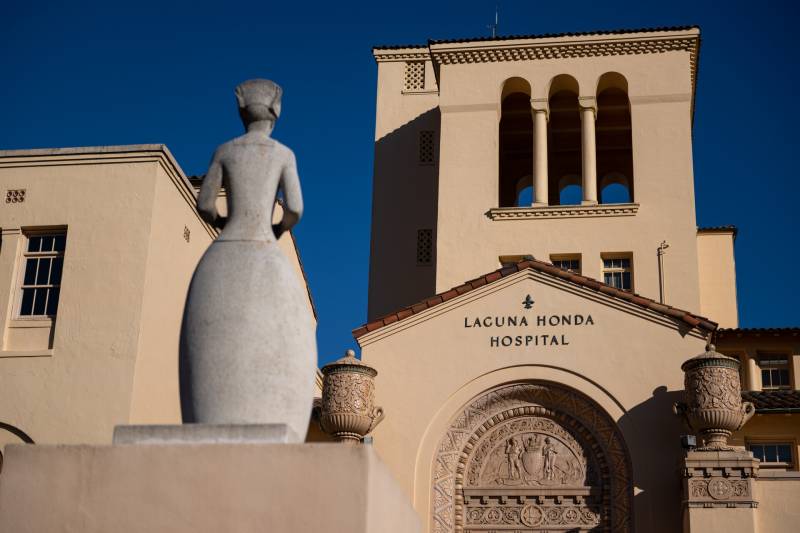
Laguna Honda is the last almshouse in the United States. It is a direct descendant of the medieval Hôtel-Dieu. It cares for those who have fallen on hard times and who are in need of medical care. That is, it cares for those who can’t care for themselves. The hospital looks like a Romanesque monastery set on a hill. There are six wings of wards, each lined with windows and crowned with a turret. Laguna Honda occupies some sixty-two acres, and comes complete with its own farm, its orchard, its massive greenhouse, and its aviary and a barnyard. Patients were expected to work, if they could, in the kitchen garden or the laundry or taking care of the pigs, cows, and sheep.
When Sweet arrives there she is assigned to the Admissions Ward. Much of the book tells the stories of her patients for whom she does the initial examination and diagnosis. Her initial patients are a mixed bunch. One has Parkinson’s disease and has fallen and broken his hip; another man has been hit by a car, and is recovering from head trauma and multiple orthopaedic injuries; another man is disabled from a brain tumour and is on dialysis; a woman has Alzheimer’s, and another is recovering from a stroke. Parkinson’s and alcoholism are conditions that recur. One man has terminal alcoholic cirrhosis, bleeding, confusion, and jaundice. But he is improving.
Sweet notes that her patients were not unlike those she had encountered in medical training. They were complex, fragile, and unstable, in need of close medications and laboratory tests. More than that she sees her patients two or three times a day, often over a period of several months, and has time to build relationships with them and to learn from their experience of being a patient.
While Sweet had been impressed throughout her training by the power of modern medicine, she remains curious about the nature of illness and about the doctor-patient relationship. She looks at alternative medicine, at Chinese and Indian medicine, but finds little that is of help. And then she stumbles across a book from the Middle Ages, a book by Hildegard of Bingen, translated from Latin. She is intrigued to discover that author was a twelfth century German nun, a mystic and theologian, and additionally a medical practitioner, who had written a book about her medicine. Alongside her job at Laguna Honda, Sweet embarks on learning Latin, and medieval Latin. And then she embarks on part-time graduate studies in medieval history and the history of medicine. And her Master’s thesis becomes the prelude to a Ph.D.
In order to complete her doctorate Sweet is granted a year’s sabbatical. She flies to Switzerland. Her plan is to visit Hildegard’s monastery and villages. She attends an international conference in Bingen. She discovers that there were two Hildegards – the mystical Hildegard who is revealed in her theology, letters, and autobiography, and the other Hildegard. displayed in her medicine, down-to-earth and practical. From the medical Hildegard she learns the importance of careful observation of the patient. And of the proverbial Dr Diet, Dr Quiet, and Dr Merryman.
On her return to Laguna Honda Sweet is assigned away from Admissions to two new wards, E.4 a complex medical ward and E.6 a dementia ward. From the patients in E.6 she learns that there are many forms of dementia. And that the tendency to use Alzheimer’s and dementia as synonymous is not accurate. And that these other forms of dementia sometimes had treatable causes.
In the background the city Mayor and the Board of Supervisors and the all-powerful Dt Stein have plans to demolish the old hospital and to replace it with a five hundred million dollar, state-of-the-art health facility. Lawyers from the Department of Justice are determined to close down all the country’s remaining long-term care institutions. Sweet admits that she wasn’t paying much attention. She had finished her PhD and determines to walk the Camino de Compostela in four stages. She flies to Paris, takes the fast train to Lyon, and the slow train to Le Puy.
Victoria Sweet went initially to Laguna Honda for two months. And she stayed for over twenty years. This is a wonderful book. It addresses important questions; about community, about pastoral care, about pilgrimage, about hospitality. About the role of doctors and the nature of medicine. Sweet’s understanding of her role changes; she returns to an older model of the body as a garden to be tended rather than a machine to be fixed. She develops a technique of ‘Just Sitting’. She begins to believe that Slow Medicine provides as good an outcome as Modern Efficient Health Care. And her patients, poor, needy, chronically ill, often addicted, seemingly derelict are at the heart of the book. Some of them may have been loveable, but many were not. Sweet’s practice exemplifies Sam Wells’ definition of Christian mission quoted above.
Envoi

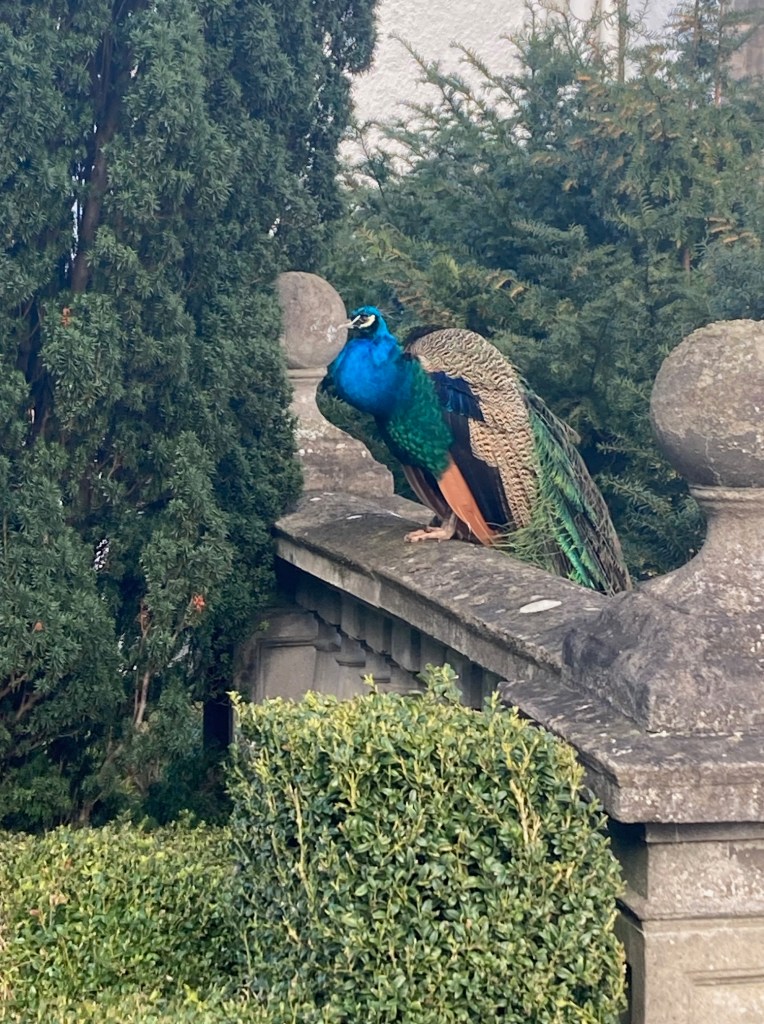
I am sorry that this comes too late to wish any readers a Happy Easter. Thankfully I now have a date, later in April, for a Pre-Op at the Royal Infirmary, and then, God willing, a date for hip surgery next month. Meanwhile our life is very restricted. We went a couple of weeks ago to have lunch with Mike and Wendy at Mortonhall Garden Centre, which is probably the furthest I’ve been from home this year. And in the afternoons, when it is dry, we hobble down to the Prestonfield House Hotel. Complete with highland cows and a resident peacock.
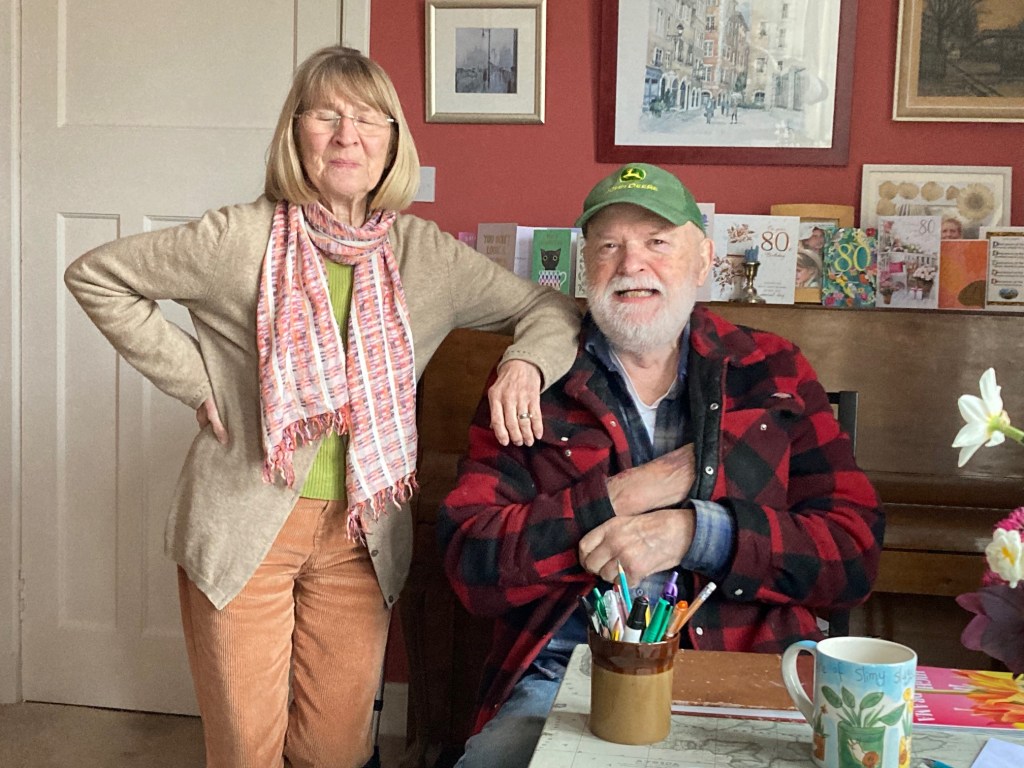
My school-friend Pete came to stay in March. He runs a small business producing high class art cards, and turns up at irregular intervals while visiting his customers in Edinburgh and in St Andrews.
During Passion Week there were the usual early morning services at Mayfield, now known as Newington Trinity. Ministers from Newington Churches Together take it in turns to lead a short service, followed by a simple breakfast. On Good Friday I failed to get to the Newington Churches Together Walk of Witness. But there was a sombre Tenebrae service in the evening. During which we both thought a bit about Joanna. A Facebook posting from Lyon of the Good Friday walk/pilgrimage at Rontalon brought back good memories. Easter Day dawned dry and sunny. But by the end of the service at Mayfield there was a spectacular snowstorm. When the snow stopped we came home to slow-cooked lamb with our friends Mike and Wendy. Clive used to swear by a recipe for gigôt à sept heures, with a bottle of white wine and haricots and a lot of garlic, sealing the lid of the roasting pan with flour and water paste. But we found that four-plus hours was enough.
April 2026
 Through a glass darkly