Setting off up north
The garage in Dalkeith from whom we hire a car asked how old I was this year. When I told them I would be 79 shortly, there was a sharp intake of breath between the teeth. But they obligingly said that this year would be possible, but it might well be the last time. Because of insurance issues.
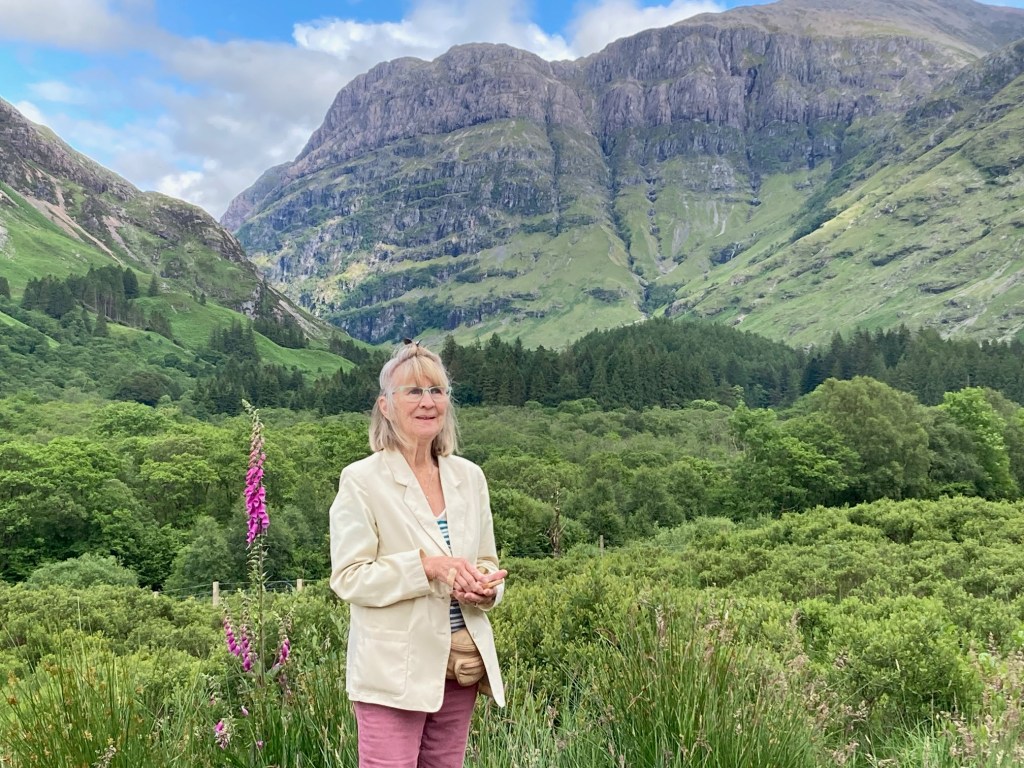
Glencoe
So we set off north on what has become an annual road trip in a white Kia C’eed. Stopping in Callander for a coffee made sense. And I was delighted to find a good condition, hardback copy of Tony Judt’s essays in the Cancer Research shop for £2.00. But going into the Rogersons shoes ‘factory shop’ and coming out with two pairs of shoes almost blew our first week’s budget ! Lunch was at the Real Food cafe in Tyndrum, a regular stop, where they do excellent fish and chips and have twinned all their toilets. Very unusually it was dry and sunny when we descended through Glencoe, stopping for a brief visit to the National Trust for Scotland visitors’ centre. The last bit of any journey is always the longest.
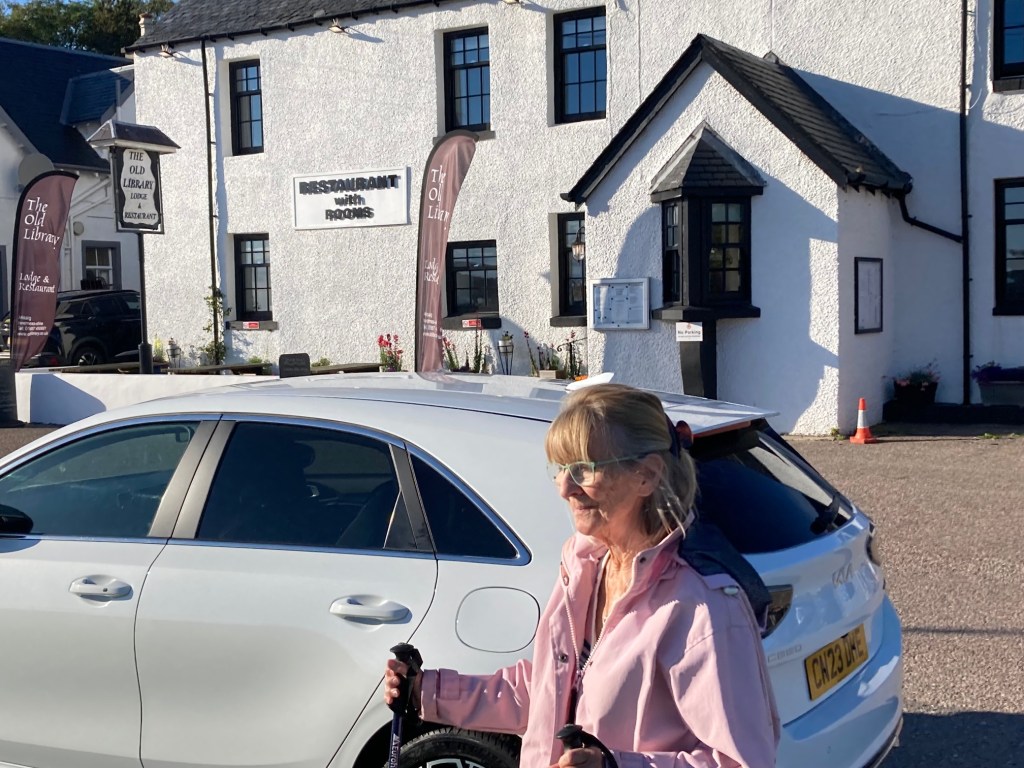
The Old Library, Arisaig
As a child Susie and her family always camped at Arisaig, on Alasdhair’s croft, just north of the village on the road to Traigh. We have stayed there several times in the past, and when Joanna was just a few months old we rented Johnny MacDonald’s house at Cuillin View. And bathed Joanna in the washbasin. [We rented the house for a month; and sublet it for two weeks to Adam Sisman, then working for OUP,, who more recently wrote the rather disappointing ‘authorised’ biography of John le Carré.] So, we were happy to arrive in Arisaig, and stayed at The Old Library with a wonderful view of the sea and Rum and Eigg. It was a good evening for walking past the small museum and down the road to Rhu [we’ve been walking down that road for decades and have never got to Rhu yet]; and mercifully there wasn’t a midge in sight.
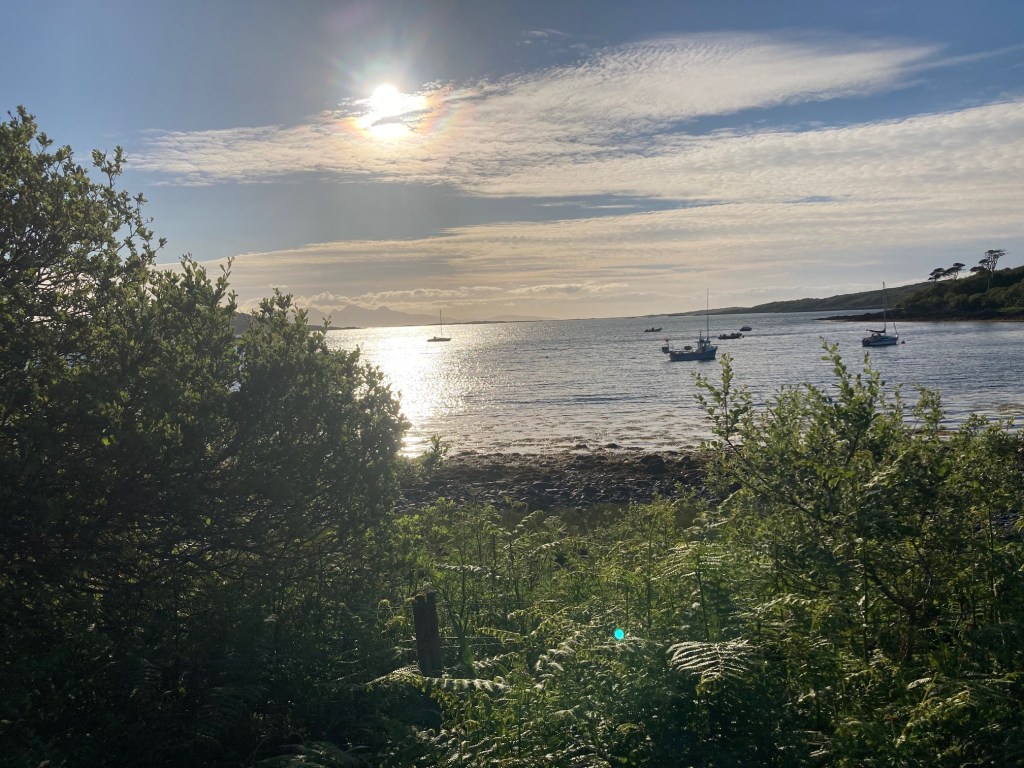
Arisaig sunset
Over the sea to Skye
Mallaig, seven miles up the road, is the terminus of the West Highland line, now best known as the setting for the Hogwarts Express. The Seamen’s Mission building hosts the world’s most chaotic second-hand bookshop, where I was pleased to find a decent copy of Ben Macintyre’s book on Colditz. Mallaig was once one of the world’s busiest herring ports, and famous for its oak-smoked kippers. [With which we celebrated our engagement just about 50 years ago. In one of Alasdhair’s vans.] It is also the departure point for our short, thirty minute, CalMac ferry crossing across the Sound of Sleat to Armadale on Skye.
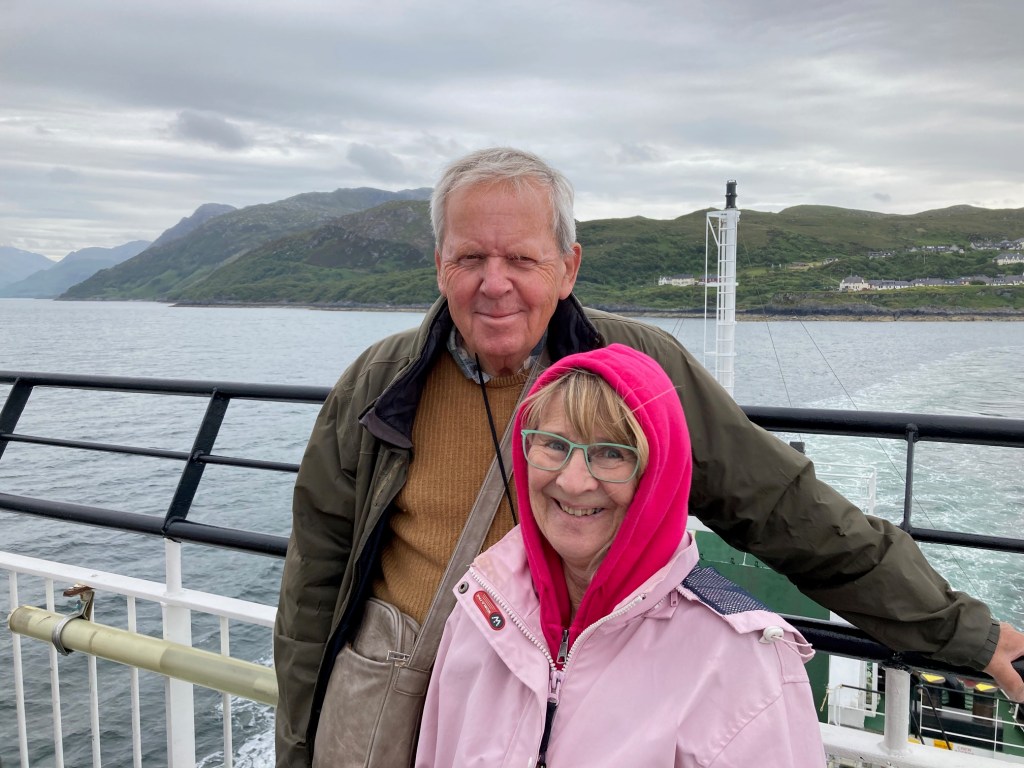
Mallaig-Armadale ferry
People say that on Skye you are never more than five miles from the sea. And generally you are never more than five metres from a tourist, most often Dutch or German, or Chinese or Japanese. We were staying for the second year running at the Skye Photo Centre B&B a few miles outside Portree. The house is at Camusnavaig, overlooking the sea. Iain and Jackie are great hosts, and Iain makes what might be the world’s best breakfasts; scrambled eggs [their own hens] and smoked salmon; French toast and local bacon and maple syrup. On a grey day we drove down the long single track road to Elgol, with an incomparable view of the Black Cuillins; we were last there sunbathing in a heatwave in 1976. And stopped for tea at Amy’s Place, run by a couple who lost their daughter to lupus in her early twenties. The next day we joined a gaggle of tourists to walk up the lower reaches of The Old Man of Storr, a very distinctive rock formation.

The Old Man of Storr
In the very good bookshop in Portree I bought a book by John Macleod. on the Iolaire disaster. This was an incident on New Year’s Day 1919 when the Admiralty yacht Iolaire, bringing soldiers back from the First World War to the Isle of Lewis, sank in Stornoway harbour with the loss of over two hundred lives. The story is little known outside the Hebrides, but was devastating for the islands who lost almost an entire generation of young men. It was one of the worst peacetime maritime disasters of the twentieth century.
Before leaving Skye, on another grey damp morning, we drove up to Kilmuir cemetery. It must be the windiest place in the world. It is where Flora MacDonald is buried, under an unattractive 19th century cross. “Her name will be mentioned in history, and if courage and loyalty are still virtues, it will be mentioned with honour”, are the words inscribed on her monument, attributed to Dr Johnson. Also buried at Kilmuir,.much more recently, is the designer Alexander MacQueen.
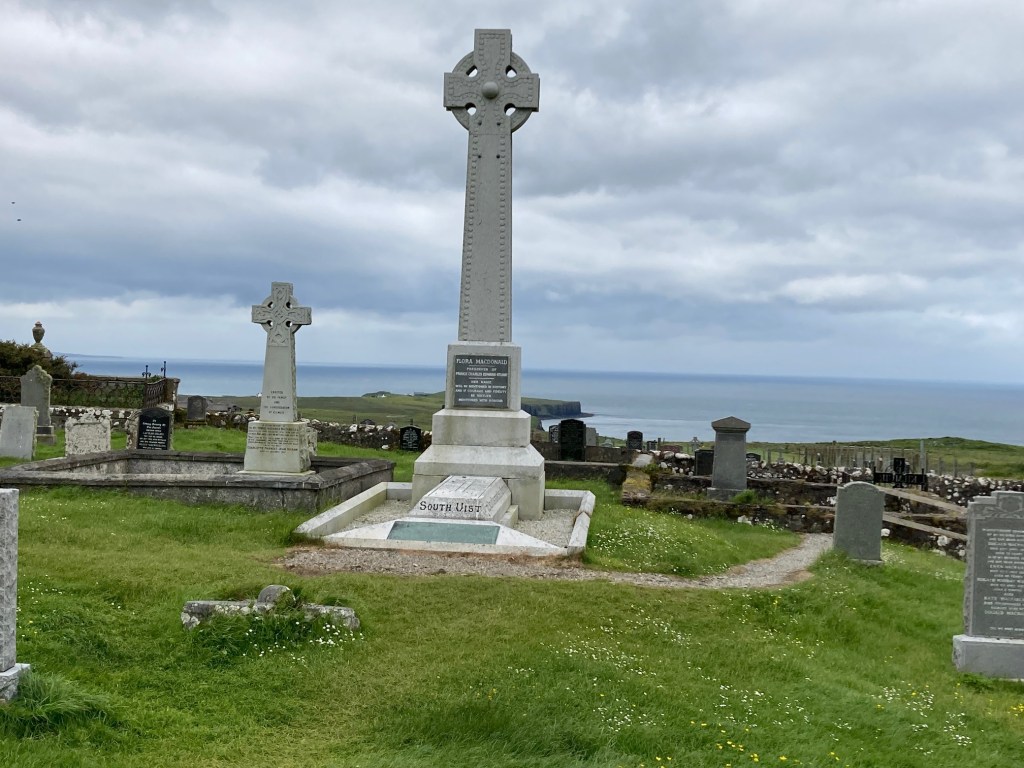
Flora MacDonald, Kilmuir cemetery
On the edge of the world
For many years I had wanted to visit the Outer Hebrides. The islands are on the edge of the map, and feel a bit like the edge of the world. We have been to the Uists and Benbecula twice in recent years, and this year we returned for a few days to Harris and Lewis, crossing on the CalMac ferry in the rain from Uig on Skye to Tarbert on Harris.
In Stornoway we stayed in a very small house in the industrial quarter. It was not a pretty street, but it was a comfortable and well equipped little house. Stornoway is very much the metropolis of the Hebrides [population around 7,000]; with a clutch of shops and eating places, a ferry terminal and an airport, and a confusing profusion of churches. On Sunday morning we went to Martin’s Memorial [Presbyterian] church. The minister, Tommy MacNeil, has been there for nearly twenty years, and is committed to charismatic renewal in the spirt of the Lewis Revival. We happened on the Sunday which marked the end of their Sunday School year; lots and lots of children and young people, and some rather dated songs accompanied on guitar and flute.

Martin’s Memorial Church, Stornoway
One day we went to Uig, where the celebrated Uig chessmen were found. As well as the largest sapphire ever found in the UK. We walked across the extensive sands, without finding as much as a pawn; had lunch in the Uig Community Cafe, where we met Iain’s cousin; and admired the bust of Leif Erikson, an 11th century Norse explorer, who is thought to have been the first European to set foot on the shores of America some 500 years before Columbus. The bust is modelled after a statue designed by Prof. August Werner for Seattle, Washington, USA. Replicas of the statue have been given to the places Leif lived or visited: Trondheim, Norway; Brattahlid, Greenland; and Vinland, at L’Anse aux Meadows, Newfoundland and Labrador, Canada. In 2018, Seattle’s Leif Erikson International Foundation gave this bust as a symbol of international friendship to mark the time Leif spent in the Outer Hebrides.
The following day we revisited the Callanish stones, an arrangement of standing stones placed in a cruciform pattern with a central stone circle. They stand on a low ridge overlooking Loch Roag. The stones date from around 2500BC, but were covered for many years by a thick layer of peat and turf which was only removed in 1857. There are suggestions that the stones were in origin related to astrology and the moon and the lunar calendar. Local tradition has it that the stones were in origin giants who refused to convert to Christianity.
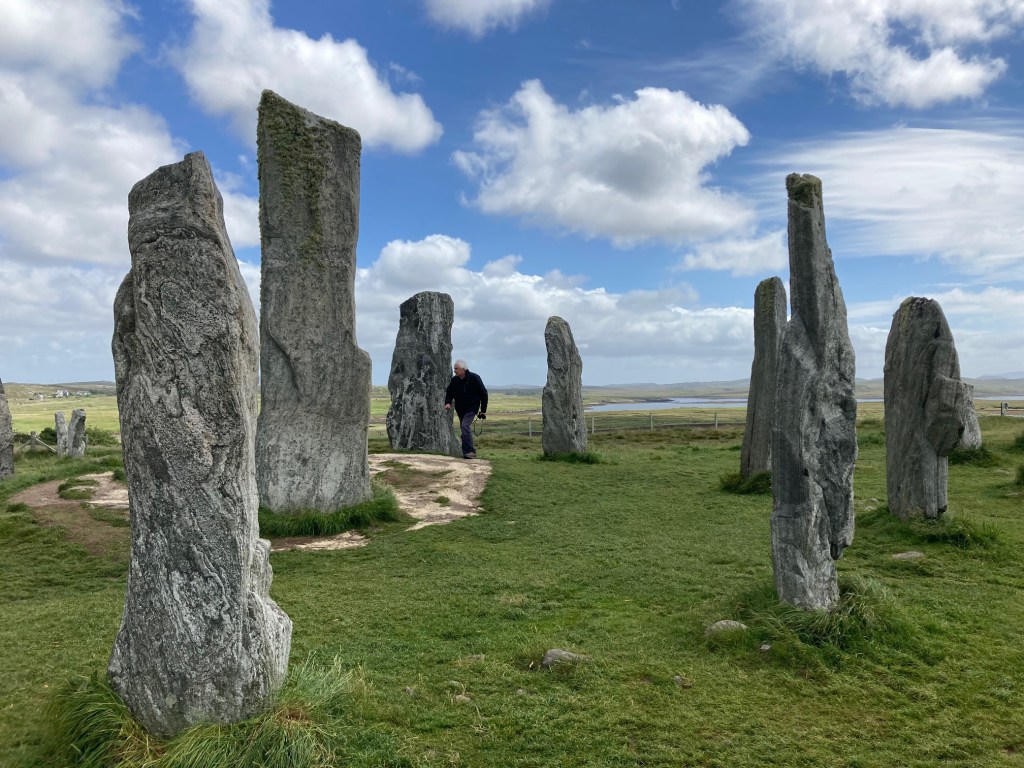
Callanish Stones
Not far away up the west coast is Dun Carloway broch. It is the best preserved broch in the Hebrides, and parts of the old wall still reach 9 metres high on the east side. The broch stands on a steep, south-facing slope with splendid views over Loch Carloway and the sea.
Red star over Hebrides
Our third ferry crossing brought us back to Ullapool. And fortified by CalMac fish and chips we drove down to Gairloch for a couple of nights. I played golf on the fascinating 9-hole course, nestling between the beach and the Church of Scotland. I lost three balls on the first hole, as my first tee shot sailed across the road and passing cars, but found two. In the end I lost eight balls on my only golf outing this year.
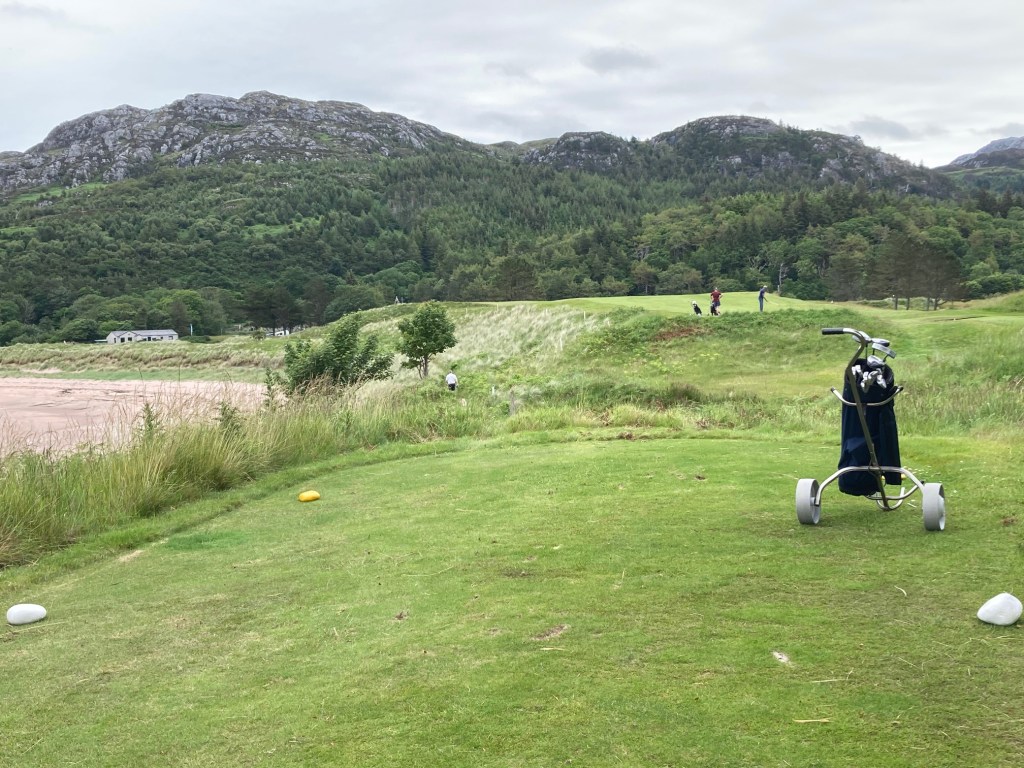
Gairloch golf course: on the 8th tee
On our last night at Gairloch we went to a talk in Poolewe Village Hall. Donald S Murray is a Lewis man, bilingual in English and the Gaelic, a writer of fiction and non-fiction, poetry and prose. His recent novel, As the Women Lay Dreaming, is a fictional treatment of the Iolaire disaster. The talk was organised in conjunction with the Russian Arctic Convoy Museum in Laide. [Following our visit to the museum a couple of years ago, Susie is again exploring the idea of getting an Arctic Convoy decoration on behalf of her father who served as a junior ship’s doctor.] The talk was [notionally] about Russia and the Hebrides, and Donald Murray rambled discursively across the topic reading from his collection Red Star over the Hebrides, It went down well with a surprisingly healthy audience.
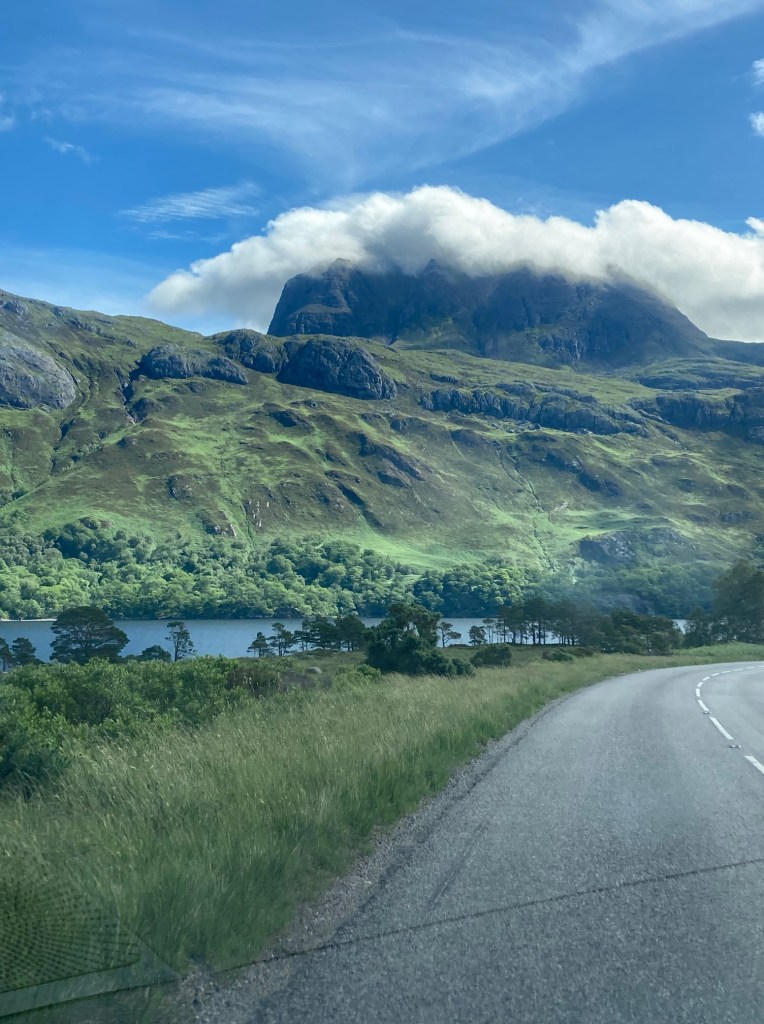
The road home
Envoi
Now we are home again in Edinburgh, home to the Euros and the Election. Neither has been promising so far. Today is Polling Day. Tomorrow may be the first day of a Brave New World. But I’m not holding my breath.
July 2024
 Through a glass darkly
i dont know if I ever told you but my family are from Harris.. I only found out a couple of years ago that a great uncle was on the Iolaire… he survived… but no one ever talked about it…
LikeLike
Yes, I thought of you when we drove cautiousy through Harris in rain and mist. We’ve never seen the famous Harris beaches at their best. I haven’t had time to read the Iolaire book yet. And I don’t know if anyone talked much about the disaster.
LikeLike
So glad to hear of your adventures o
LikeLike
Thanks, Madge. How are you finding life down there this morning in the People’s Republic ?
LikeLike
We have a huge conservative majority here so h ow I vote doesn’t count!!
<
div dir=”ltr”>Sent from Madge,s IPad
<
div>Canford 26 Greenways BEckenh
LikeLike
Dear Chris
You are a year older
And I have just said goodbye to our Australian family who are off to France this morning!
I am joining them next week.
We now have our first labour MP for generations because of boundary changes here!
Love Madge
Mrs.Madge E OLBY
Canford
26 Greenways
BECKENHAM Kent
BR3 3NG
020 8650 3844
Mobile: 0775 287 5755
LikeLike