A shrinking world
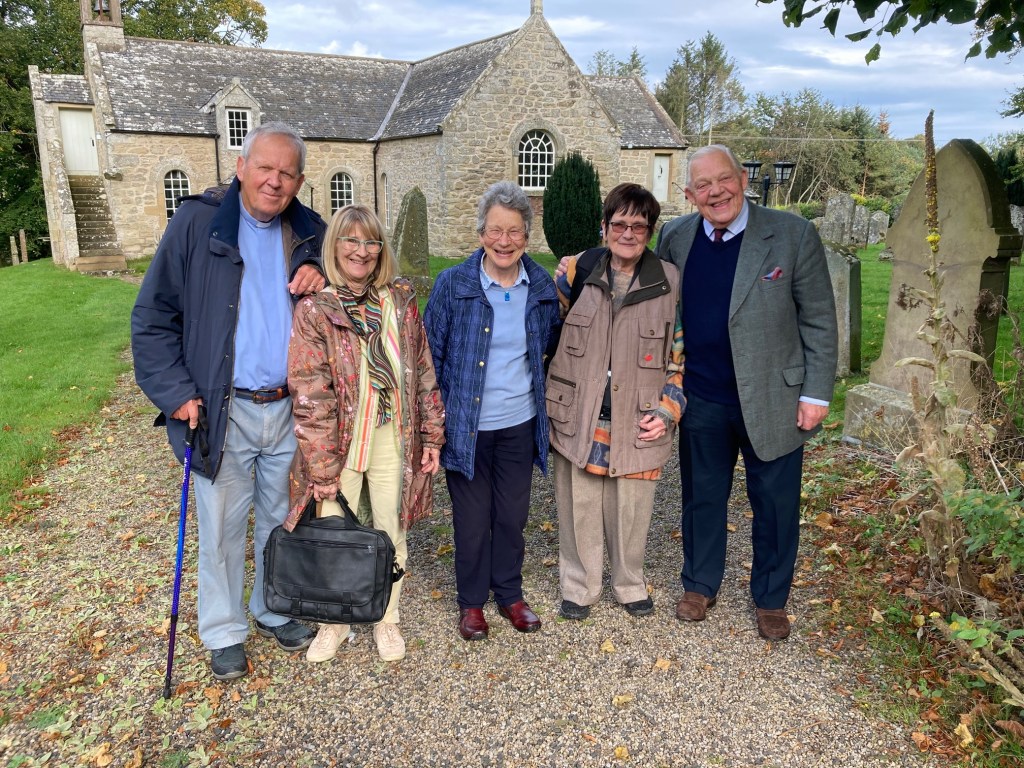
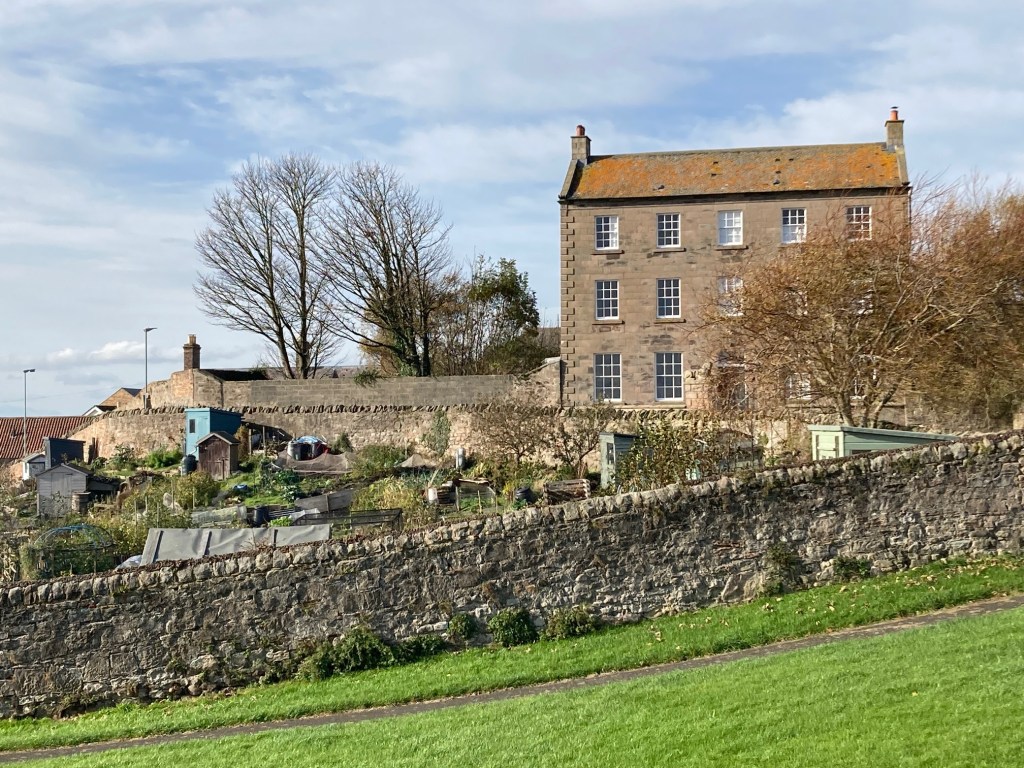
As autumn turns to winter it has been a quiet few months. Susie and I limp around, as if preparing for a Senior Citizens’ three-legged race. We had a day down in Berwickshire at the beginning of October, when I was preaching in Fogo. An old village church and a welcoming congregation. And then an enjoyable weekend in Belgium for the Men’s Retreat down at Maredsous. And more recently I had a day out in Berwick, using up an LNER credit voucher which was about to expire. It was lovely walking the ramparts before having lunch at The Maltings. But other than that we haven’t been further than we can walk – which, sadly, is not as far as it used to be !
Waugh and Isherwood
As we think in a desultory way about trading down to a smaller apartment, I look at my books and start to carry small bags of them to the OXFAM shop.When I was much younger I thought that Evelyn Waugh and Christopher Isherwood were the two best English writers of the first half of the twentieth century. As the years roll by Isherwood has gone down a lot in my estimation. I read some of his stuff last year before putting the books out to OXFAM, and although I likeMr Norris changes trains and Goodbye to Berlin, I don’t really rate anything that he wrote after he and Auden left for the States in 1939. With Waugh it is the other way around: I think highly of Brideshead Revisited and Men at Arms, but I used to have reservations about his earlier work. So – I thought it was time I looked again at some of these books.
Evelyn Waugh
Evelyn Waugh was born in Hampstead in 1903, the son of Arthur Waugh, publisher and literary critic, and younger brother of Alec Waugh, a popular novelist. He was educated at Lancing, a monastic, Anglo-Catholic institution, high up on the South Downs, and at Hertford College, Oxford, a small and undistinguished college, where he read Modern History. At Oxford he made a new circle of friends. Through Terence Greenidge, an eccentric fellow undergraduate, he was introduced to the Hypocrites Club. “By the time I joined it was in process of invasion and occupation by a group of wanton Etonians who brought it to speedy dissolution. It then became notorious not only for drunkenness but for the flamboyance of dress and manner which was in some cases patently homosexual”. During his Oxford years Waugh was involved in student journalism and won a reputation for decorative drawings and bookplates. They were years of excessive drinking and homosexual crushes, and he subsequently destroyed his Oxford diaries.
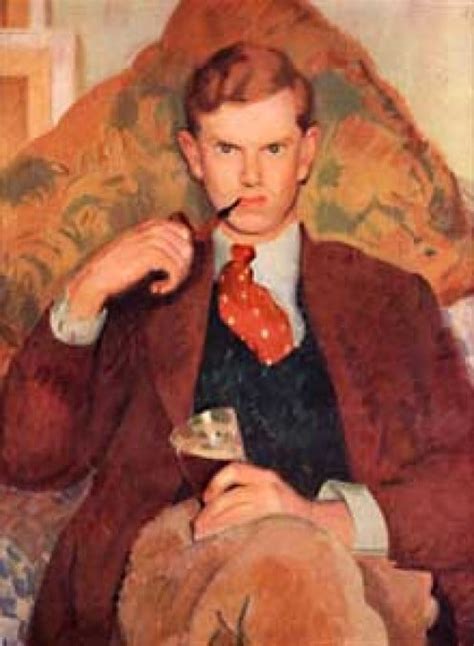
The years between Evelyn Waugh’s coming down from Oxford in the summer of 1924 and his secret agreement to ‘She-Evelyn’ in the winter of 1927 were probably the unhappiest stretch of his life. He had no settled job or ambition. He spent two terms on the staff of a prep school in North Wales [the inspiration for Llanabba in Decline and Fall]; and taught, until he was sacked for allegedly assaulting the matron, at a school for backward boys at Aston Clinton. His insecure employment record was accompanied by an unsatisfactory social life. At Oxford his principal emotional attachments had been to other male undergraduates. After Oxford he led an intense social life, at first with friends from Oxford and later among the Bright Young People, a name invented by the newspapers in 1924. This was a shifting group led mainly by girls; Elizabeth Ponsonby, the Jungman sisters, Diana Guinness and Olivia Plunket Greene, a disconcerting, secret girl with who Evelyn fell in love. A feeling that was not wholly reciprocated.
Decline and Fall
Waugh’s first novel, Decline and Fall, published in 1928, is the story of Paul Pennyfeather who is sent down from Oxford for indecent behaviour. [After being debagged by a bunch of upper class hearties following a drunken dinner of the Bollinger Club. It sounds like Christ Church.] The innocent Pennyfeather finds a job teaching at Llanabba Castle, a very minor public school on the Welsh coast. The school is populated by a bunch of eccentrics: the Headmaster, Dr Augustus Fagan, and his daughters, Dingy and Flossy; his colleagues, the red-haired, one-legged Captain Grimes, not quite a gentleman; and the wig-wearing Prendergast, a former vicar assailed by Doubts; and the mysterious butler, the fantasist [Sir Solomon] Philbrick.
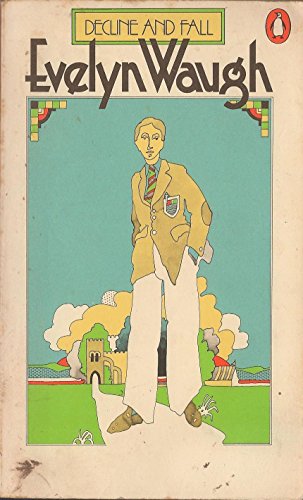
Parts Two and Three of the book have a darker feel. Pennyfeather is to be married to the glamorous and extremely rich the Hon. Margot Beste-Chetwynde, the mother of one of his pupils at Lanabba. But there is a hitch in the wedding preparations when he is arrested in connection with Margot’s Latin American Entertainment Company. His Oxford friend Potts had been the League of Nations chief investigator into an international prostitution ring. Pennyfeather is sentenced to seven years penal servitude in Blackstone Gaol while Margot decamps to Corfu. The prison regime suffers at the hands of the self-regarding social reformer Sir Wilfred Lucas-Dockery. Prendy who has found a new career as prison Chaplain has his head sawed off by a religious maniac to whom Dockery has misguidedly given a set of carpenter’s tools. At Egdon Heath prison Pennyfeather re-encounters Grimes, now serving time for bigamy. Margot, now Viscountess Metroland, smuggles gulls’ eggs and other delicacies into prison, and comes to visit Paul, a difficult meeting for them both. But through the influence of her new husband, the Home Secretary, Paul is enabled to disappear [‘die on the table’] at Cliff Place Nursing Home. Worthing [Augustus Fagan M.D. Proprietor.] A resurrected Paul returns to Oxford, with a Calvary moustache, to Scone College to read Theology. And is visited by his former pupil Peter, now a member of the Bollinger Club.
Decline and Fall was thought a rather licentious book by the standards of the day. There is a clearly suggested homosexual relationship between Captain Grimes and the boy Clutterbuck; there is stress on Peter Pastmaster’s prettiness, making him attractive to his mother’s lovers; and there are references to a ‘knocking shop’ and the Welsh predilection for sheep shagging. The book was under contract to Duckworths, but their reader wanted to insist on major cuts and corrections. Waugh was outraged, and took the book to Chapman and Hall, his father’s firm. They too demanded significant changes, but the book was published in September 1928. Contrary to popular myth it was not an immediate best-seller. But the book sold steadily, much helped by an enthusiastic review by Arnold Bennett in The Evening Standard; “A genuinely new humorist has presented himself in the person of Evelyn Waugh, whose Decline and Fall is an uncompromising and brilliantly malicious satire, which in my opinion comes near to being first rate … I say that this novel delighted me.” The book had reached its fourth impression by October 1929 [each printing probably being 2,000 copies.] On the strength of the book, Waugh encouraged his agent A.D. Peters to present him to newspaper editors as the ‘personification of the English youth movement’.
Vile Bodies
Vile Bodies, published in 1930, introduces us to a kaleidoscope of characters, prominently featuring the Bright Young Things. We meet most of them on a cross-Channel ferry in the opening chapter. Father Rothschild is an omniscient and well-connected Jesuit, travelling with a false beard and six new books in six different languages. Mrs Melrose Ape is a travelling evangelist chaperoning a troupe of performing [but worldly] angels. Agatha Runcible and Miles Malpractice, busy strapping each other’s tummies with sticking plaster, represent the Younger Set. The twin sisters Lady Fanny Throbbing and Mrs Kitty Blackwater represent an older generation. They have mislaid the sal volatile. The Leader of his Majesty’s Opposition lies in his bunk in a coma, dreaming of Oriental ladies with golden limbs and almond eyes. Adam Fenwick-Symes is a young writer, engaged to be married but impecunious, returning with his newly completed manuscript from Paris.
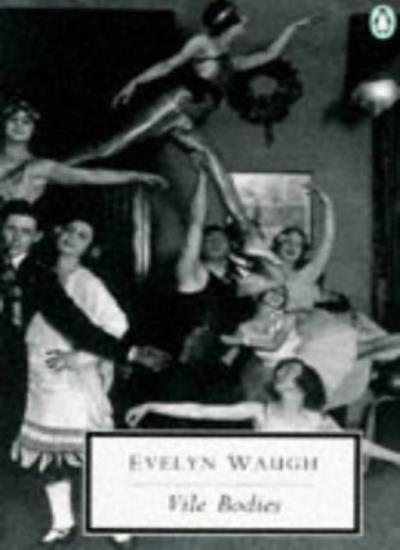
These characters reappear and interact in a series of set pieces, mainly set between Park Lane and Bond Street. Adam’s engagement to Nina Blount is an on-off affair, dictated by the precarious state of his finances.. There are two wonderful accounts of his visits to Nina’s wealthy father, a crusty and deaf old colonel who lives in Buckinghamshire and has a passion for the cinema. Adam succeeds Lord Balcairn as a gossip writer for the Daily Excess. But loses his job which then goes to Miles Malpractice. Adam and his friends go off to the motor races, but Agatha Runcible is wrongly installed as the spare driver and crashes her car into a market cross in a neighbouring village.
In the public mind, the Bright Young People were notorious for their parties. “Oh, Nina, what a lot of parties”, says Adam Fenwick Symes; “Masked parties, Savage parties, Victorian parties, Greek parties, Wild West parties, Circus parties, parties where one had to dress as someone else, almost naked parties in St John’s Wood, parties in flats and studios and houses and ships and hotels and night clubs, in windmills and swimming baths, the parties at school where one ate muffins and meringues and tinned crab, parties at Oxford where one drank brown sherry and smoked Turkish cigarettes, dull dances in London and comic dances in Scotland and disgusting parties in Paris … all that succession and repetition of massed humanity … Those vile bodies …” Though Waugh himself was on the fringe rather than at the centre of this world.
Vile Bodies was an instant success and secured Waugh a position as a young writer to be noticed. It was widely reviewed, though not always with enthusiasm. Arnold Bennett complained that the book was structurally incoherent; St. John Irvine called it “appalling … a hateful book”; Frank Swinnerton thought it was “bogus”; and Edward Shanks saw it “less of a novel than a revue between covers”. But there was a roar of approval from younger writers and from the gossip columns. Ironically Waugh came to be viewed as a spokesman for the Bright Young Things, whose behaviour he depicted. But there is an undertone of malaise and disillusionment, a vision of the relentless decline into barbarism. In the sombre final scene Adam sits on a splintered tree-stump amid a landscape of desolation in “the biggest battlefield in the history of the world”.
I read these books when I was at school about fifty years ago. When I almost certainly missed the satirical nature of Waugh’s writing. When I look at the books now, I find the writing is witty, the plotting ingenious, and many of the characters vividly entertaining. The early books sold well enough, and enabled Waugh to be offered a lot of well-paid journalism. Much of which he seems to have despised. Where does that leave Waugh as a writer ? On the strength of these early books, he is a gifted writer of the second rank. And after that ? I’m currently trying to track down a copy of Black Mischief, and I’ll look at that and at A handful of dust and at Scoop in the coming weeks. And maybe thereafter Brideshead Revisited and the Sword of Honour trilogy.
Meanwhile there are leaves to rake up in the garden. And we are going to Glasgow for the day at the weekend. And I am at last on the Orthopaedics waiting list for hip surgery. But I’m not holding my breath. The current waiting time is said to be a bit over two years.
November 2024
 Through a glass darkly