We are just back from a week down south, with the children and grand-children, and I have been re-reading Evelyn Waugh’s Brideshead Revisited, published in 1945 the year I was born. I guess this book has been around all my life. There was certainly a paperback copy in our house in Wimbledon Park Road, the house in which I grew up. [Though my father was more interested in leather bindings than in paperbacks.] I read most Waugh books when I was at school; and preferred the early books, like Decline and Fall and Scoop, to the later ones. Brideshead Revisited is a turning point in Waugh’s writing; turning away from his early, lightweight books, he now embarks on his A La Recherche du Temps Perdu, with an intimate, first-person narrator. The book presents as a clear lament for the past, but also a statement of faith.

Brideshead Revisited
The book is divided into three parts, book-ended by a short prologue and epilogue.The epilogue sets the scene; it is the middle of the Second World War, and the narrator, Charles Ryder, has de-trained after an overnight journey into a setting which is deeply familiar to him.The new billet for his troops is Brideshead Castle. From where he looks backwards, thoughtfully and painfully.
Ryder is not dissimilar to Waugh, however much he denied it; a middle-class student at Oxford, in an obscure college. a gifted artist, living out a difficult relationship with his elderly father. In Book One, Et in Arcadia Ego, Ryder falls in love with his enchanting fellow undergraduate Lord Sebastian Flyte, the second son of Lord Marchmain. Sebastian lives high up in Christ Church, and introduces Ryder, first to Aloysius his ubiquitous teddy-bear, and then to a string of extravagant old Etonians, and then to the whole Marchmain family and their estate at Brideshead Castle. Ryder is enthralled. He and Sebastian spend much of their first long vacation painting murals on the walls of the castle and drinking their way through some of the older wines in the castle cellars. After which they go to Venice to stay with the long-exiled Lord Marchmain and his mistress in their palazzo on the Grand Canal. Sebastian’s family are all Catholics, which surprises Ryder who is a convinced atheist. Lord Marchmain had converted from Anglicanism to Catholicism, but abandoned the church when he left his wife for Venice. Lady Marchmain holds tenaciously to her faith, and this faith is shared by her elder son, the Earl of Brideshead [Bridey], and her younger daughter, Lady Cordelia.

In Book Two, Brideshead Deserted, Sebastian’s relentless heavy drinking puts all the family relationships under a great strain. Lady Marchmain sees Ryder’s support for Sebastian as a betrayal. Lady Julia, the older daughter, marries Rex Mottram, a rich but vulgar Canadian businessman, who is not only a Protestant but a divorcee with a wife alive in Canada. Ryder goes to Paris to study painting. His relationship with the family is only restored when Lady Julia asks him to track down Sebastian, now seriously ill in a monastery in Morocco. Ryder is commissioned by Bridey to paint pictures of Marchmain House in London which is going to be demolished. The paintings are a great success and Ryder achieves fame and fortune as an architectural painter.
At the start of Book Three, A Twitch upon the Thread, Ryder is a successful artist, married with two children, returning from America with his wife Celia. The marriage is loveless. And Celia has been unfaithful. Ryder falls in love [on a transatlantic liner] with Lady Julia, who is now separated from Rex Mottram. Lady Marchmain is dead. Sebastian is reported to be dying in a Tunisian monastery. The aged Lord Marchmain, terminally ill, returns to Brideshead to die in the ancestral home. He determines to make Julia [and by extension Charles Ryder as both are now divorced] heirs to the estate. But the dying Lord makes [arguably] a sign of faith on his deathbed. Which causes Julia, much moved, to realise that she cannot after all marry a divorcee of no faith.
In the Epilogue Ryder, now an army officer, is to be billeted at Brideshead Castle. He is “homeless, childless, middle aged, and loveless”. Although the house has suffered at the hands of the military, the private chapel, which had been closed after the death of Lady Marchmain a decade earlier, is to be re-opened for the use of the troops. Which causes Charles Ryder, now himself a nascent Catholic, to reflect that God’s purposes will ultimately be fulfilled.
This is the first self-consciously Catholic of Evelyn Waugh’s books. He wrote that the novel is essentially “about the operation of Grace’, that is to say, “the ways in which which God continually calls souls to Himself“. Many of the characters in the book undergo some form of conversion or of reconciliation, including ultimately Ryder himself.
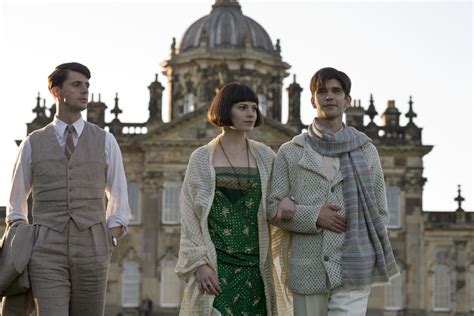
In various letters, Waugh refers to the novel a number of times as his magnum opus. But , in 1950 he wrote to Graham Greene stating “I re-read Brideshead Revisited and was appalled.” In his preface to the revised edition of Brideshead (1959), the author explained the circumstances in which the novel was written: “It was a bleak period of present privation and threatening disaster – the period of soya beans and Basic English – and in consequence the book is infused with a kind of gluttony, for food and wine, for the splendours of the recent past, and for rhetorical and ornamental language which now, with a full stomach, I find distasteful.”
The ‘real Brideshead’
Waugh’s friends and contemporaries would have had no trouble in identifying the ‘real Brideshead’. During the 1930s, after the collapse of his marriage to ‘She-Evelyn’, Waugh spent a great deal of time with the Lygon family at their turreted, ancestral home at Madresfield Court. Hugh Lygon, the younger son, was a friend of Waugh from Oxford, and Waugh’s friendship with the Lygon sisters would last for the rest of his life. Madresfield, like the mythical Brideshead, is a much renovated country house, part Jacobean, part Victorian Gothic, with 136 rooms set in 4,000 acres of parkland, surrounded by avenues of oaks, cedars, poplars, and cypresses, a rock garden, a yew maze, and statues of Roman emperors. For Waugh it was an enchanting world.

So, Sebastian is Hugh Lygon, a languid and lascivious aristocrat [although Waugh also draws on his close Oxford friend Alistair Graham]; Bridey is Elmley Lygon, onetime President of the Hypocrites Club at Oxford, but now a dull and rather pompous MP; while the Marchmain sisters Julia and Cordelia are the Lygon sisters, Maimie and Coote, known as the Beauchamp belles. The younger girls had the Madresfield house largely to themselves as their father, Lord Beauchamp, Lord Steward of the Royal Household, an artist and craftsman, and well-known homosexual, had been driven into exile by his vindictive brother-in-law, the Duke of Westminster, in order to avoid a public scandal. Maimie, tall and blonde, like Hugh, was Waugh’s favourite.
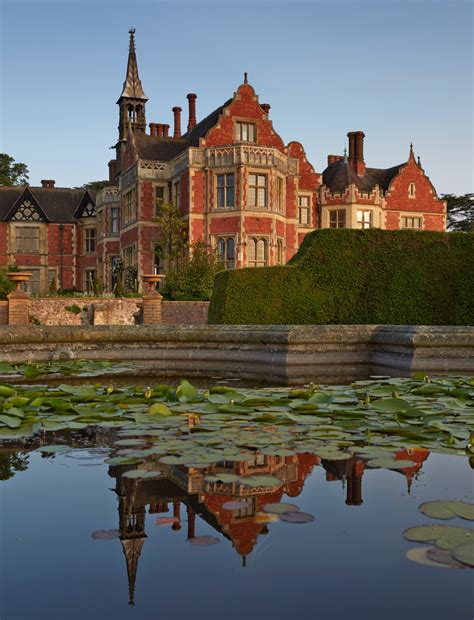
Of the minor characters, Rex Mottram is an unattractive amalgam of Brendan Bracken and of Lord Beaverbrook. [Sibell, the oldest Lygon sister, was the on-off mistress of Beaverbrook.] Lady Lygon’s pet Oxford don, Sammy Samgrass, is clearly an unflattering portrait of Maurice Bowra. Anthony Blanche, Charles and Sebastian’s friend from Oxford, is equally clearly based on the witty, flamboyant homosexual, Brian Howard.
There is a disclaimer in the book’s prelims, signed with Waugh’s initials, which reads: “I am not I: thou art not he or she: they are not they.” But I think we can take this with a pinch of salt.
The reception of the book
The publication of Brideshead made Waugh rich. The book’s success in the United States enabled Waugh to fix his income at £5,000 a year for the next 5 years. But reactions to the book were varied. His ‘fan club’, Osbert Sitwell, Graham Greene, Christopher Sykes, and Nancy Mitford all proclaimed the book to be his masterpiece. {His wife] Laura’s family made favourable noises, though they were not people whose judgement Waugh respected. The community at Campion Hall thought Brideshead Waugh’s best book. But Martin D’Arcy and Katharine Asquith and some stricter Catholics found the book distasteful and some episodes embarrassing.
The conscious Catholic apologetic confused some critics. Rose Macaulay complained that Waugh equated “the divine purpose of God at work in the universe … … with obedient membership of a church”. Henry Green was appalled by Lord Marchmain’s deathbed conversion; “my heart was in my mouth all through the deathbed scene, hoping against hope that the old man would not give way, that is, take the course he eventually did”. Edmund Wilson objected strongly to the snobbery of Brideshead, and suggested that the final scenes might have been Waugh at his satirical best were it not painfully clear that Waugh meant us to take them seriously !
Revisiting Brideshead
I have enjoyed re-reading this book. And I certainly enjoyed it when I first read it some sixty years ago. I liked the depiction of the privileged life of Oxford students in the 1920s; and throughout the book there are lavish descriptions of food and drink. Such as the dinner that Charles Ryder selects for Rex Mottram in a Paris restaurant that sounds very like the Tour d’Argent. Life in an ancestral country house was beyond my imagining. But I was able to envy the glimpse of life on a transatlantic liner. [Susie and I stayed on the Queen Mary in Long Beach, California, a decade ago. And it isn’t as luxurious as I had imagined.]

So – does this book qualify Evelyn Waugh as a great novelist ? Sadly, I think the answer is No. For two reasons. First, I find the central characters of the book unconvincing. Charles Ryder is a dry stick. While Lady Julia Flyte, the love of his life [played in the much-lauded 1981 television series by Diana Quick, the acknowledged beauty of my student years in Oxford], stubbornly remains a two-dimensional character. She is essentially a composite of the tall, blonde, aristocratic women to whom Waugh was so often drawn – Maimie Lygon, [Lady] Diana Guinness [née Mitford], and [Lady] Diana Cooper. None of these women reciprocated Waugh’s romantic attentions. The coup de foudre between Ryder and Julia, in the middle of a storm on a transatlantic liner after their respective marriages have broken down, is embarrassingly badly written. [Waugh later rewrote it.]
Secondly, given the conscious catholic apologetic, I find that aspect of the book unsatisfactory. The Marchmain family are Roman Catholics, and it is the Catholic church to which Ryder has come in the Epilogue, but this faith seems to consist only of rules, mainly concerning divorce and remarriage, and of attendance at the Mass. For me there is nothing compelling about the characters’ faith; nothing that speaks of a living relationship with God in Jesus Christ. [Waugh’s loudly proclaimed conversion and catholic faith remains a mystery to me. But that is anther story.] Brideshead Revisited is certainly a good read. But not a great novel.
March 2025


I have to comment that Waugh has been a little too subtle for you, as far as Charles Ryder is concerned. He does hint that Ryder is a highly talented and attractive personality, but I would agree that this does not really come through in the book.
Where you are more definitely mistaken is in saying “Ryder is not dissimilar to Waugh, however much he denied it; a middle-class student at Oxford, in an obscure college.” Waugh plants clues (too subtle for modern readers to pick up after the social changes of the last 80 years) to show that Ryder is not middle-class. He is the son of the younger son of a landed family, whose country house is called Boughton. His father’s style of life as a man of leisure, with a manservant and a pretentious though bad cook, is that of the lower fringes of the upper class, definitely not Waugh’s own world.
Further, if you follow up the clues you will see that Ryder’s college is New College, which in the 1920s was probably the fourth in social prestige at Oxford.
LikeLike