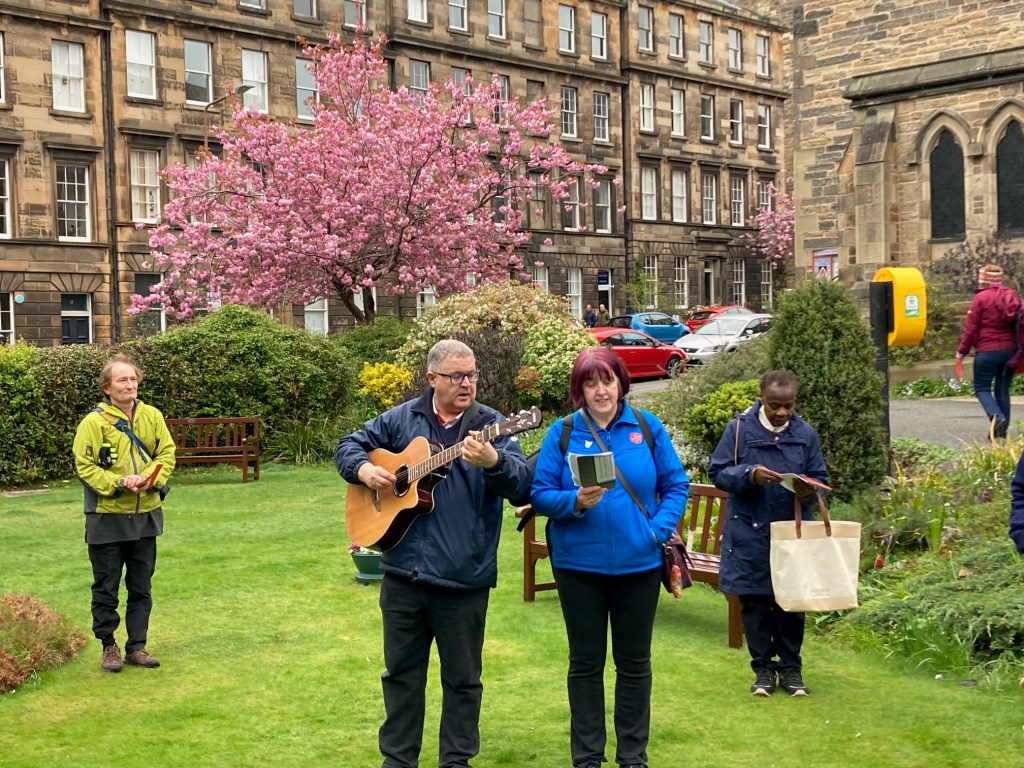
The days go by, each day getting a little longer. Passion Week began with an appointment with the diabetic nurse. continued through a series of early morning services at Newington Trinity, and ended with a walk of witness from Mayfield Church to Nicholson Square. And a sombre service of Tenebrae on Good Friday evening. During which I thought mainly about Joanna.
The Pope died on Easter Monday. [As did my younger brother 3 years ago.] Probably a kindness for him, but a great loss to the Roman Catholic church. [The Pope, not my brother Peter.] And beyond, as he was evidently loved by a multitude of people around the world. I read that viewings of Conclave went up by some 250% following his death. Incidentally I think that Robert Harris is a diligent researcher, but not much of a novelist. Ralph Fiennes might be an outside bet as the next Pope. Almost relatedly, I read someone saying in the Church Times that Monty Don displayed many of the desirable characteristics to be the next Archbishop of Canterbury. I have little idea as to who that might be. But I think the Bishop of Newcastle has probably put herself out of the running.

Fare Well in Christ
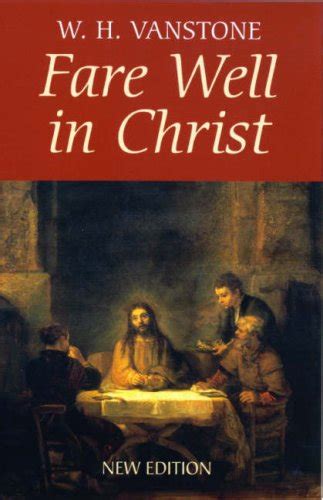
Last month I wrote about two slim books by the English theologian W.H. Vanstone, Love’s Endeavour, Love’s Expense and The Stature of Waiting. In recent days I’ve been reading his third and final book, Fare Well in Christ, [published in 1997]. It’s a bit of a mixed bag.
Vanstone starts with a reflection on the word grace. The phrase ‘the grace of God’ is absent from the Old Testament. The Prologue to John’s Gospel clearly states that the grace of God came into the world with the birth of Jesus Christ. Vanstone argues that grace is not just another divine power or attribute. Rather it is the way in which powers and virtues are expressed. The grace of God, Vanstone suggests, is that which elicits from men a response of joy and gratitude.
We then move on to what Vanstone calls the ‘power of stories’. Stories, he suggests, affect us more powerfully than general statements about the way the world is or ought to be. And the Christian church came into being as the evangelists told, and as people received, stories about Jesus Christ.
These stories could not be replaced by summaries of ‘what the story means’.
This leads Vanstone on to the Saxon poem The Dream of the Rood, in which the Cross on which Jesus was crucified tells its own story. The image of the “Cross of Christ towering above the skies” became for centuries afterwards a prominent Christian symbol. Vanstone notes that the Cross has been largely removed from public view, privatised, in our generation. But he offers us six powerful stories, from his own experience, that demonstrate the healing power of the Cross. The power to heal things like anger and obsession. Sermon illustrations really.
Vanstone points to the story of Jesus’s encounter with Zacchaeus as a powerful example of the grace of Jesus Christ. There is no mention of repentance from Zacchaeus, and no mention of forgiveness from Jesus. But Jesus’s words and actions win from Zacchaeus the change of mind and outlook that we call salvation. This healing is a free gift which enlarges the freedom of the person who receives it. God’s healing is never burdensome.
In a final chapter Vanstone reflects on our [largely negative] attitudes towards death and dying. He points to some words found on a tombstone on Oronsay in the Hebrides: “Sleep after toyle, port after stormy seas, ease after warre, death after life doth greatly please.” The words are a quotation from a poem by Edmund Spencer. Vanstone takes issue with the common assumption ‘you only live once’. He encourages us to wonder what life might like when the earthly body is reduced to dust and ashes. It is a challenge to reflect on the mystery of existence.
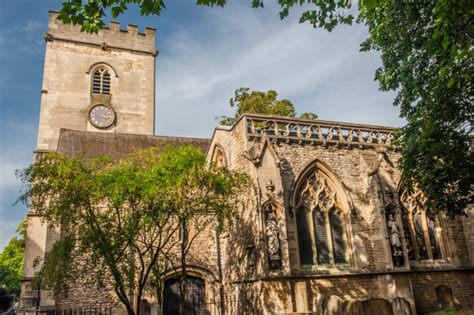
It sometimes seems that everyone knows everyone in the Church of England. [Except for me. I don’t know anyone.] [Bishop] Donald Allister, whom I see at church most weeks, told me that Bill Vanstone was Rector of the neighbouring parish in Chester Diocese when he was just a curate. And that he, Donald, was once called on to preach for Vanstone at short notice after an accident with a hover-mower while mowing the grass in sandals. Which sounds painful. [Bishop] Richard Holloway with whom I had coffee a week or so ago [lots of laughter and lots of reminiscence] told me that he used to ask Vanstone to preach at St Mary Mags in Oxford [I lived across the road in the 1960s]. And that he was always stimulating.
Envoi
We have had a week of glorious sunshine. I cut the grass and the garden looks as good as it gets. Friends from down south have been staying here for a few days. Nigel was in the youth group at St Nicks, Sevenoaks, when Donald was the curate there. So they caught up a bit over dinner a couple of nights ago. We are invited to a VE Garden Party at the Prestonfield House hotel on Monday, so I hope it will warm up a bit. A piece in The Times today reflects that the Second World War was a novelists’ war, unlike the First War which was a poets’ war. That might be an excuse to re-read Evelyn Waugh’s Sword of Honour trilogy. And perhaps also Irwin Shaw’s The Young Lions [published in 1948] and Olivia Manning’s [published 1960-65]. Neither of which have I read. And to make sure to leave time to reflect on the mystery of life !
May 2025
 Through a glass darkly
Thank you Chris As you continue to mourn Joanna I mourn Terry but. I
LikeLike