Disappointment
“Do not be anxious about anything,” Paul writes to the Philippians, “ but in every situation, by prayer and petition, with thanksgiving, present your requests to God. And the peace of God, which transcends all understanding, will guard your hearts and your minds in Christ Jesus.”
Disappointment is something common to all our lives. We are disappointed when our expectations don’t align with reality. Which leaves us feeling hurt and a bit lost. And sometimes angry. I had a very disappointing day on Monday: I was at the Western General Hospital for a TWAC test. After living with a catheter for a month following urine retention problems this was an opportunity to turn things round. Dave Healey drove us there across a tranquil, largely traffic-free Edinburgh. I was at the hospital from 8.00am to about 2.30pm, drank about 2 hogsheads of water, was able to pee only about 5 ml, and came away with the catheter reinserted. It was not the outcome that I had anticipated or wanted. Or prayed for. Had I been guilty of ‘naming it and claiming it’. [What one of Dave’s former, American colleagues called ‘blabbing it and grabbing it’.] So the day was a major disappointment. And I am not sure what the next step will be.
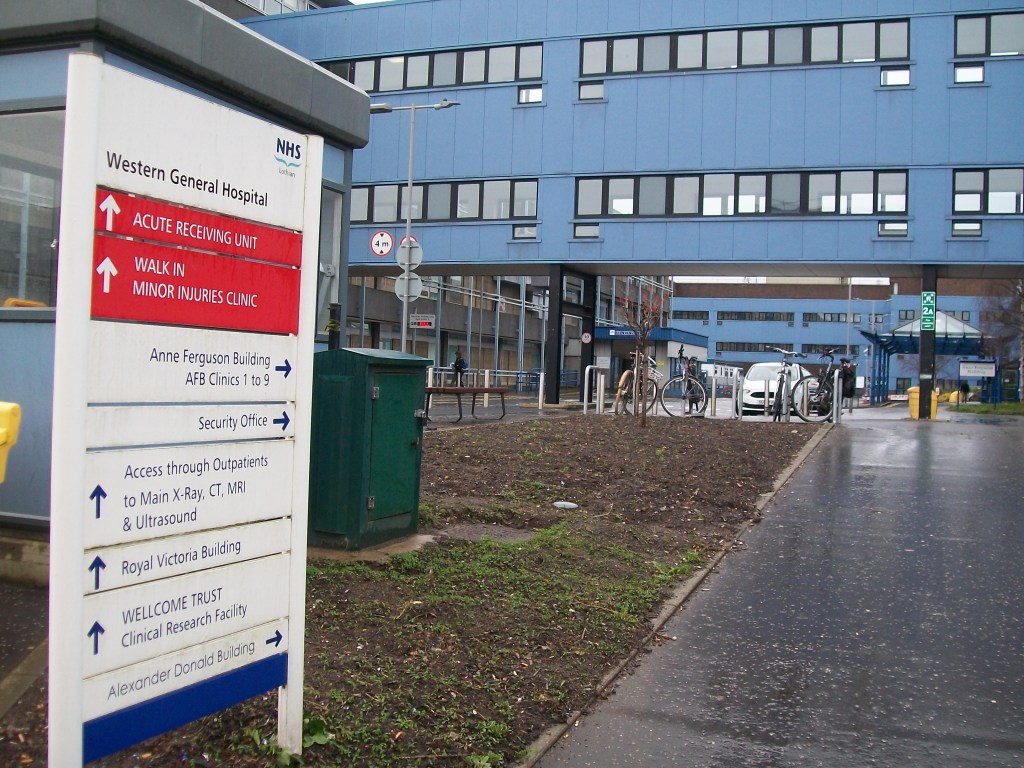
Things got worse in the evening. There was an acute blockage in the new catheter [blood clot] which was extremely uncomfortable. Susie rang 999 and NHS 111. And a district nurse came to the house at about 10.30pm; cheerful and capable, and sorted the problem out with a minimum of fuss. And I slept peacefully. I felt she was a real God-send. I guess it’s a simple theological lesson. God hears our prayers. He may not always give us exactly what we ask for. But he travels with us along our life’s journey; with us in the disappointments and frustrations as well as the sunnier days. The next morning, at Morning Prayer at St Peter’s, I was happy to give thanks for answered prayer, for the NHS, and for the support of a loving and long-suffering wife.
Going away to school
Seventy years ago this month an hour’s car journey changed my life. I went from home, the familiar surroundings of Wimbledon Park Road, Southfields, in south west London, where I lived with my parents and older and younger brothers, to start secondary school at Christ’s Hospital. Colloquially known as the ‘Bluecoat School’, CH was a religious, royal, and ancient foundation, set in 600 acres of rolling countryside just outside Horsham in West Sussex. My only knowledge of boarding schools came from the Jennings and Darbishire books by Antony Buckeridge. Amusing, yes. But they were inadequate preparation for the forced intimacy of boarding school life. And Jennings didn’t have to cope with the novelties of our school uniform; knee breeches, long yellow socks, white, quasi-preaching bands at the neck [secured to a collarless shirt with a safety-pin], and long blue coats with silver buttons.
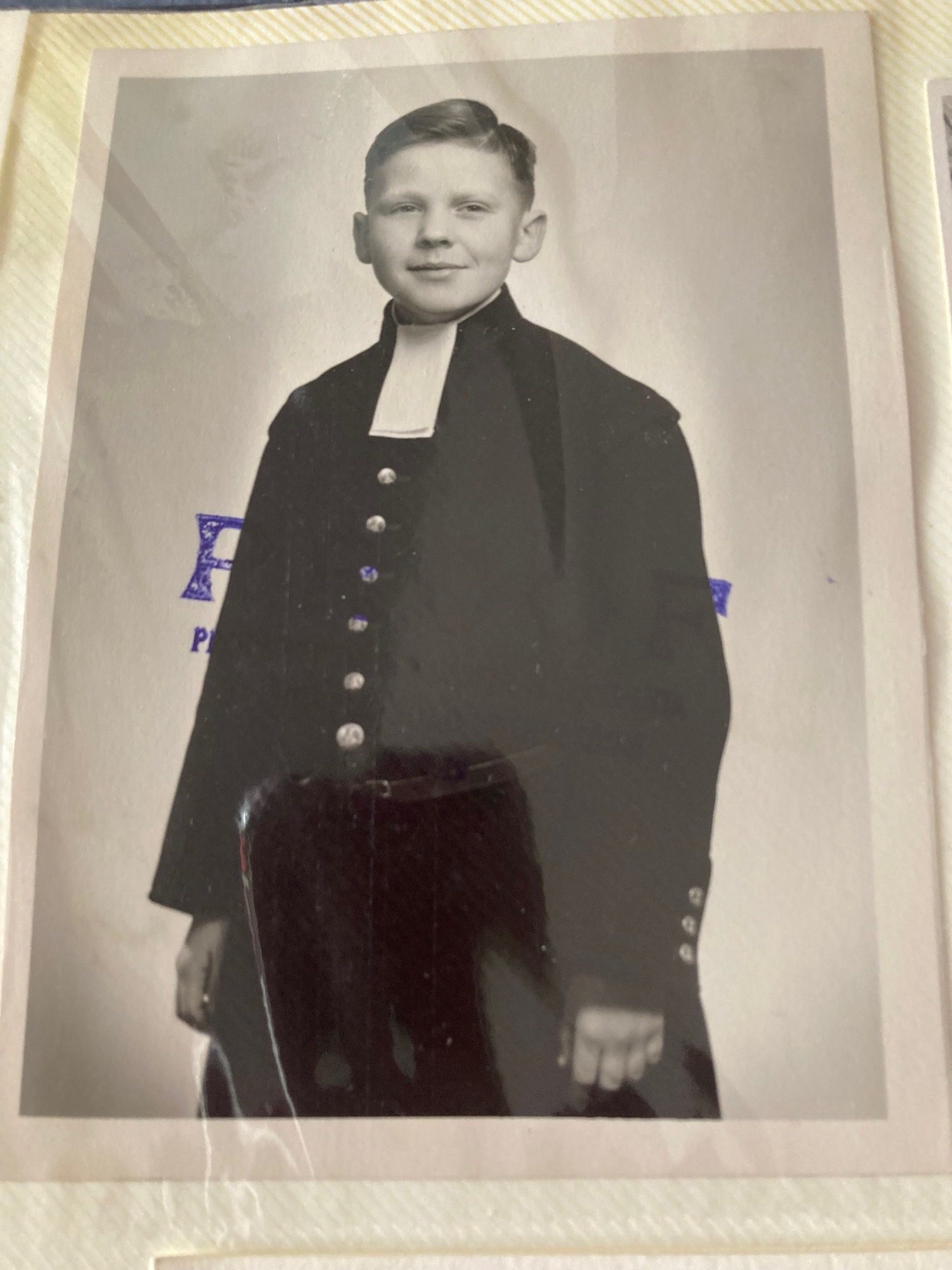
New boy, 1956
The past, as we know, is a distant country. But as John Gregory, a school friend and exact contemporary, e-mailed me the other day, youthful days seems to come closer as we age. Some things about those early days at CH seem astonishingly vivid. Sleeping in unheated dormitories on iron-frame beds. Being woken by the Big School bell at five to seven every morning, and marching into breakfast some thirty minutes later. Muddy afternoons on the rugby pitch followed by communal baths in a primitive, and equally muddy, sort of trough. [There were showers, but I never saw them work.] The senseless punishment of ‘double-changes’, changing from school uniform into games clothes and back again in the allotted four minutes. Sitting on the window-sill on winter half-holiday afternoons, eating mint imperials and reading books by people like G.A. Henty and Percy F. Westerman. A few tearful nights when I realised that it would be thirteen weeks before I experienced the comforts of home.
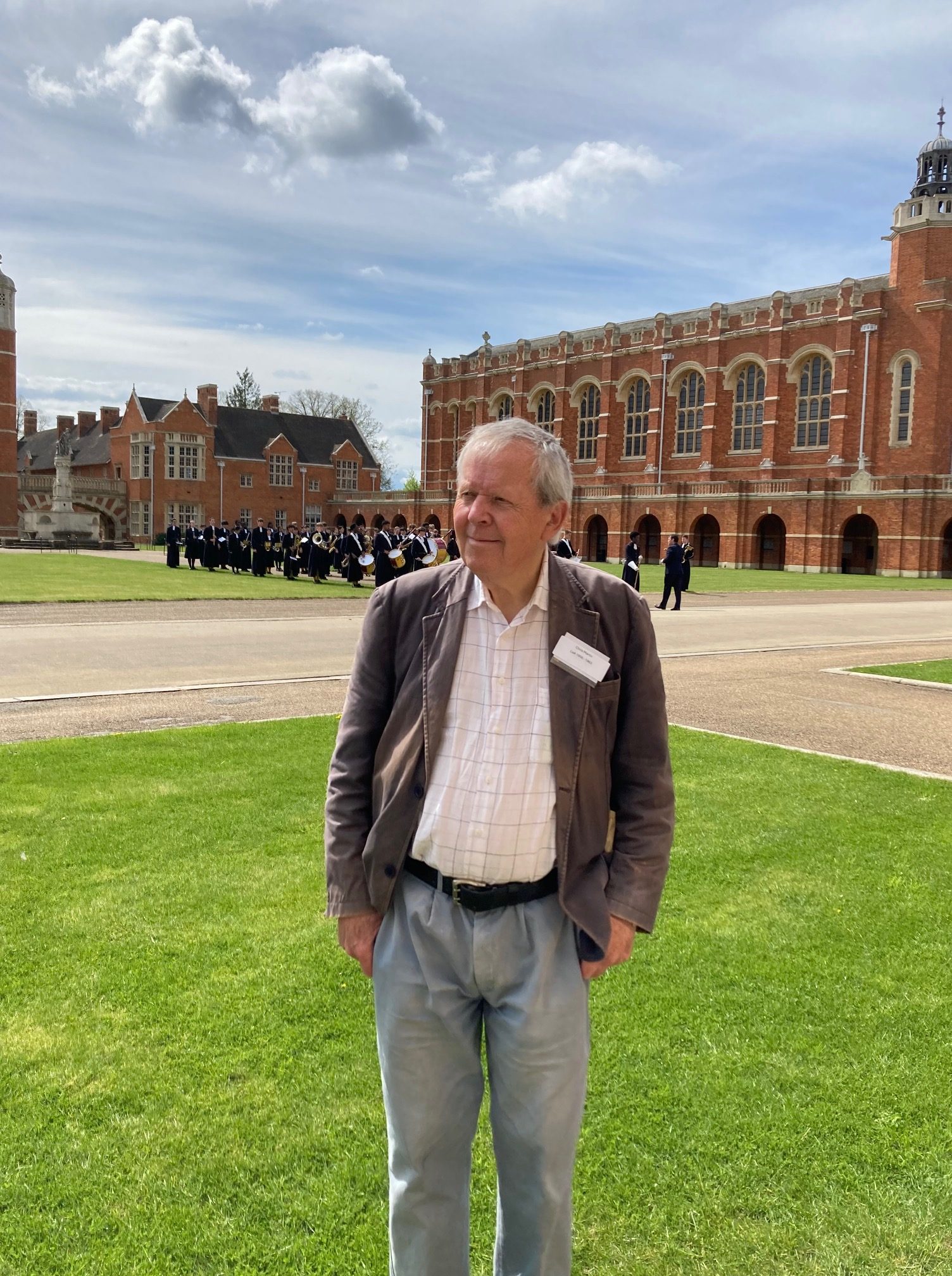
At CH, April 2024
What of the actual teaching. The best masters were excellent, but I think the standard was pretty uneven. My first English teacher was the urbane David Herbert, who left a year or two later to head up StudioVista publishers. But when I was put up a form [from LFB to LFA] I came under Mrs Hurst, one of the few women teachers left over from the War and now well past her best. For Latin I had first Tom Keeley, who occasionally fell asleep in class, and then Colin Tod, like David Herbert an Old Marlburian. A year later I had the very civilised Edward Malins for English and History, before he left to teach at the School of Art at Corsham. For Science and Maths I was less fortunate. Bill Armistead, the Second Master, who taught physics, may have been the last person to spell kathode with a k. Bill Kirby, who taught chemistry and biology, cycled round in ancient battle fatigues. He was as mad as a hatter, and kept ‘the worst dog in Sussex’ on the end of a piece of rope. M.B. Jones could [and did] in those pre-computer days work out the school timetable on the back of an envelope. But he signally failed to encourage me to take any interest in any form of maths.
When I look at books like Cuthbert Worsley’s autobiographical Flanneled Fool: A Slice of Life in the Thirties, where he writes about his time as a school-master at Wellington College in the 1930s, or the second volume of Brian Magee’s autobiography, which majors on his time at CH in the 1940s, I realise that CH in the mid-1950s was stuck in a kind of time warp. Most of the senior house-masters had attitudes formed in the 1930s and had never really moved on. ‘Bolshy’ was the all-purpose negative epithet. Which covered everything from reading the News Chronicle to not trying hard enough on the rugby pitch. Johnny, my red-faced house-master, the product of Royal Masonic School, Bushey [he had a masonic symbol on his study door] and Downing College, Cambridge, was a reactionary philistine. In due course he prepared me for Confirmation. But he also beat me six for wearing a yellow pullover on a leave day [it happened to be my birthday] in Horsham. There were more civilised, more enlightened, more sympathetic staff members – David Jesson-Dibley, and Michael Cherniavsky, and Tim Law. But I didn’t encounter any of them in my first couple of years at CH.
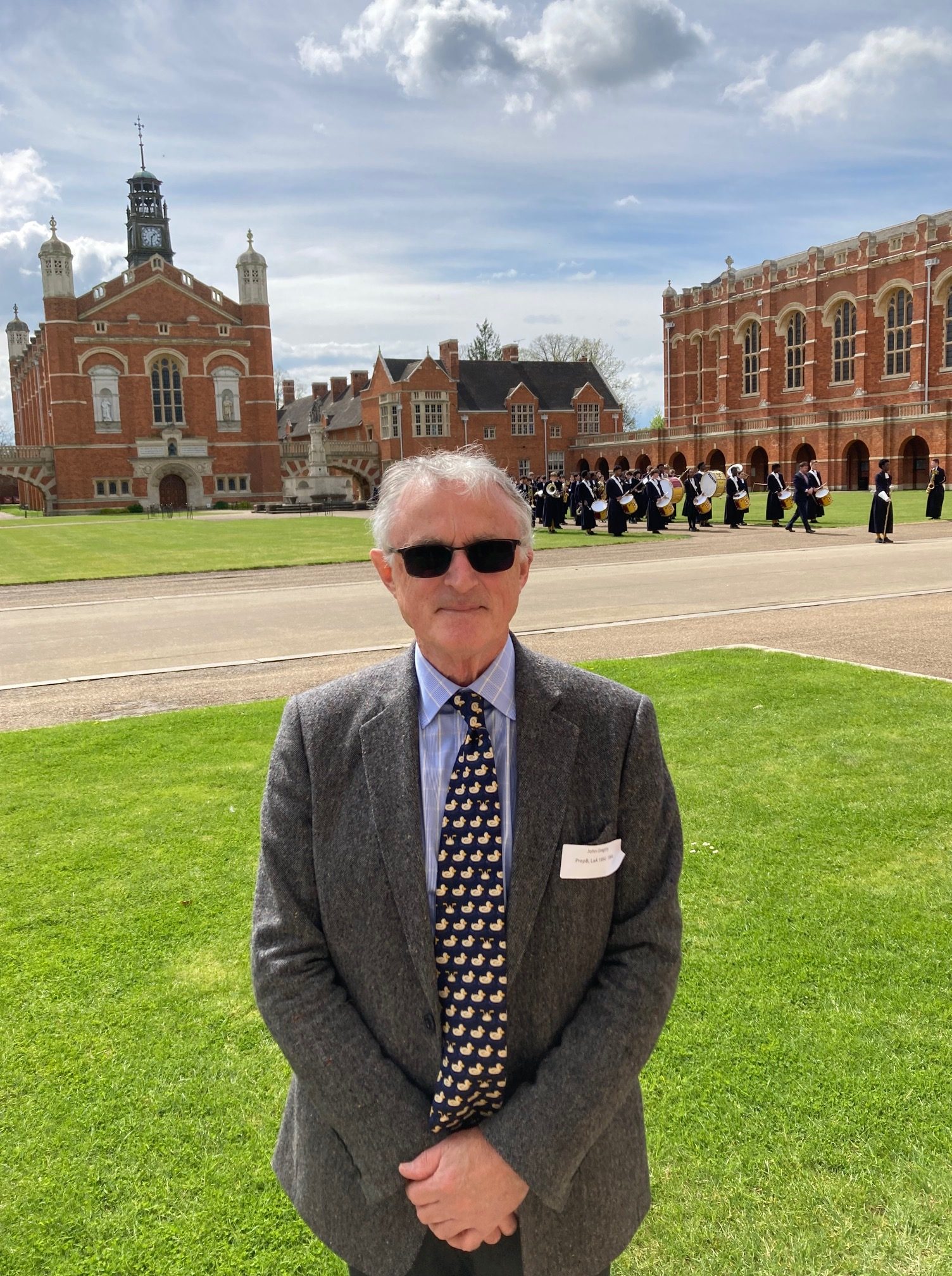
John Gregory at CH, April 2024
People say [probably Evelyn Waugh] that prison is a doddle for anyone who has spent time at an English public school. Not quite relatedly spending eight days in hospital recently reminded me straightaway of school food. I never quite took to cod for breakfast – ‘the Piece of Cod that passeth all Understanding’. Michael Cherniavsky claimed that the food at CH improved enormously in the late 1950s. But there were occasionally blips. Once of twice there would be an outbreak of food poisoning on an industrial scale. It was usually blamed on the shepherds’ pie. On one occasion at least large numbers of us had to stay beyond the end of term to recover.
With a degree of hindsight, English public schools teach you coping techniques. As my wife frequently points out, I started biting my nails at secondary school. And continued to do so for the next five decades. One of the striking features of school life was the almost total lack of personal time and space. Which I guess was a deliberate control policy. If the staff or house monitors couldn’t see what you were doing, then the chances are that you were doing something that you shouldn’t be doing ! [Like having a cigarette on top of the toilet block in the Art School car-park. Or making an assignation with one of the more attractive young women on the domestic staff. But these discoveries came later.] Parents were always asking questions about ‘What is it really like ?’ at school. But the truth is that you lived in two worlds where there was limited overlap. And the lack of personal space encouraged us all to retreat to personal spaces inside our own heads. To carve out places where we could feel safe. Decades later, when I attended a Selection Conference for training for ordination in the Church of England, the chief selector accused me of hiding behind a well-constructed barricade of defences when faced with questions that I was reluctant to answer, He was probably right. But I thought that everybody did it !
Envoi
I can’t quite believe that we are into September. August seems to have passed by all too quickly. And is morphing into autumn. I continue to dream about a week in Biarritz. Before winter comes. Or possible a few days in Venice, staying once again in the hotel along the street from the Rialto Bridge. The Hotel Da Bruno. Or even a 48-hour trip on the bus and CalMac ferry to Stornaway. We will see …
September 2026

