Question: What’s the difference between a lawyer and a wounded buffalo ?
Answer: A lawyer charges more.
A well-dressed man goes into a pub with a crocodile on a lead and asks ‘Do you serve lawyers here ?’ ‘Yes, certainly, Sir’, says the barman. ‘In that case, I’ll have a pint of bitter for me and a lawyer for my crocodile.”
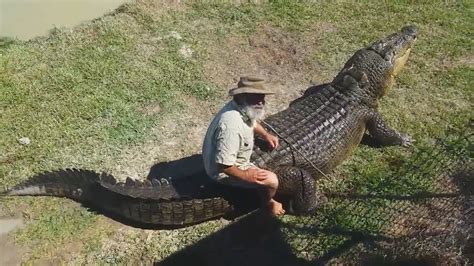
Man with a large crocodile
That was how the minister began his reflection this morning on the latter verses of Mark 12, the condemnation of the scribes by Jesus. The minister in question was himself a lawyer before his ordination, so I guess he knows what he is talking about.
By tradition Newington Churches together have a shared service daily at 7.45am during Passion Week. Held in Craigmillar Park Church of Scotland. The local ministers take it in turns to offer a bible reading and a short-ish reflection, and we sing a couple of hymns. And there is breakfast in the hall afterwards; muesli or cornflakes, white rolls and butter and marmalade, tea and coffee. All served by an efficient team from Craigmillar Park. There are familiar faces from the local congregations, and it seems an appropriate way to mark the transition from Lent into the Passion Story. Although it sometimes feels as if there is a table marked ‘Ministers and scribes only’ !
Palm Sunday
Palm Sunday has always felt like a significant festival to me. The liturgical colour is red. Which is appropriate for the story of Jesus’s triumphal entry into Jerusalem with the crowd waving palm branches as they shouted:
“Hosanna to the Son of David.
Blessed is he who comes in the name of the Lord.”
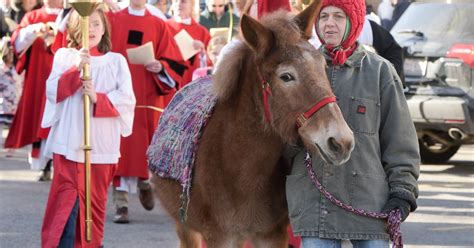
Palm Sunday procession
We never managed to source a donkey [or two] for the service, neither in Duns nor in Lyon. And I suspect that too often our Palm Sunday liturgy failed to do justice to the excitement and the sense of anticipation and the raw energy of the original entry into Jerusalem. I am reminded of David Leitch’s account [in God stand up for bastards] of his covering the very dramatic, eleven-hour visit of Pope Paul to Jerusalem in 1964, at a time when the Vatican did not officially recognise the state of Israel. A visit attended by hysterical crowds.
But the red also signifies danger. As Harold Wilson once said, ‘A week is a very long time in politics.’And we know as we gather on Palm Sunday that the coming days will bring rejection and betrayal, arrest and a trumped up trial, and [almost] finally a very public execution. Which is why we pray the Palm Sunday Collect:
True and humble king,
hailed by the crowd as Messiah:
grant us the faith to know you and love you,
that we may be found beside you
on the way of the cross,
which is the path of glory.
Passion Week
It was good to be at Melrose Sevens last Saturday afternoon, though cold in the sunshine. I realise that I have been going there on and off, on the second Saturday in April, since 1979. When Stewart’s Melville FP beat Kelso in the final. In recent years the number of guest teams has increased, as has the number of catering outlets. There were certainly some very classy guest sevens on Saturday.
At Melrose Sevens, 2022
Rugby apart, I am finding Passion Week difficult this year. Partly because of the continuing bad news from Ukraine. The encouragement of the withdrawal of Russian troops from the north and from menacing Kyiv has been totally negated by the uncovering of a succession of war crimes, perpetrated by [very young] Russian soldiers against civilians, Ukrainian women and children. We are doing a talk at a local church tomorrow on our time in Kyiv. And it almost seems indecent to propose to show a lot of photographs of the city and the country as it was prior to the invasion.
Closer to home my younger brother has been in a hospice since last Thursday. His life seems to be drawing to a close, but we have no idea how many days, or possibly weeks, are left. We were very pleased to see him down in Warwickshire last month. And we have no plans to dash down and see him. But his wife and their two daughters are much in my thoughts and prayers. Perhaps relatedly I feel a sense of heaviness in recent days, and find that is much easier to fall asleep after lunch. Meanwhile, I will be taking Communion to Bob this afternoon in the Royal Infirmary where he is recovering from invasive surgery.
Peter in Berwick-on-Tweed, 2021
I may not make the Passion Week early service tomorrow. But I very much doubt if there will be any jokes about crocodiles.
simply sitting in a chair and looking into the distance.”
Vasili Rozanov
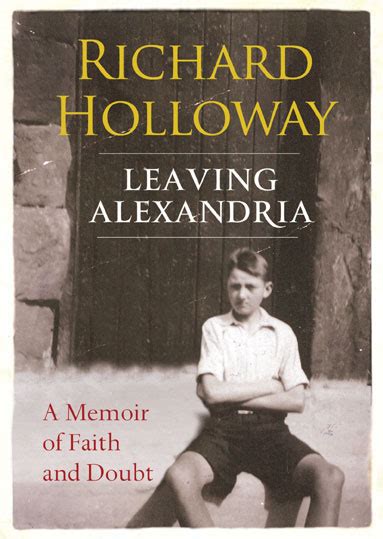
This aphorism prefaces the opening chapter of Richard Holloway’s 2004 book Looking in the distance. Richard notes that the words served as a prompt to his own life; as he was drawn from his first encounter with romantic, incense-filled religion in his hometown in the west of Scotland into a heroic quest for something that remained too often elusive. The story is told in his 2012 book Leaving Alexandria: A Memoir of Faith and Doubt. A beautifully written memoir which drew admiring reviews from Christians and non-christians alike. “So compelling and so intense. Nobody, whether interested in religion or not, could fail to be intensely moved”, wrote Mary Warnock in the Observer, “… What a deeply lovable man; and what a wonderful book.”
Leaving Alexandria
In Looking into the distance, Richard claims to recognise himself in the A.S.J. Tessimond poem Portrait of a romantic:
“He is in love with the land that is always over
The next hill, and the next, with the bird that is never
Caught, with the room beyond the looking-glass
… …
He is haunted by the face behind the face
He searches for last frontiers and lost doors
He tries to climb the wall around the world.”
He gave his life to that search, becoming successively an Anglican priest, a bishop, and then Primus {presiding bishop] of the Scottish Episcopal Church. “Now forty years, and many battles later, it has passed and I am left sitting in the chair and looking into the distance.”
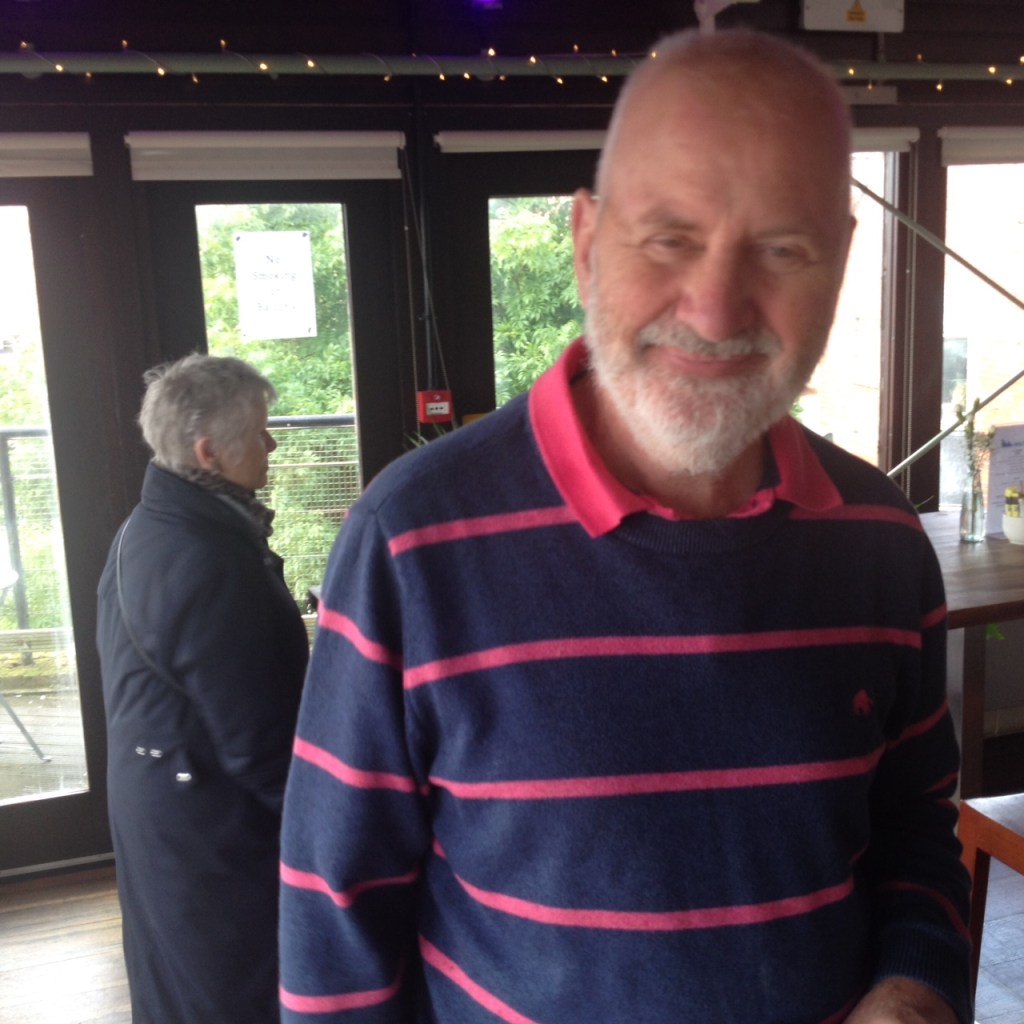
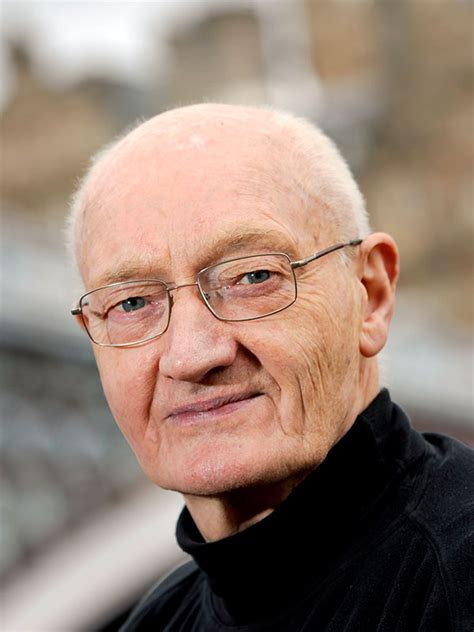
Richard Holloway
Clearly Richard doesn’t spend all his time sitting in a chair gazing quizzically into the distance. Since he retired as Bishop of Edinburgh in 2000 he has written almost a dozen books, many of them looking at the Christian faith from a sympathetic, fellow-travelling stance. Some have liked to label him as a post-Christian bishop. Though I think that may be a bit simplistic. He was my bishop during the twelve years that I served in the Edinburgh Diocese. It is a small enough diocese to have direct contact with the bishop. I liked him a lot, but I found myself out of sympathy with his generally liberal views abut all sorts of issues. And his frequent declarations of support for gay and lesbian Christians, and for the recognition of same-sex relationships, didn’t play well in my own parish in the predominantly conservative church culture of the Scottish Borders. But I recall he wrote me a very nice letter when we went off to Lyon in autumn 2000.
Shortly before we left for France he came down to preach in Duns. And used as a text something he had found on a fridge door in New York. “I get most of my theology from fridge doors nowadays”, he said. And later “ I’ll read you a couple of lines from a poem by Philip Larkin, and I’ll bowdlerise them in case there is a reporter from the Daily Mail present.” [There was. Lord Palmer’s brother] The Duns congregation loved him.
A couple of weeks ago Richard came to speak, at St John’s, Princes Street, to an occasional meeting of SARAC. An association of retired Anglican clergy in Scotland, which was encouraged into [a precarious] life a few years ago by the late Ken Gordon from Aberdeen. The topic was Forgiveness. The turnout was very modest, and we sat round a couple of tables as Richard spoke before we moved into a general conversation..
Forgiveness
Much of what he said was in his 2002 book Forgiveness. He wanted to believe that scripture has given us many of the best stories and metaphors. He quoted from Hannah Arendt; to the effect that things [and relationships] remain stuck until forgiveness takes place. He distinguished between corporate forgiveness and individual forgiveness. He didn’t suggest that any of it was easy.
There was the inevitable question about Putin’s invasion of Ukraine and the unfolding war crimes. Richard pointed to what had happened in South Africa, the work of the Peace and Reconciliation Commission, inspired by Desmond Tutu, and to the Good Friday agreement in Northern Ireland, as examples of intractable problems being turned around by a willingness to forgive. There was more discussion about individual forgiveness. And about how difficult it can be to forgive ourselves. Richard encouraged us not to set impossibly high standards for ourselves. Acknowledging that we will always fall short. He acknowledged too that, even when we forgive ourselves, our dream life does not always get the message !
The attendance was disappointing. And some of the problems continue to be difficult. But Richard is an excellent communicator; wise, humane, and, as Mary Warnock noted, lovable. Which is perhaps not something that you could say about a lot of Anglican bishops.
It is two days short of the winter solstice. The temperature is five degrees below freezing. At dusk it snows steadily for five hours. When the snow stops the writer leaves his desk to go for a walk. He clears the suburbs, finds a hole in the hawthorn hedge, and follows the field path east-south-east, rising towards a long chalk hill-top, visible as a whale-back in the darkness. Dry snow squeaks underfoot. A fox crosses the adjacent field at a trot. The path is a grey snow alley flanked on one side by hawthorn, and on the other by a mix of blackthorn, hawthorn, hazel, and dogwood. In the forty-acre field the snow is densely printed with the tracks of birds and animals. “I found a line of fox-pugs, which here and there had been swept across by the fox’s brush … … I discovered what I supposed were traces of a pheasant taking off: trenched foot prints where it had pushed up, then spaced feather-presses either side of the tracks, becoming progressively lighter and then vanishing altogether.”
The walker pauses for a drink of whisky. He steps onto the county’s most exclusive golf course, walking straight down fairway after fairway. On the fifth green he lies on his back and stares at the stars. Most of the tracks on the course had been made by rabbits. “If you’ve seen rabbit prints in the snow, you will know they resemble a Halloween ghost mask, or the face of Edward Munch’s Screamer: the two rear feet are placed laterally to make elongated eyes, and between them and behind them fall the forefeet in a slightly offset paired line, forming nose and oval mouth.” There are occasional headlights from the road to the west. He follows rabbit tracks through another blackthorn hedge and onto the Roman road that runs for miles over the low chalk hills. The Roman road passes the end of an avenue of beeches and skirts the earthworks of a large Iron Age fort. “At the down’s top, under the moon, near the outline of a Bronze Age burial barrow, I sat in the snow and drank whisky again”. The walker looks back at the line of his own tracks leading up to the hilltop. And then picks out one of a dozen other print-trails, following it downhill to see where it will lead.
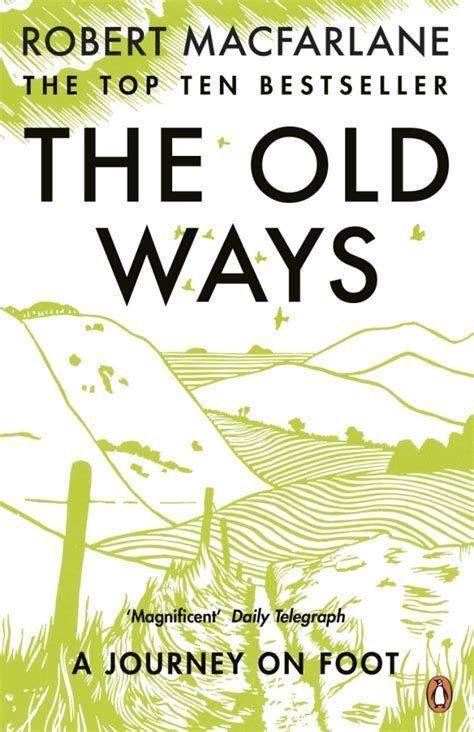
This is a book about walking. And about a host of other things too. Robert Macfarlane follows the tracks, drove-roads, and sea paths that form part of an ancient network of routes criss-crossing the British Isles and beyond. His conviction is that, while walking feet leave their mark on the landscape, so too does the landscape imprint itself on the mind of the walker. Walking the old ways opens up a word of pilgrimage and ritual, and stimulates our imagination and our senses.
The Outer Hebrides
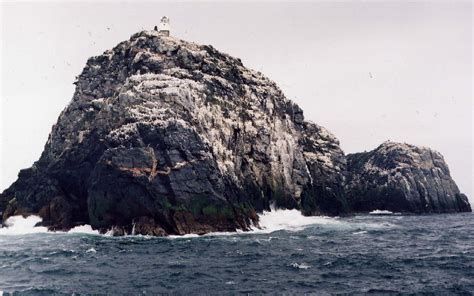
In a later chapter Macfarlane quotes Richard Kearney: insisting that Irish scholars practised the habit of navigatio, of undertaking circular journeys by boat as an apprenticeship that would enable them better to appreciate their own intellectual and spiritual context. In the same spirit he undertakes a journey in a small boat to the bare rock islet of Sula Sgeir. This is a jagged black peak of gneiss some forty miles north of the Butt of Lewis, the same distance from the Outer Hebrides as St Kilda. It is the topmost summit of an undersea mountain and is home to around 10,000 pairs of gannets. And for a few years to the only black-browed albatross in the northern hemisphere. In big storms the seas break right over the top of the island. This is the place to which men come from Lewis every year to hunt the guga , the gannet chicks. The first recorded mention of the guga hunt dates to 1549, when the men rowed out in an open boat to cull the gannets and brought the bodies back as ballast. This annual expedition is central to Peter May’s The Black House, the first book in his Hebridean trilogy [see Through a glass darkly – 52]. For centuries men reached Sula Sgeir in an open boat, by rowing or by sailing. Since the 1950s they have travelled in fishing trawlers, but it is still an arduous five-hour journey. Macfarlane sails from Port of Ness in the elderly Lewis boat Jubilee; gannets are feasting on a shoal of sand eels. They see a minke whale. And a single dolphin.
Sula Sgeir
He recalls that Mark Twain trained as a river-pilot on the Mississippi, as an apprentice to Horace Bixby, the veteran steamboat captain. “The face of the water “, wrote Twain, “became in time a wonderful book – a book that was a dead language to the uneducated passenger, but which told its mind to me without reserve …”
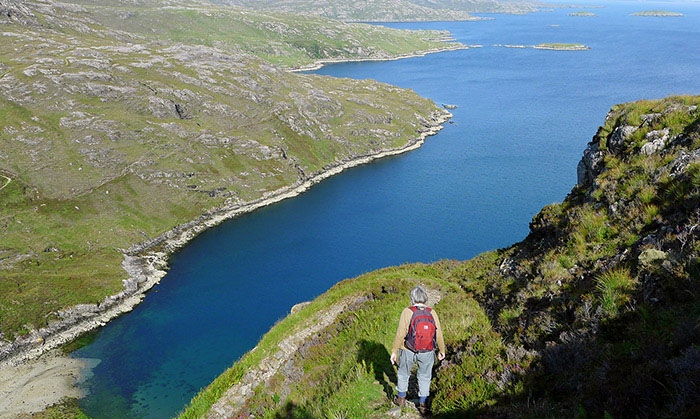
Back on land Macfarlane goes in s search of a path that was thought to run south-east from west Lewis down into Harris. It was a path that existed in folklore before it existed as terrain, and like a folk-song its route subtly altered its each retelling. The path was unknown to the Ordnance Survey. It was called the Clachan Mhànais, Manus’s Stones, and the cairns had been laid by a crofter called Manus MacLennan. Finlay MacLeod, naturalist, novelist, and local historian, drives him down past the great sands of Uig to the road-end, the remains of the crofting settlement of Mealasta. He pitches his small tent on a peninsula overlooking the bay. Above him a golden eagle is roaming on a late-day hunt. As he drinks his tea a seal surfaces ten yards away. In the morning he follows the deer tracks that run beneath the north face of Griomabhal, searching for the elusive path. At last he spies the cairn sequence running up from the Dubh Loch shore, and he follows the path east over the slopes of gneiss. As the day warms up he pulls off his boots and socks, and walks barefoot for an hour or two on the cool and slippery peat. He quotes Nan Shepherd approvingly. “Walking barefoot has gone out of fashion”, she wrote in 1945, “but sensible people are reviving the habit.”
Huisinish, North Harris
In the evening he crawls into a dome-roofed rock shieling, constructed of overlapping gneiss slabs turfed over to act as windbreak and insulation; and cooks the trout he caught earlier. No midges. An enormous sky. And a sensation of huge emptiness. During the night he is woken only once, by the hoarse coughing of a deer. The next day he walks south-east all day, following shieling path, croft path, drover’s road, and green way. He spends the night in the youth hostel at Rhenigdale. The next day he continues towards Tarbert on what has been described as ‘the most beautiful path in Britain’. “The track contoured above sea coves … … after a mile the path dropped down into a sheltered coastal glen called Trollamaraig, and here, protected from the sea wind, I found a flourishing dwarf forest of willow and aspen, `honeysuckle, foxglove, and woodrush. Then it was up, zigzagging the east face of a hill called the Scriob until the path eased and led due west between two pap-like peaks with Norse names, Trolamal and Beinn Tharsuinn. “ Macfarlane descends under rainbows to Tarbert, and makes his way to the house of Steve Dilworth, artist and path-maker; “in whose house I stayed for several days. days which have in my memory taken on the texture of a fairy tale: the traveller on foot welcomed in off the path for a pause in his travels, to a house of dark wonders, the strangest energies, and an apparently self-replenishing tumbler of gin”.
Rhenigdale Hostel
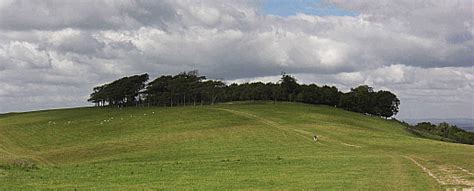
Chanctonbury Ring
Many pages later Macfarlane sets out in the footsteps of Edward Thomas.He plans to follow the ridge line of the South Downs east from Winchester until the chalk dips into the sea near Eastbourne. He spends the first night in a forestry plantation called War Down, tucked into his cocoon-like tent. The next night he [mistakenly] decides to spend in Chanctonbury Ring; a prominent circle of beech trees planted in 1760 by a local aristocrat on the site of Bronze and Iron Age fortifications and a Roman temple. When I was at school in Sussex in the 1950s-60s Chanctonbury Ring was a prominent landmark on the South Downs. Up to which we once climbed on what must have been a school whole holiday.
It turns out to have been a mistake. “I heard the first scream at about two o’clock in the morning. A high-pitched and human cry … … It came from the opposite side of the ring to where I was sleeping. My thoughts were sleep-muddled: A child in distress ? A rabbit being taken by a weasel or a fox ? … … an owl surely. But it was like no owl I had ever heard … … I lay there for two or three minutes listening to the. screams. Then I realised, with a prickling in my shoulders and fingers, that the voices had split and were now coming towards me … … “
Chanctonbury Ring
When he gets home he researches the folklore of Chanctonbury Ring. And discovers it has a reputation of being one of the most haunted places of the Downs. If you ran round the Ring on a moonless night, the Devil would come out of the wood and offer you a bowl of soup. “The ghosts that had been summoned in this way, apart from the Devil, included a Druid, a lady on a white horse, a white-bearded treasure seeker, a girl child, and Julius Caesar and his army. It clearly got crowded up there on busy nights.”
Edward Thomas
One of Macfarlane’s inspirations was the poet Edward Thomas. From an early age he had been a compulsive walker, He kept a diary of natural events, and collected wild flowers and birds’ eggs. In 1906 Thomas moved with his wife and young children into Steep, a village in Hampshire; into a house called Wick Green, at the end of an ancient track. The house was high up on the plateau and looked across to Chanctonbury Ring and the ridge-line of the South Downs. Suffering from recurrent depression Thomas responded by walking, long distances in all weathers, Paths and tracks are prominent in his writing. And weather is integral to his thinking. “Other people talk about the weather”, noted Eleanor Farjeon, “Edward lived it.” In the course of 1913 Thomas becomes friends with Robert Frost, and they walk together in the woods near Dymock in Gloucestershire.
Edward Thomas
In July 1915 Thomas draws up his will and enlists as a private in the Artists’ Rifles. He trains in Essex, and then volunteers to go out to the batteries in France. He is posted near Doullens, where the wooded chalk hills remind him of the South Downs. He looks up from his observation post to see kestrels hovering in pairs. And above them wheel five planes. Easter Monday, April 9th, is the beginning of the Battle of Arras. It begins with a massive artillery barrage from the British. As the first wave of British troops moves forwards towards the German lines, a stray shell drops near to Thomas’s dug-out. His body is untouched. But he is killed instantly by pneumatic concussion. A photo of his wife and a slip of paper are found in his pocket:
“ Where any turn may lead to Heaven
Or any corner may hide Hell,
Roads shining like river up hill after rain.”
The Old Ways
The Old Ways is a magnificent book. Which was chosen as Book of the Year by more than a dozen critics and periodicals when it was first published in 2012. Macfarlane is a polymath, who discourses knowledgeably on geography, geology, ecology, flora and fauna, landscape and literature. And he also writes beautifully. “An extraordinary book …”, wrote Jan Morris in the Daily Telegraph, “… it made me feel that I myself am always walking some external track, sharing its pleasure and hardships with uncountable others, treading its immemorial footprints, linking me with all the generations of man and beast, and connecting in particular the visionary author of the book, as he unrolls his sleeping bag beneath the stars …”
The Old Ways
The smudgy black-and-white photos do little for me.My only caution is that the book is dense, a rich read. I tried to read it in Ibiza in the sunshine in 2015. And failed. It is best taken in small doses. Like the Collin Street bakery Corsicana Cake that my brother generously sends us every Christmas. I am very glad to have at last come back to it. And/but, when I can find the time, Macfarlane has written half a dozen books since this one. Including Landmarks and Underland.
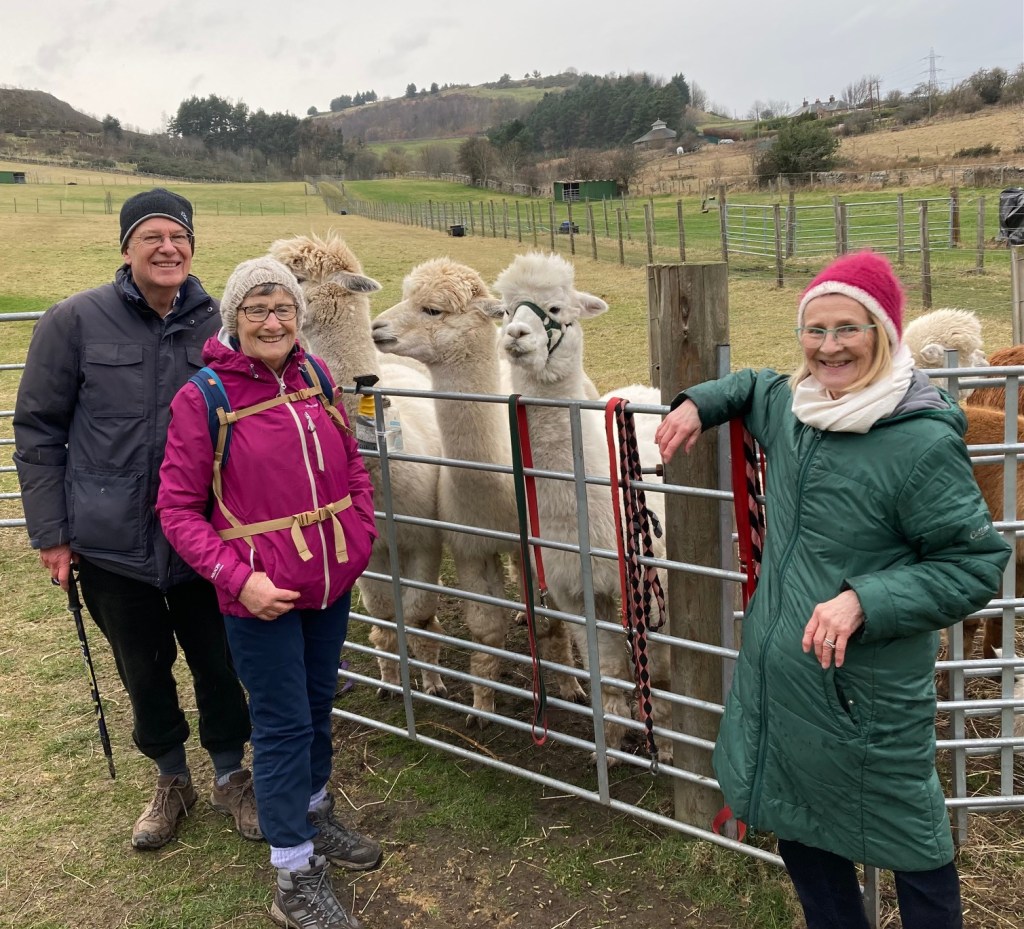
It was Susie’s idea. For a belated birthday celebration. As a change from watching all the depressing news on the television, we would go walking with alpacas. No trip to the altiplano of Latin America was needed. Instead we went with our friends Mike and Wendy to Bobcat Alpacas at Bonaly, just south of Edinburgh, a few minutes walk from the terminal of the number 10 bus.
Mike & Wendy & Susie & ‘The Boys’
Bob, who runs the business with his wife, worked for many years for the prison service. But he fell in love with alpacas a few years ago down in the Borders. The business has now been running for a decade or so, and they have about 50 alpacas. With another dozen crias [baby alpacas] expected later this year. Their mothers are called hembras and fathers are called machos. Bob and his wife Cat take groups out walking several days a week. A walk is about an hour and a half, on the edge of the Pentlands and across the bottom of Torduff Reservoir, the oldest of the several reservoirs in the Pentlands. The alpacas that we walked with were all male, mostly six or seven years old. Bob, who knows all the herd by name, started with an introduction to the animals in our group; which animals liked to be together, which walked at the front, which dawdled at the back etc.
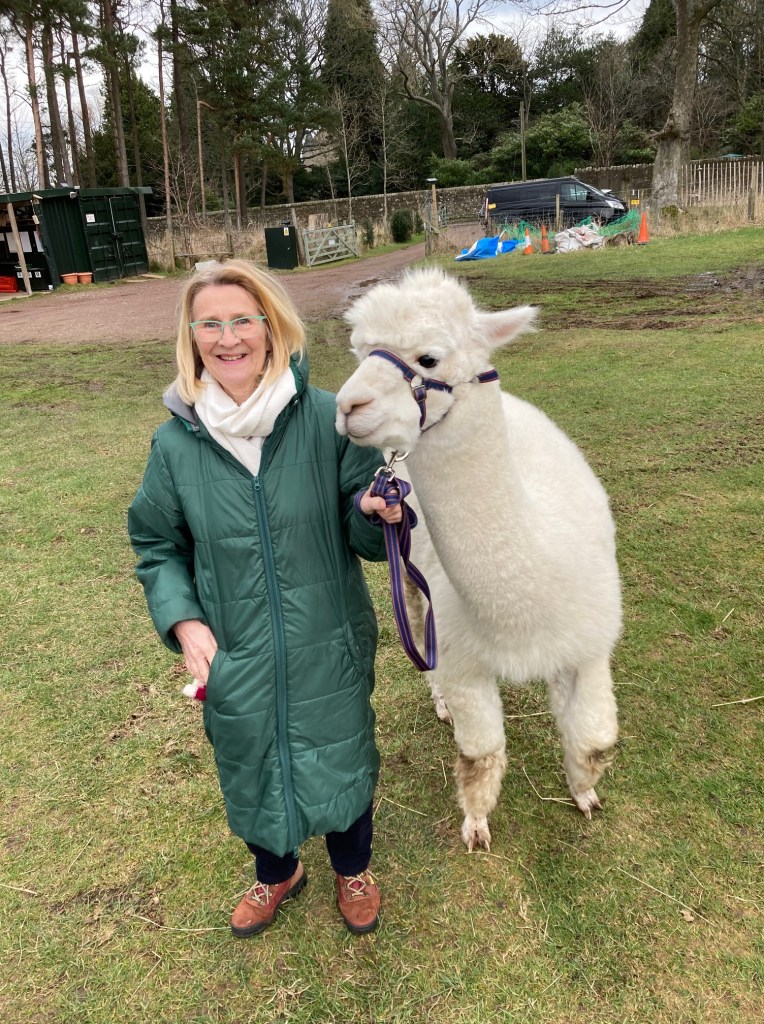
Susie & Milo
The alpaca is a member of the camel family. They are natives of the Andes mountains and live at an elevation of several thousand feet above sea level. The great majority of animals are Huacaya alpacas. If I understood correctly, they were in origin the result of cross-breeding between llamas and vicuna, tens of thousands of years ago.
Chris & Ignatius
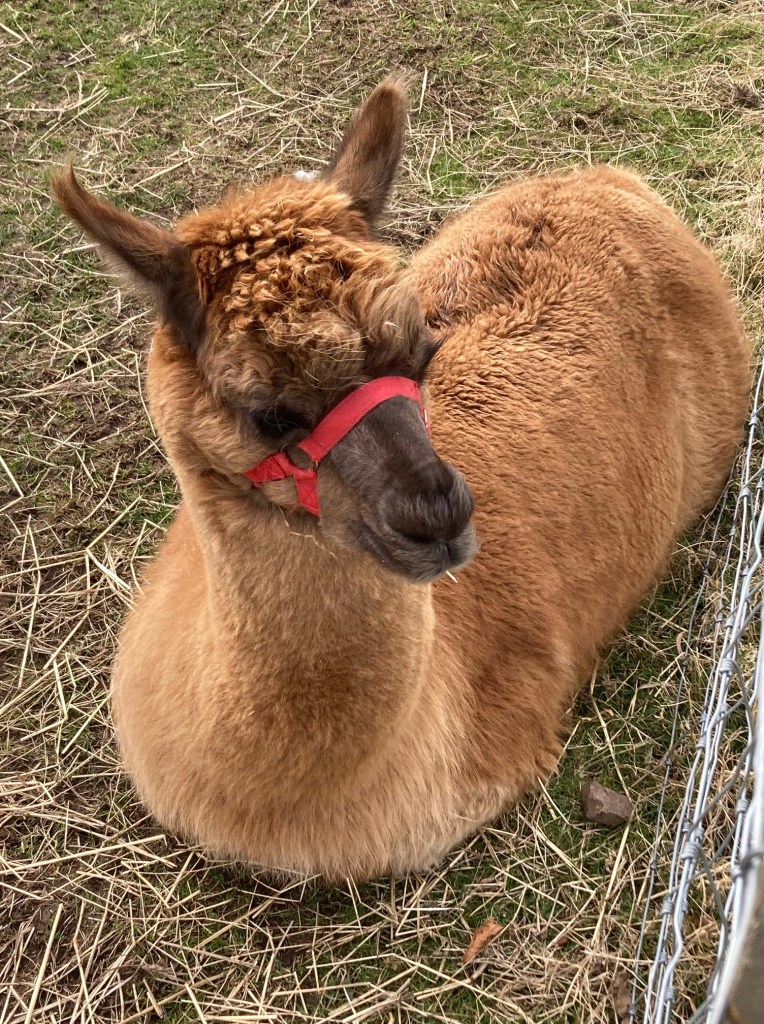
One white alpaca looks very like another to me. Susie and I started by sharing Milo, a biggish animal of some 85 kilos. All the animals are very calm and gentle, and seem to enjoy having their photos taken. They are sociable animals, and like to walk as a group. But they like to decide exactly when and where they want to walk. It was said that alpacas can run at a top speed of about 20 mph. But this is only when they are impatient for lunch and there is a following wind. Milo’s best friend was Ignatius, better known as Iggy. But I couldn’t really tell the two of them apart. It seems that the easiest way to tell them apart is by the variations in their distinctly punk hair-cuts.
Most of our walking group were white. But two of the animals were brown with different coats and long, silky ringlets. These were Suri alpacas, and they were known as ‘the Rastas’.
Petrus
Like camels the alpacas do spit occasionally. More at each other than at their handlers. Mainly gobbets of semi-digested grass. Guttural warning noises come first.
As we walked we gleaned odd facts from Bob. Alpacas are prized for their wool. We could sink our fingers deep into their soft fleeces, and they are sheared annually. Only one mill in Scotland is currently equipped to spin the alpaca fleeces, and this is at Duns in Berwickshire. Skeins of alpaca wool were on sale back at base at £15.00 per 100 grammes. Alpaca meat is said to be good for eating, but they are never bred for slaughter.
Curiously alpacas only give birth between [about] 9.30am and 4.30pm. This sounds as if it might be in accordance with NHS guidelines, imposed at the demand of the health-workers’ unions. In reality it is because pregnant alpacas can determine when to initiate the delivery of their babies. And they know that in their native environment it is too cold, and therefore dangerous, to give birth at night.
Susie & Milo
In addition to the organised walks, Bob said that his alpacas can be rented out as guard animals to protect sheep and chickens against foxes. And also as novelty guests at wedding parties. He also said that they had a valued role as thera-pets, being very gentle and non-judgemental. It would be good if more humans were like that too ! In times of stress I can greatly recommend walking with alpacas.
It has been a rather dispiriting few weeks. Apart from France, the quality of rugby in the Six Nations has been pretty poor. Scotland have got steadily worse as the Six Nations progresses. It now seems as if their opening win over England was a false dawn. My younger brother, Peter, is terminally ill. But it was very good to spend time with him, and with Alice, and with Paul and Jean, down in England last week.
with Peter and Paul at Baddesley Clinton
And then there is the news from Ukraine …
Bad pictures from Ukraine
We came back from Kyiv on January 11th, our 47th wedding anniversary. The Russian troops invaded Ukraine in the early hours of February 24th, incidentally Susie’s birthday. Three weeks later we are alternately angry and despondent, shocked and silent, as we watch the images on our television. As the story of the invasion unfolds. With a succession of attacks on civilians, on schools and hospitals and apartment blocks. Tens of thousands may have died. Two million women and children, perhaps three million, have fled Ukraine into Poland and beyond.
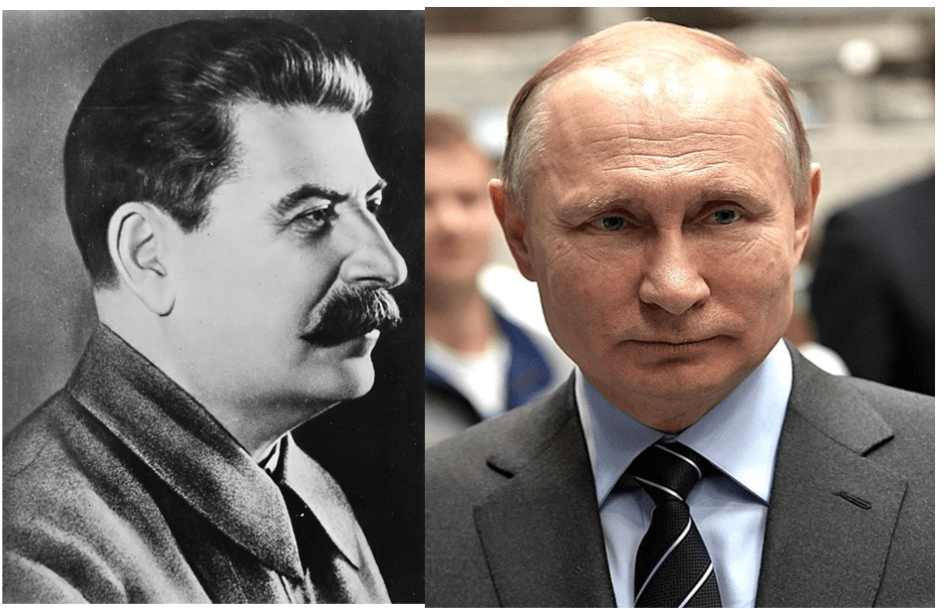
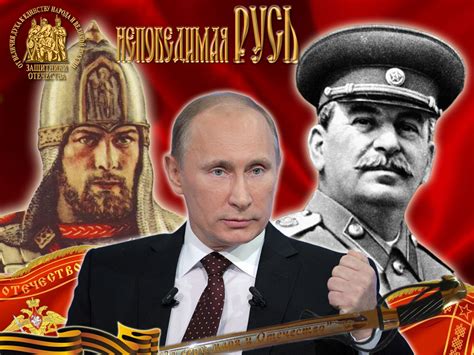
Stalin and Putin
During our six weeks in Ukraine we knew that Russian troops were massing on the borders, in both Russia and Belarus. But I did not believe that they would invade. I thought that Putin could gain all his objectives by the threat of invasion; Europe and America would take him seriously as a world statesman. Western leaders would seek to ‘do business’ with him. Russia’s place on the world stage would be strengthened. Concessions could no doubt be extracted as regards Russian authority over the disputed areas, the Crimea and in the Donbas. Now it seems that I was totally wrong. Three weeks after the invasion it seems that Putin is prepared to destroy the country that he was claiming to liberate. It reminds me of an American in Vietnam, I don’t remember who, claiming, ‘We had to destroy the village in order to save it’.
For blustering Boris the events in Ukraine are the ultimate dead cat. All that stuff about Partygate – a drinking culture at no 10 Downing Street, civil servants sent out to fill suitcases with wine bottles, a whole raft of people who thought that the rules didn’t apply to them, a Prime Minister with a disregard for the truth, lying to the Commons and obstructing a police enquiry – all that is now forgotten. The Russian invasion has offered him the chance to don his tin hat and to polish up his Churchill impersonation. Next it will be siren suits and a big cigar. Neither posting photos of Liz Truss in a tank, nor putting Chelski football club up for sale, is likely to bring much comfort to the people of Ukraine. The Ukrainian President, a clown who became a politician [rather than the other way around], would like NATO and the Europeans to intervene with a no fly zone. Sadly perhaps, no western leader is prepared to do anything that might result in an escalation of the war.
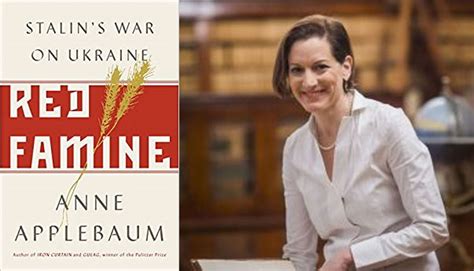
We are happy to pray for peace with friends at Priestfield and at St Peter’s and elsewhere. There is a worldwide prayer initiative, of which we are please to be a very small part. We pray for friends from Christ Church, Kyiv, who are now scattered. Some but not all have fled the country. And I pray too that Putin will be removed from office by one of his own people, aware of the damage his actions doing to a country that neither understands nor wants what he is doing in their name. As we have been waiting for the peace initiative to gain some traction I have been reading Red Famine: Stalin’s War on Ukraine, another book by Anne Applebaum, the American-Polish historian. It is a book that sets what is now happening into a historical context, showing that Putin is following in Stalin’s footsteps.
Anne Applebaum: Red Famine: Stalin’s War on Ukraine
The Ukrainian Revolution, 1917
The book offers a magisterial account of the famine in Ukraine in the mid-1930s, a deliberate attempt by Stalin to suppress any idea of Ukrainian nationalism. The story begins in April 1917, when, after the collapse of the Russian Empire, there seemed a real prospect of a free Ukraine. But the spread of national consciousness, foreign recognition, and even the Brest-Litovsk treaty were not enough to build a Ukrainian state. There was a great divide between those who supported a Ukrainian national government and the Bolsheviks. All the Bolshevik leaders were raised in the Russian empire and shared a contempt for Ukraine. And they were ambivalent about nationalism.
The Bolshevik leaders were obsessed with food supply. Imperial Russia’s centralised food supply system was in chaos. The policy of ‘War Communism’ involved taking grain from the peasants at gun-point and distributing it to the industrial workers in the cities. Linked to food collection in Ukraine, the Bolsheviks banned Ukrainian newspapers and the use of Ukrainian in schools.
Famine and Truce, the 1920s
The Ukrainian peasant revolution of 1918-20 led to widespread anarchy and chaos. The Bolsheviks forced an uneasy truce on Ukraine in 1920-21. There was mandatory grain collection. But bad weather and incompetent food collection policies led to a huge drop in the yield; which fell to just 5% of the former harvest. Widespread famine resulted. Unlike what happened later, this was no secret. Aid came from the American Relief Association [the ARA], under Herbert Hoover. In 1922 they were feeding 11 million people daily. Yet Lenin continued to put pressure on Ukraine peasants to supply more grain,
By 1927 it was clear that Lenin’s New Economic Policy had failed. Living standards in the Soviet Union were lower than they had been under the tsars. All food was rationed and scarce. Stalin, who had succeeded Lenin in 1924, used the grain crisis as a weapon against his political rivals. He brought back ‘extraordinary measures’ and declared a state of emergency. All trading in grain was now a criminal activity. The Ukrainian peasants were in an impossible situation: if they worked hard and built up their farms, they became ‘enemies of the people’; the other option was to remain bedniaks, poor peasants. The Soviet Union comprehensively destroyed their incentive to produce more grain. Instead they favoured large state-owned farms; collectivisation matched Stalin’s plans for Soviet industry. The ‘Great Upheaval’ was a return to the principles of War Communism. Someone had to be blamed for the slow pace of Soviet growth. Ukrainian intellectuals and all who favoured Ukrainian independence became the scapegoats. Show trials followed. The Ukrainian Bolshevik [newspaper] commented: “the proletarian court is examining a case not only of the Petliurite scum, but also judging in historical retrospect all of Ukrainian nationalism, nationalistic parties, their treacherous policies, … … , of Ukraine’s independence.” From 1927 onwards the Soviet press continued to denounce ‘Ukrainian bourgeois nationalism’.
In the 1920s the presence of the Soviet state in Ukrainian villages was minimal. Ten years after the revolution people were disappointed. The Bolshevik triumph had been a hollow victory. But in 1929 new faces appeared: the ‘Twenty-Five Thousanders’ were outsiders, urban activists, who were recruited to manage the drive towards collective farms. Collectivisation was Stalin’s personal policy, driven from above. But the Twenty-Five Thousanders knew nothing about agriculture. Their aim was to eliminate the class of kulaks, small independent farmers. Especially Poles and Germans. The policy degenerated into plunder, with the collectivisation brigades resorting to intimidation and torture. Large numbers of deported kulaks were sent to the Gulag.
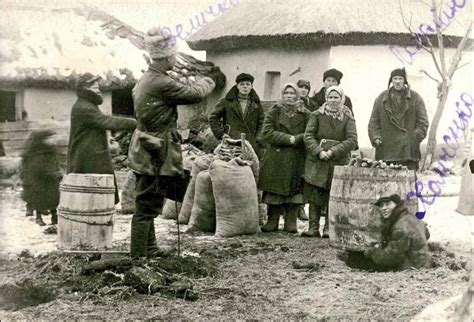
Soviet soldiers confiscating grain
Collectivisation: Revolution in the Countryside
During the winter of 1929-30 all across the USSR local leaders, successful farmers, priests, and village elders were deposed, arrested, and deported. The policy led to massive and widespread resistance, often chaotic. Peasants slaughtered their animals rather than hand them over to collective farms that they did not trust. Between 1928 and 1933 the number of cattle and horses in the USSR dropped by a half. Stalin blamed the failure of collectivisation on local party members. OGPU counted some 2,000 mass protests in Ukraine, many of them by women. There was organised resistance to a much hated policy. “Moscow’s paranoia about the counter-revolutionary potential of Ukraine continued after the Second World War, and into the 1970s and 1980s. It was taught to every successive generation of secret policemen, from the OGPU to the NKVD to the KGB, as well as every successive generation of party leaders. Perhaps it even helped mould the thinking of the post-Soviet elite, long after the USSR ceased to exist.”
In autumn 1932 Stalin twisted the knife further in Ukraine, launching a famine within a famine. The result of the Holodomor was to extinguish the Ukrainian national movement. Moscow was determined to squeeze grain, and other foodstuffs, out of Ukraine. They could give up their grain reserves and risk starvation; or keep some reserves hidden and risk arrest or even execution. Blacklists were vigorously applied to reinforce grain collection policy. Farms and villages that did not meet their targets were blacklisted. Increasing numbers of refugees began to flee from Ukraine into neighbouring Poland. It was clear that a widespread famine was coming.
During winter 1932-33 teams began operating across Ukraine searching not just for grain but for anything that was edible. They took fruit from the trees, seeds and vegetables from the gardens, as well as honey and beehives, butter and milk, meat and sausages. In many places they also took away the family cow. The searchers used iron rods to seek out buried food.. During the searches violence was often used. Just being alive attracted suspicion, suggesting that a family had food. A grain confiscator wrote: “I persuaded myself, explained to myself … We were performing our revolutionary duty. We were obtaining grain for the socialist fatherland. For the five-year plan.”. The teams used beatings, confiscation of belongings, and other forms of violence and torture. The brigades had good reason to believe that the party leadership at the highest level sanctioned extreme cruelty and supported the removal of all food and possessions from the peasantry.
Starvation: Spring and Summer 1933
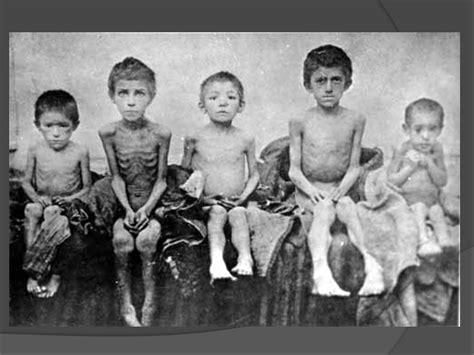
Survivors recalled the physical effects of starvation and of the related conditions – scurvy, joint pain, night blindness, dropsy, swollen bellies and body sores. Personalities were changed by hunger and normal behaviour ceased. Many families were driven to unimaginable decisions. There was suspicion of strangers and outsiders. Honest people were transformed into thieves. Adults were driven to killing their own children. The dead were buried without coffins. Some very ill people were buried alive. There were multiple reports of cannibalism; where parents had eaten the flesh of children who had died of starvation, or where starving family members had killed weaker ones. In March 1933 the OGPU in Kyiv were receiving 10 reports of cannibalism every day.
The Holodomor
To survive people ate anything: rotten food, horses, cats, rats, squirrels; moss, acorns, leaves; wild birds. Many peasants owed their survival to having held onto the family cow. People sold their possessions to buy food. Bartering with city-dwellers who had received food coupons allowed some to survive. Many country dwellers turned their children over to the state. Many orphanages more than doubled in size.
Aftermath
The famine reached its peak in spring 1933. Statistics about deaths are hard to establish. Before the famine life expectancy for rural men was 42-44 years. Males born in Ukraine in 1933 had a life expectancy of 5 years. Life never did return to normal. But the grain procurement plan for Ukraine was reduced for 1934. In 1934 no vegetables were requisitioned. And Ukrainians slowly stopped dying of hunger. There was now a drastic shortage of labour in the Ukrainian countryside. In late 1933 came the first resettlement ;programme; 117,000 peasants arrived from Russia and from Belarus. Subsequent programmes followed. They were a form of Russification.
“Between 1959 and 1970 over a million Russians migrated to Ukraine, drawn to the republic by the opportunities that a population depleted by war, famine, and purges had created for new residents.”
By the 1970s and 1980s the idea of a Ukrainian national movement seemed dead and buried.
In the official Soviet world the Ukrainian famine did not exist. There was a taboo on speaking of the famine in public. The first indications which came in the 1937 census were shocking. But Stalin ordered the statisticians to be shot. Many foreign diplomats and journalists were aware that things were going wrong. But the USSR imposed strict controls on reporters. And both European and American politicians were anxious not to jeopardise their friendly relationship with the USSR.
Epilogue: The Ukrainian Question Reconsidered
Those who lived through the famine always understood it as an act of state aggression. Starvation was the result of forcible removal of food from people’s homes. Stalin did not seek to kill all Ukrainians; but he did seek to eliminate the most active and engaged, in both the cities and the countryside. Should this be called an act of genocide ?
NB The term genocide was invented by Raphael Lemkin, a legal scholar from the University of Lviv. “The city had been Polish until the 18th century, then part of the Austro-Hungarian Empire. It became Polish after the First World War, Soviet after the Red Army invasion of 1939; German between 1941 and 1944; part of Soviet Ukraine until 1993; and the of an independent Ukraine.”
The famine is a unifying national memory for Ukrainians; seen by many as a Russian crime against the country. Conversely in 2008 the Russian press denounced the commemorations in Ukraine as Russophobic. So – the Ukrainian famine continues to shape the thinking of Ukrainians and Russians about themselves and about each other. The Russification that followed the famine has left its mark. Many Russians do not accept that Ukraine is a separate country with a separate history.
The Holodomor popularised hate speech. Those who organised the famine felt justified because the victims were ‘enemies of the people’. In 2014 when Russian special forces invaded the Crimea and eastern Ukraine, Russian state media portrayed them as patriots fighting against fascists and Nazis from Kyiv. Eighty years later there are still echoes of Stalin’s fear of Ukraine, or rather the fear of unrest spreading from Ukraine to Russia. If Ukraine were to become more integrated with western Europe, Russians might want something similar for themselves. “Today’s Russian government” [Applebaum is writing in 2017] “uses disinformation, corruption, and military force to undermine Ukrainian sovereignty just as Soviet governments did in in the past.” Seeing young Ukrainians demonstrating against corruption and in favour of the rule of law greatly disturbs Russian leaders. So the talk of war and enemies is very useful to these leaders who cannot explain stagnant living standards, nor indeed their own wealth and power. As Putin persists in a senseless and vicious invasion it does feel as if history is repeating itself.
I used to think I knew quite a lot about the Second World War. Certainly more about the Royal Air Force than about the Army. And more about the Army than the Royal Navy. I guess that I know a lot more about the activities of SOE, especially in France, than I do about more conventional forces. Something that is certainly reflected on my bookshelves. And, like a lot of people of my age and stage, I know quite a lot about Colditz, and about D-Day, and about Operation Market Garden, the doomed attempt to shorten the Second War by dropping air-borne troops into the Netherlands in order to force a bridgehead across the Rhine into Northern Germany.. A Bridge Too Far.
But apart from watching Saving Private Ryan some twenty years ago, a film that begins with an extended, bloody, gut-churning sequence of American GIs landing on Omaha beach in June 1944, I realise I know very little about the role of American troops in the Second World War. And very little about what they did between D-Day in June 1944 and the end of the war some eleven months later. So, although I should be reading a small pile of books on the Ukraine, mainly by Anne Applebaum, I have been reading a very slight book, The Boys’ Crusade by Paul Fussell. Unlike books by Max Hastings, which get longer and longer, this is a small book with no footnotes and no bibliography.
The Boys’ Crusade
Paul Fussell [1924-2012] was an American academic, a professor of English literature, the author of more than a dozen books, including The Great War andModern Memory [described by Joseph Heller as “the best book I know about World War One”]and Abroad: British Literary Travelling between the Wars. What I didn’t know is that he landed in France in 1944 as a twenty-year-old lieutenant in the 103rd Infantry Division, and remained with them until he was wounded fighting in Alsace. After the war he became an academic, and several of his books seek to disentangle the romantic myths about war from the painful reality.
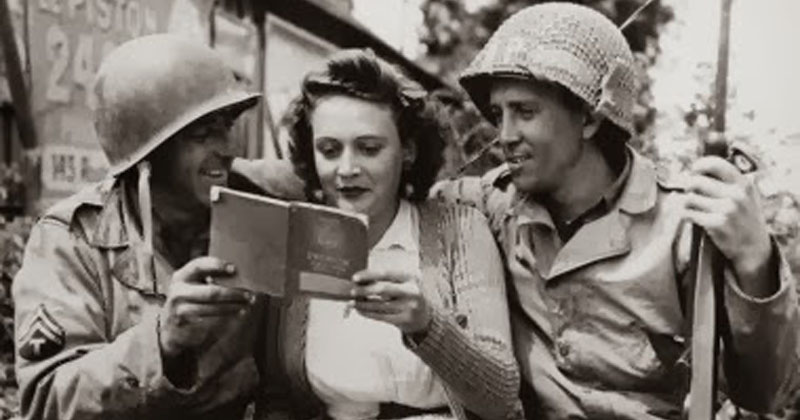
The Boys’ Crusade is essentially a tribute to the young men with whom Fussell served. He stresses their youth; reminding us that the bulk of the infantry were boys who were seventeen, eighteen, and nineteen years old. You could enlist at seventeen with your parents’ permission. Most waited to be drafted at eighteen. Of the millions of Americans sent overseas during the Second World War, only 14% were infantry-men. And they accounted for 70% of the casualties. For nearly all of them it was their first time overseas. In the UK the cars were tiny, the food was bland, and the beer was lukewarm; the bathroom facilities were archaic. And it rained all the time. The only compensation was the reception they had from British women. Who found that the GIs had better hygiene, better uniforms, and were substantially better paid than their British equivalents. Hence the joke: ‘Have you heard about the new utility knickers, One Yank and they’re off’.’ The American army calculated on 22.5 sheets of toilet paper per man per day. The British estimate was 3 sheets. British troops complained that the Americans “were over-paid, over-sexed, and over here”. The Americans retorted that the British were “under-paid, under-sexed, and under Eisenhower”.
Over-paid, over-sexed, and over here
Fussell notes that the American policy of strict racial segregation was another source of friction with the British. Who found the policy unlawful and distasteful. Race riots broke out in several cities. Including Bristol, where the black soldiers were convinced that they had been allocated the less desirable public houses. A major fight broke out there involving some four hundred black and white GIs, and more than a hundred MPs with truncheons were needed to break it up.
Many British civilians found the blacks GIs more polite and more decent than the whites. George Orwell commented that “the only American soldiers with decent manners are the Negroes”. One wit remarked: “I don’t mind the Yanks, but I don’t care for those white chaps they’ve brought with them”.
As a boy the young John Keegan, subsequently a distinguished military historian, was enraptured by the sight of the American GIs. By their habitual sloppiness; the way they chewed gum, leaned against buildings, and drove their jeeps with one leg outside, ostentatiously steering with one hand.
For the vast majority of American solders, France was a very foreign country. [General George Patton was an unusual commander in that he knew France well and spoke the language.] A pamphlet advised the GIs not to refer to the French defeat of 1940. In fact they had neither the knowledge nor the language to have done this. Most could manage only a few cliches about food and about sex. Fussell writes of a GI on a truck heading for Paris shouting joyously: “we’re all going to get laid, French style”. In truth the Americans resented having to equip an almost non-existent French army with Sherman tanks and American uniforms. Many GIs resented the fact that for the second time in half a century they had come to pull the French chestnuts out of the fire. And the French for their part resented the huge black market in Paris run by some two thousand American deserters.
D Day and beyond
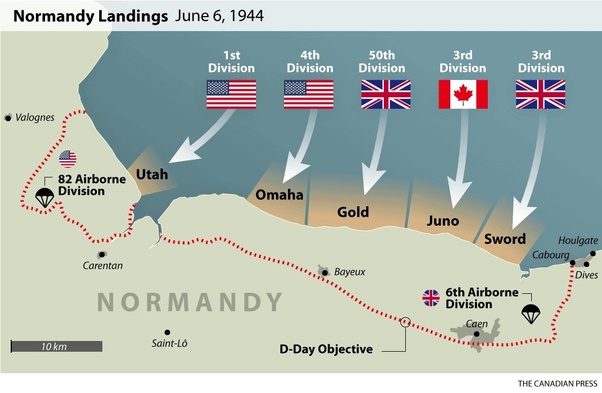
The Normandy Landings
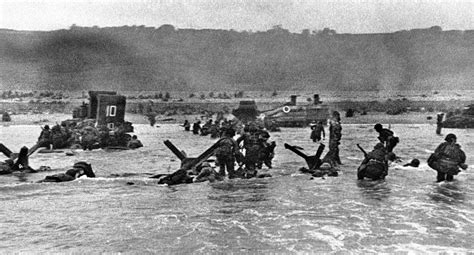
Much of Fussell’s book is given to episodic snapshots of the subsequent advance of the American GIs. The horrors of the landing on Omaha beach, hampered by sea-sickness of the troops in their landing craft off-shore, inadequate naval bombardment prior to the assault, imperfect navigation, and heavier than anticipated German fire, both automatic weapons and artillery, are disturbingly depicted here, as in the opening sequences of Saving Private Ryan. Breaking out from the landing beachheads took most of a month. After which the inexperienced GIs were fighting in the Normandy bocage, small agricultural fields delineated by thick hedgerows, too often concealing German soldiers with rifles and machine guns, grenades, mortars, artillery, and Tiger tanks. When General Omar Bradley called in airstrikes, of fighter-bombers and heavy B-17s, to open the way for a ground advance, Operation COBRA, the planes got the message wrong; and 111 US infantry soldiers were killed and a further 500 were wounded. Many of the boys mangled or killed by the bombing were green replacements, only recently arrived from their training camps.
Omaha Beach
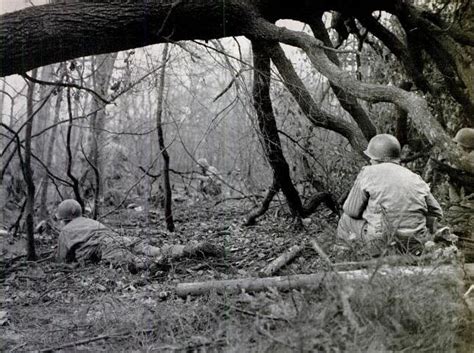
After Omaha beach the episode most feared by the American infantry was the battle of the Hürtgen Forest. A story that was completely new to me. Fighting went on through the month of November 1944 in an area of some fifty square miles, an area of dark woods, deep gorges, and stone walls, not far from Aachen. Of the 120,000 American troops who fought there, some 33,000 were killed or wounded. For those who fought there the name ranks with Passchendaele or Verdun from the previous war. Russell Weighley wrote about “a witches’ caricature of a forest”; while John Ellis spoke of “attacking a particularly intractable maze … inhabited by a malevolent breed of troll”.
Hürtgen Forest
Fussell writes admiringly of the work of the medical orderlies, the American aidmen, unarmed and protected on the battlefield only by a red cross on their left arm. Aidmen soon learned to sport a similar cross on their right arm. Albert Cowdrey, a historian of army medicine, wrote: “The damage that weapons could inflict on the human body was varied and spectacular. Veterans remembered – and sometimes dreamed of, years after the war – bodies literally torn to pieces, of intestines hung on trees like Christmas festoons”.
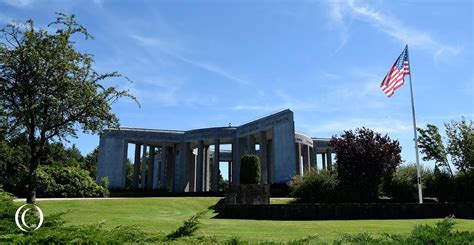
In autumn 1944 with Germany staring defeat in the face, Hitler made a momentous decision; the Germans would launch a major offensive from the Ardennes, aimed at Antwerp. The objective was to split the British and American forces. In the hope of destroying the coalition and turning his attention to the Russian front. The brunt of the offensive was borne by the US Third and First Armies, under General Patton and General Hodges. And by the men of the 101st Airborne Division under Brigadier Anthony ‘Nuts’ McAuliffe., who were besieged in Bastogne. The Battle of the Bulge, as it became known, was the largest and bloodiest battle fought by American troops in the Second World War. Of the 600,000 American troops involved in the fighting, some 90,000 were casualties, with over 10,000 killed or missing. Many of them are buried in the cemeteries at Bastogne, which also houses the Mardasson Memorial, erected in 1950 to honour the memory of Americans killed or wounded n the battle.
Mardesson Monument, Bastogne
Fussell himself was profoundly affected by his army experiences. His book is dedicated “to those on both sides who suffered”. It concludes with a quotation from Martha Gellhorn, the American reporter, who was at Dachau on the day the war ended: “Surely this war was made to abolish Dachau and all the other places like Dachau and everything that Dachau stands for … We are not entirely guiltless because it took us twelve years to open the gates of Dachau. We were blind and unbelieving and slow, and that we never can be again”.
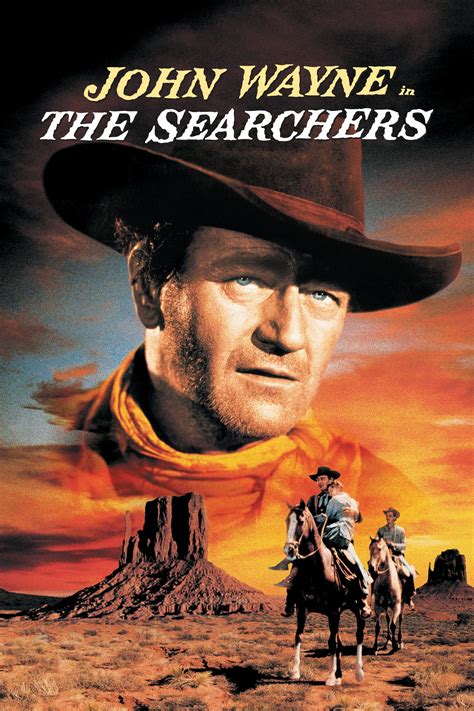
I watched The Searchers on the tv last weekend. Or to be more precise, I watched it on DVD having missed the daytime television showing. It is now generally recognised as one of the Best Westerns, if not the best American films ever made. Number 10 in a list of the 100 Best Films ever according to the Cahiers du Cinéma in 2008. Although it was a commercial success when it came out in 1956, I don’t remember it gaining such recognition. But I was only 12 at the time !
The Searchers
I think I first saw the film at school, at CH, one Saturday evening in the late 1950s. Films were shown in Big School, a big barn of a building otherwise used for concerts, school plays, Speech Day etc. There was no heating as I recall. And we were encouraged to take blankets with us. There were four film nights in the autumn and spring terms; but no films in the summer. Probably because there was no way of blacking out the light. I don’t know who chose the films. Or what the criteria were. There certainly wasn’t any Brigitte Bardot stuff. I remember seeng a 1949 Marx Brothers film called Love Happy. [Wikipedia tells me that there was a walk-on part by the unknown Marilyn Monroe. Which I don’t recall.] And a rather unfunny 1959 Boulting Brothers film called Carleton-Browne of the FO, starring Ian Carmichael. And I think we saw Audrey Hepburn in Breakfast at Tiffanys. And a 1954 film called Knock on Wood, memorable only because Danny Kaye played a ventriloquist with a dummy called Clarence. Which happened to be the name of the Headmaster – Clarence Milton Edwards Seaman. Known to his family and friends, but not to us, as George.
For those who don’t know The Searchers is a an epic technicolour Western directed by the great John Ford. Based on a book of the same name by Alan Le May. The setting is western Texas in the 1860s. The film opens with the return of Ethan Edwards, returning after eight years away fighting with the Confederates in the Civil War and in the Mexican Wars. He returns to the isolated homestead of his brother, Aaron, and his sister-in-law, Martha, and their three children. Soon afterwards Ethan is recruited by the Revd Samuel Clayton, part-time preacher, and Captain in the Texas Rangers, to go in pursuit of an Comanche raiding party. In their absence the Comanches raid the homestead. The adults and their son Ben are killed and scalped, the buildings are burnt down, and the two girls, Debbie and Lucy, aged 8 and 12, are abducted.
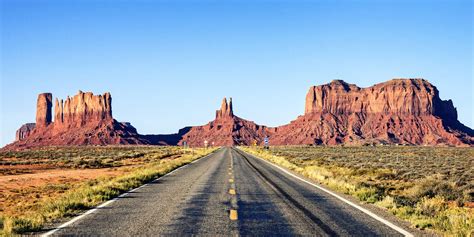
Monument Valley, Utah
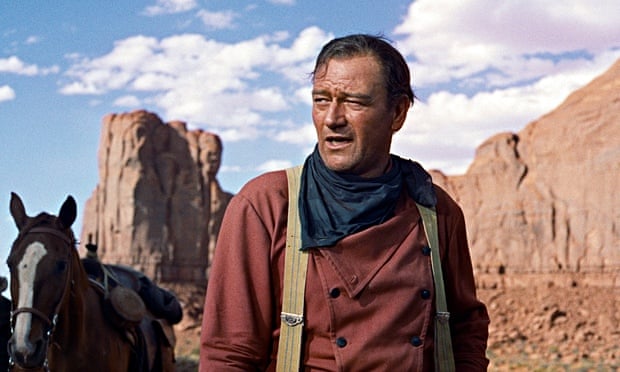
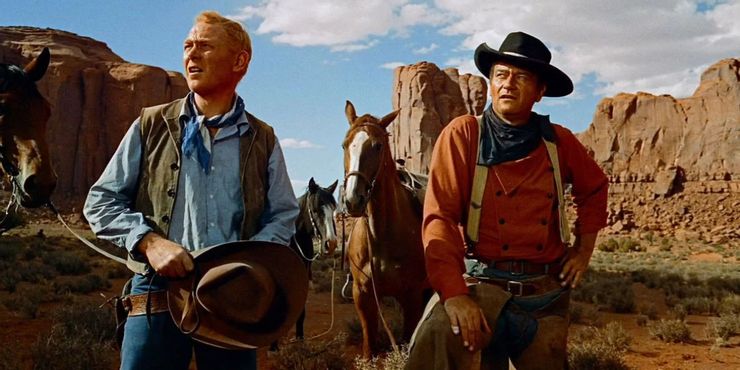
For the greater part of the film Ethan Edwards, played by John Wayne, goes in search of the girls, assisted only by Martin Pawley, their part-Indian adopted brother. Ethan Edwards is laconic, a loner, a misfit, good with a gun. Marty is younger, and vulnerable. As the years go by the search becomes a desperate obsession. They find the body of the older girl, Lucy, brutally murdered and presumably raped, but her younger sister is reported as being still alive living among the Indians.
John Wayne as Ethan Edwards
After five years they trace Debbie, now an adolescent, to New Mexico, where she is living as a Comanche, as one of the wives of a chief called Scar. There is now a powerful tension between Ethan and Marty. Ethan believes that Lucy has been defiled, contaminated, by her living as an Indian squaw. He would rather see her dead than living as an Indian, and his plan is to kill her. But Marty wants only to rescue her and to take her home. The two men come to blows. Marty shields Lucy with his body, Ethan is wounded by an Indian arrow, and the Comanches make their escape.
The Searchers
Meanwhile back at home, at the Jorgensen ranch, Laurie Jorgensen, Marty’s long-standing and long-suffering girl-friend starts to lose hope. Finally a letter arrives telling how Marty has [inadvertently] bought and married a young Indian squaw. Which pushes Laurie into the arms of Charlie McCorry.
After years away Ethan and Marty return in the midst of Laurie’s and Charlie’s wedding celebrations. Marty and Laurie are reunited. At which point Ethan’s half-crazy friend, Mose Harper, reports that Scar and his band of Comanches have been located. Captain Clayton leads his men on a direct attack on the Comanche camp. Martin is allowed to sneak in ahead of the assault to find Debbie. Martin kills Scar, and Ethan scalps him.
The ending is powerful. Lucy is brought home to the homestead of the Jorgensens, the Swedish-American couple. Marty and Laurie are finally together again. But as the door of the homestead closes, Ethan is left on the outside. A man on his own. With a gun. But with an uncertain future.
The Searchers
Not everyone liked the film. Some critics thought that the romantic sub-plot, Laurie and Marty and Charlie, and the almost comic accent of the Jorgensens, detracted from the main story line. More importantly, there is something profoundly unattractive about the racism of Ethan; for whom native Americans are simply an inferior species. He is seemingly less interested in rescuing Debbie than he is in wreaking vengeance on the Comanches for the slaughter of his brother’s family. [One of the unclear sub-themes is the relationship between Ethan and his sister-in-law, Martha. Could it be, as some have suggested, that Debbie is not his niece but his own daughter ?]
And miscegenation is another theme that runs through the film. Near the beginning Martin gets a very disapproving look from Ethan when he admits that he is one-eighth Cherokee. Even the gentle Laurie tells Martin: “Ethan will put a bullet in her brain.I tell you Martha would want him to”.
When I was a bit younger John Wayne was extremely unfashionable. We thought he was a simple, right-wing, gun-toting Republican. Good only for playing cowboys and Green Berets. But this is one of his great roles. “Wayne is plainly Ahab“, wrote one critic. “He is the good American hero driving himself past all known limits and into madness, his commitment to honour and decency burned down to a core of vengeance.” And the character, and his performance, undoubtedly influenced a later generation of American cinematic loners.
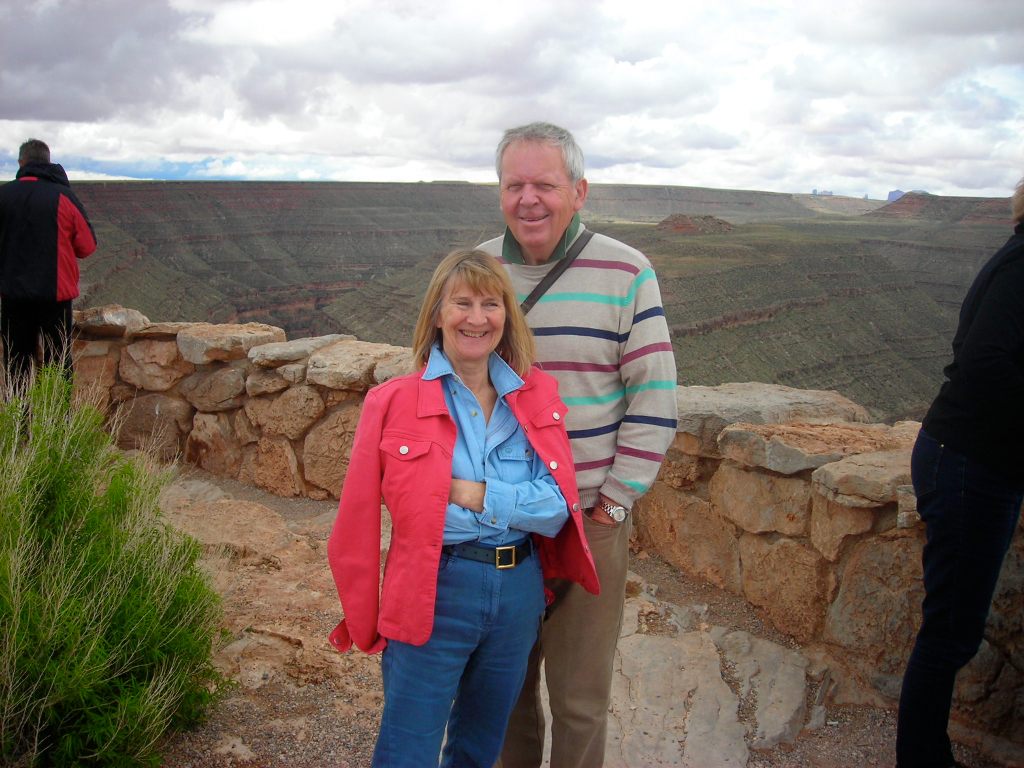
Gooseneck Canyon, Utah, 2016
The other great star of the film is Monument Valley, on the edge of Utah and Arizona. Which I was thrilled to see on our one-and-only trip across the States in 2016. When we had lunch an a Navajo restaurant. And the opportunity to see the trailer in which John Wayne slept during the making of his movie. [Unfortunately I can’t at the moment find the photos; so instead here is a photo of the nearby Gooseneck Canyon, Utah.] I was so impressed by the film that I nearly bought a biography of Wayne in an excellent bookshop in Denver. But then I thought – there are limits.
February 2022
PS
For those who like to know these things, it was after the film was shown in Lubbock, Texas, that John Wayne’s repeated line ‘That’ll be the day’ became the inspiration for the Buddy Holly track That’ll be the day that I die.
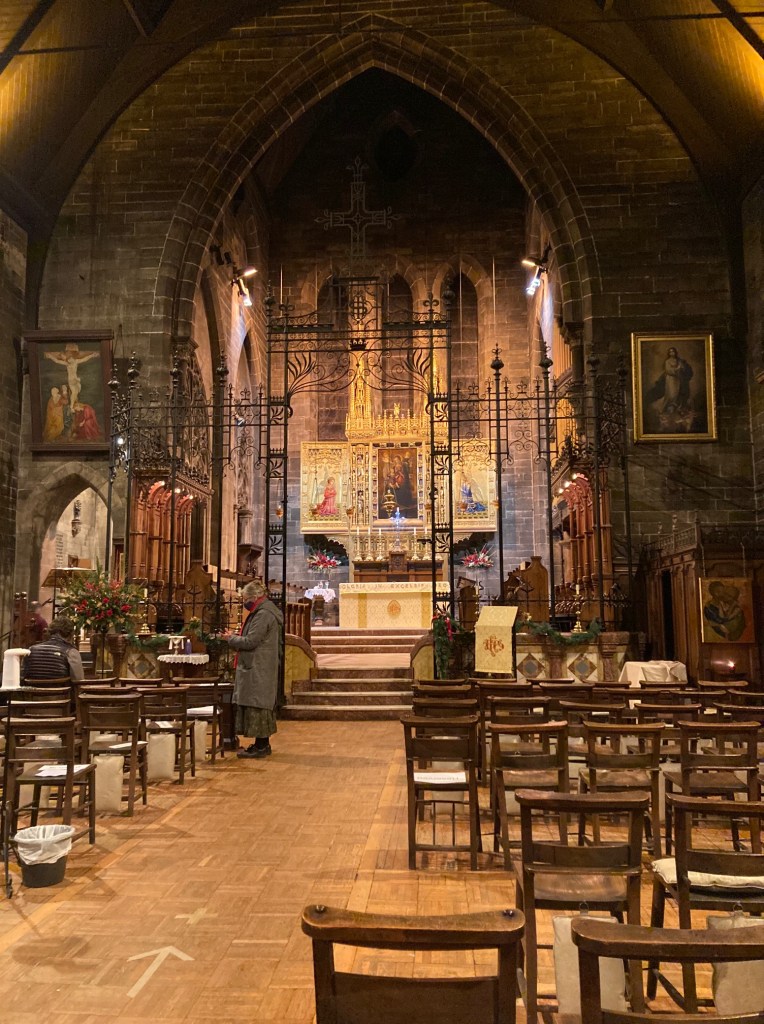
Old St Paul’s is a church that is much admired by those who love it, and by perhaps by many who don’t. It is at the other end of some kind of church spectrum from St Thomas’s, Glasgow Road, where I was once the curate. Although both began as breakaway groups. St Thomas’s began as a 19th century reaction against the prevalent Anglo-Catholicism of the then Scottish Episcopal Church; the Revd T.D.K. Drummond was apparently not allowed to hold a midweek Bible study if there was no celebration of the Eucharist ! By contrast Old St Paul’s began life a few centuries earlier, in 1689 when, as the Church of Scotland chose to abolish the rule of bishops, [Bishop] Alexander Rose led his people out of St Giles’ Cathedral in order to set up a new place of worship in an old wool shop, in Carrubber’s Close, not far away off the High Street.
Old St Paul’s is the oldest congregation in the Scottish Episcopal Church. When the Church of Scotland supported the Hanoverian kings, the new Protestant monarchy, many Scottish Episcopalians remained Jacobites, loyal to the Stuart pretenders. Members of the St Paul’s congregation came out in the uprisings of 1715 and 1745. After which the Piskies were treated with suspicion and laws were passed to restrict their form of worship.
Old St Paul’s
When the original buildings became too dilapidated to use the current church was built nearby in Jeffrey Street, and the church was renamed Old St Paul’s in order to distinguish it from another St Paul’s church in York Place. [Now known as St Paul’s and St George’s. A very different kind of church.] The church is perhaps best known for its faithful ministry to the slum dwellers of the eastern end of Edinburgh’s Old Town, for many years under the ministry of Canon Laurie who was Rector of OSP from 1898 until his death in 1937. Both Canon Laurie and his predecessor, Reginald Mitchell-Innes, stood firmly in the tradition of the Oxford Movement, and oversaw a shift towards a distinctly Anglo-Catholic form of worship. Subsequent rectors include Richard Holloway, who was Rector there from 1968 to 1980, and Ian Paton, now Bishop of St Andrew’s, who was there from 1997 to 2018. The ministry to the poor and destitute continues through the work of the soup kitchens, but the gathered congregation is now predominantly posh, with people drawn to the weekly celebrations of High Mass by the quality of the music and the richness of the liturgy.
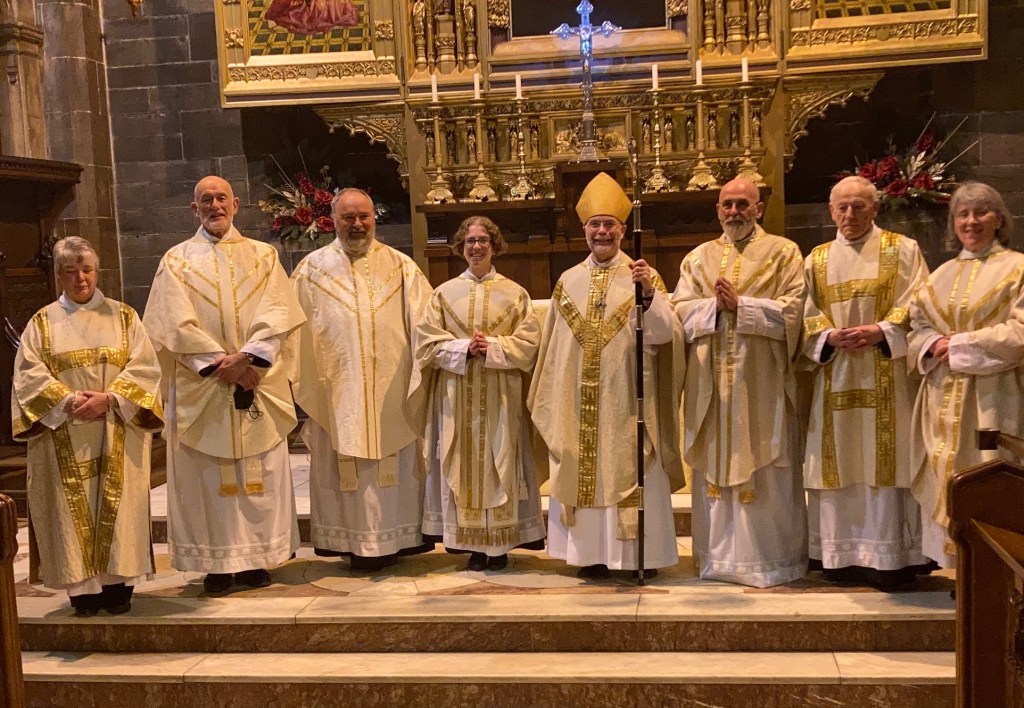
I was there on Tuesday evening, for the first time in some thirty years. [On my previous visit, as a relatively new curate, I fell out with the man sitting next to me, who turned out to be [Bishop] Alastair Haggart, onetime Bishop of Edinburgh and Primus of the Scottish Episcopal Church.] On this occasion I was there for the priesting of Jaime Wright, the current curate at OSP. I met Jaime and her husband Eric a few years back, when they were both young American students doing doctorates at New College, Edinburgh, and both were exploring a call to ordained ministry in the Scottish Episcopal Church. As I recall, they both came from very protestant, non-denominational churches, in Indiana and New York respectively, so they were clearly on some kind of ecclesiastical journey. They came to lunch here in 2018 and we hadn’t seen them since then.
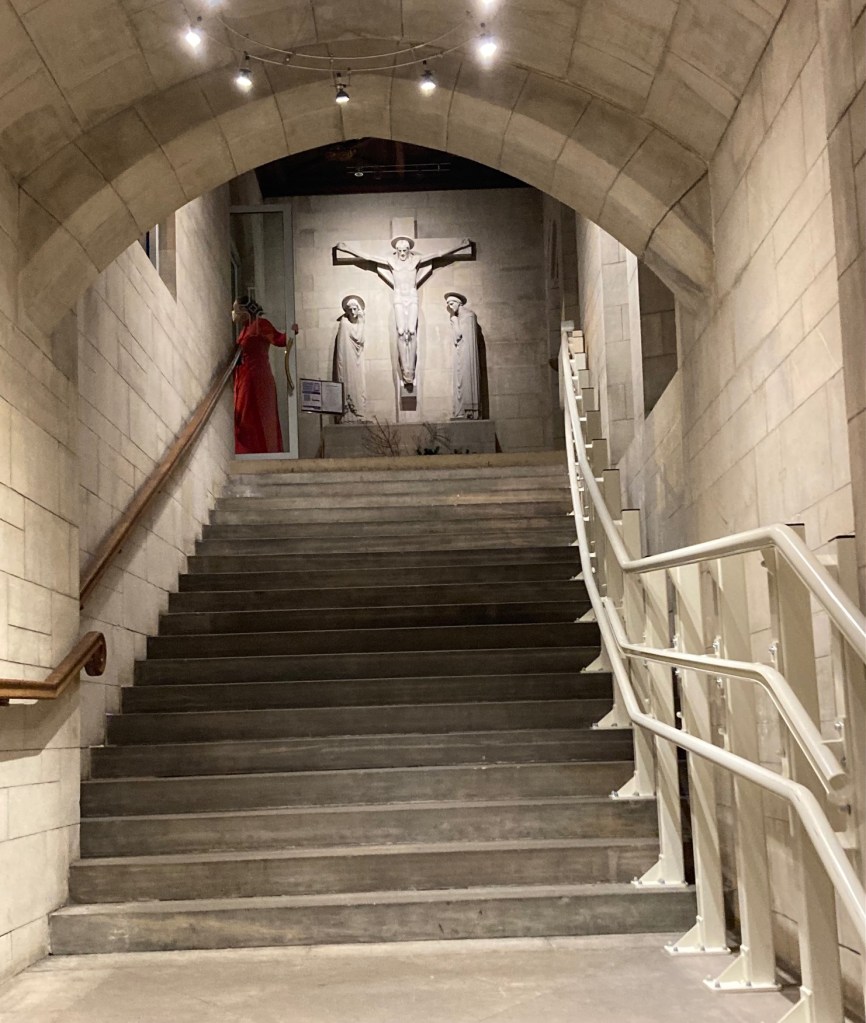
Calvary Stair
Entrance to the church from Jeffrey Street is up a long flight of steps, the chisel-dressed and stone-vaulted Calvary Stair. There are thirty-three steps, one for each year of Christ’s life. They lead to a sculpture of the Crucifixion, Christ on the Cross flanked by his mother and by St John. The stairs are meant to symbolise both Christ’ s journey from life to death and also the ascent to Calvary.
It was a cold evening in Edinburgh. The congregation, not enormous, were predominantly in tweed jackets and puffer coats. The front pews were reserved for robed clergy, who processed in and out. I had been invited to robe, but I don’t really do that sort of thing; I don’t think we should promote clericalism ! It was quite a long and wordy service, using what I thought was the 1928 liturgy. Hymns were from the New English Hymnal. It had lots of things of which I really don’t approve: seven lighted candles on the altar, chasubles, clouds of incense, a gospel procession, and Bishop John Armes con-celebrating with a cluster of priests. But there was an excellent sermon/homily by John McLuckie, the present Rector, on the Conversion of St Paul and the apostolic ministry in which we share. And, to my surprise, I thought the whole thing was rather splendid.
Priesting of Jaime Wright, January 2022
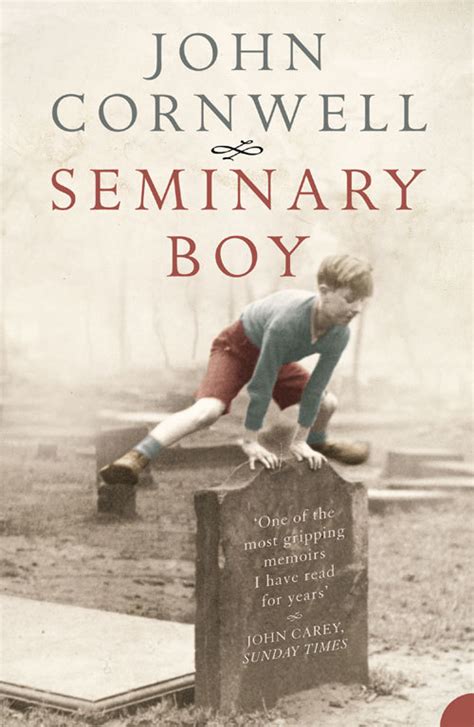
John Cornwell: Seminary Boy
Since we returned from Kiev we have been dealing with an accumulated backlog of Christmas post and re-adapting to life in Edinburgh. I now have a small pile of books to read on Ukraine and on eastern Europe, most of them by Anne Applebaum, the Jewish-American academic and writer, whose grandfather came from what was then Poland and is now Belarus.
John Cornwell: Seminary Boy
Before I get started I have been turning the pages of Seminary Boy by John Cornwell. It is a beautifully written book. Cornwell [b. 1940] grew up, during the Second World War, in a tough, working class Irish family. His father had a gammy leg and worked as a groundsman; his mother, with an explosive temper, did a variety of jobs including working nights in a hospital. Cornwell escaped his home background by serving at the altar of a local Roman Catholic church, and was ‘privileged’ to be sent aged thirteen to Cotton College, a junior seminary somewhere deep in the Staffordshire countryside. At the seminary he started on Latin [he was known as Fru, short for frumentum bene, corn well in Latin] and on New Testament Greek; and sang in the choir; and was, in due course, introduced to a whole range of English literature and classical music. But the dominant emotions are guilt and fear. The ‘Profs’ are [nearly] all muscular Christians, emotionally stunted, male priests, all heavy smokers, who go off on their motor bikes on their days off to visit their elderly mothers. The recurrent themes are learning by rote and digging drainage ditches in the clay soil and long runs through the countryside. Above all ‘special friendships’ are forbidden. With both fellow students and with staff.
Cornwell survives. Just. In spite of complicated emotional relationships with one or two of his fellow students. And an indecent approach by an abusive Prof. But his vocation does not survive the transition to a senior seminary. And he takes leave of the church for many years. And becomes a journalist and a writer. In a sad coda he re-encounters two of the former Profs decades later, both now working in the Oxford Diocese, including one who might have been an important father figure. But it didn’t work out.
Cotton College, Staffordshire
The book reminds me how much I dislike some aspects of the Roman Catholic faith. The reluctant church-going based on fear. The joylessness of church life. The clericalism. The importance of hierarchy. But at the same time I feel for the loneliness of many Roman Catholic parish clergy. Including those priests in the Lyon diocese who periodically came to ask me if they could be received into the Church of England – along with their woman friends ! Requests to which the Archdeacon was invariably unsympathetic.
So, now I must get down to my Ukraine reading. But I thoroughly recommend Seminary Boy to anyone reading this who hasn’t read it.
The outward journey was frankly a disaster. Lviv is about six hours west of Kiev by train, not far from the Polish border and the Carpathian mountains. We had been encouraged by The [omniscient] Man in Seat Sixty One to picture a modern, high-speed train, and we envisaged travelling in comfort with our first class tickets, and the provision of an on-board restaurant car and individual wi-fi connections. When the train arrived, it was all 1950s, wagons-lit, rolling stock, with four passengers seated in a six-seat compartment; no wi-fi connection, no reading light, no leg space, and uncomfortable seats. Our two companions were bulky Ukrainian women who hung their coats on the hook that infringed on Susie’s seating space. The refreshment car turned out to be a friendly railway man who dispensed hot water in cardboard cups from the end of the carriage, and sold a selection of Bounty and Twix bars. It was a very long six hours !
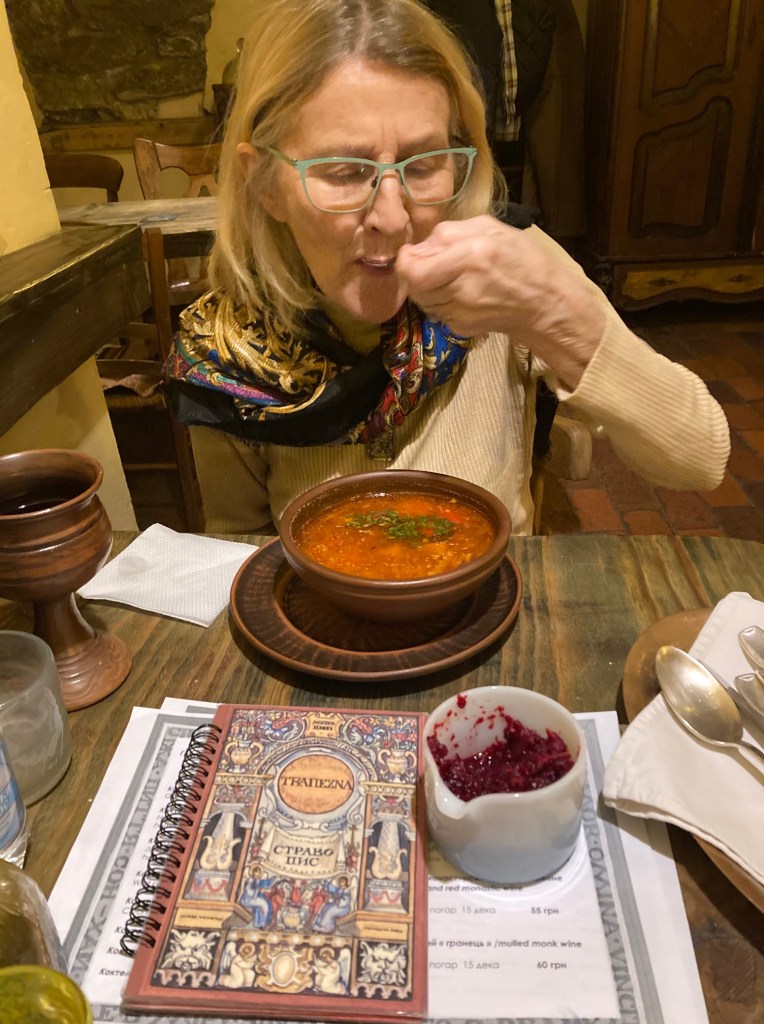
Dinner at the Trapezna Idey
After which Lviv was wonderful …
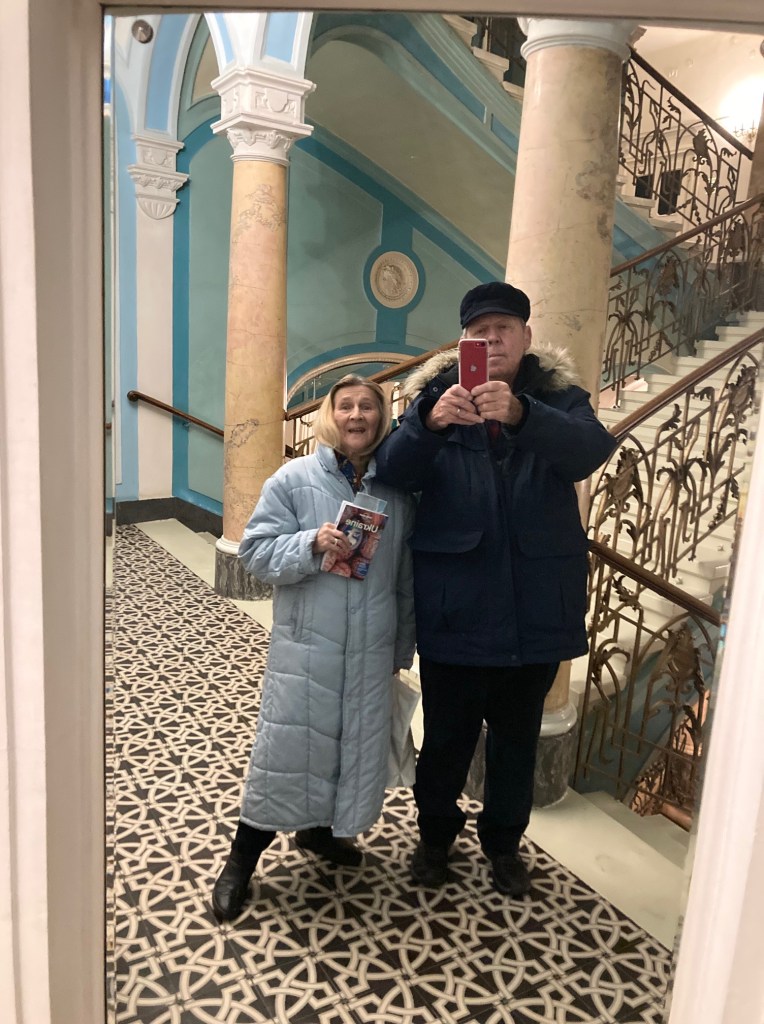
We were staying in the George Hotel, again on the recommendation of The Man in Seat Sixty One. It is a splendid, spacious, turn-of-the century building that, thankfully, has not been crudely and insensitively renovated. .In fact it hasn’t been renovated at all. Our spacious room had solid wooden furniture, desk and wardrobe; the light fittings and door handles were brass. The mirrored double staircase is magnificent. So too is the dining room, all bent-wood chairs and sensitive lighting, and a gallery clearly intended for a small orchestra. Breakfast is laid out on a series of tables across one end of the room: hot items in lidded warming dishes, breads, ham. cheese, yoghurts, jam and honey.
The George Hotel
Sadly the details are not quite right. The [very small] lift smelled as if it were inhabited by a large, wet dog. The water pressure in the shower is a bit low. The television set that offered us BBC World News had more dandruff that blustering Boris. The breakfast omelette and the breakfast sausages were both lukewarm and tasteless. And I couldn’t face the fried liver. But I will certainly make an effort to return to the George if and when we return to Lviv.
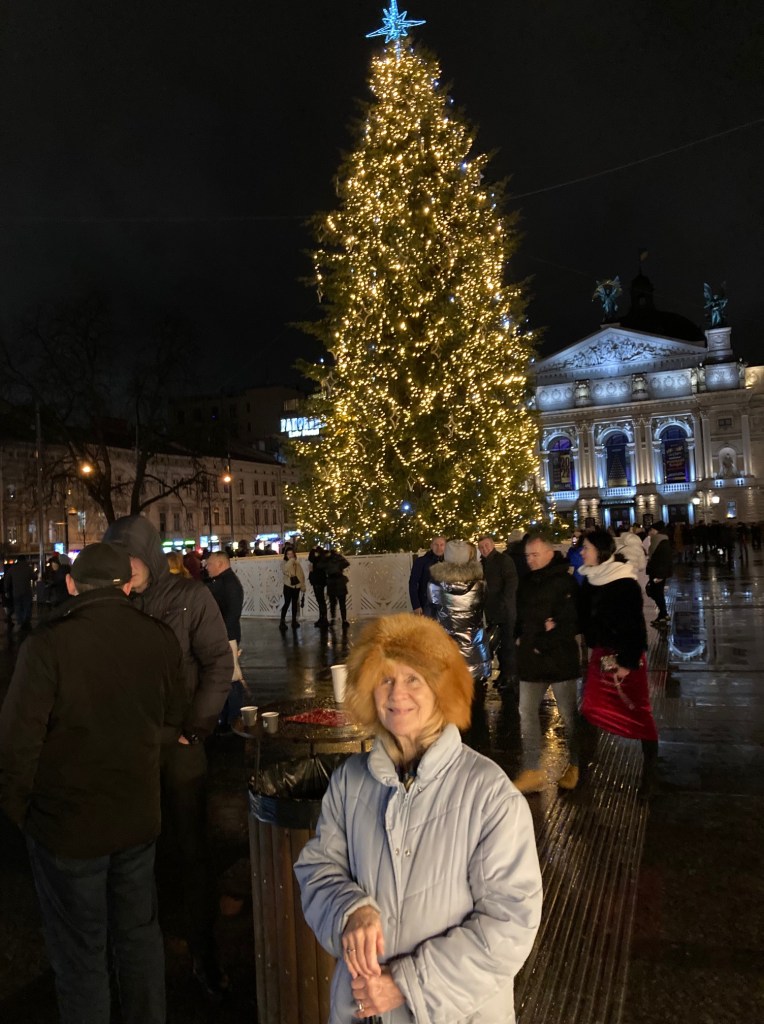
From the entrance to the hotel you come out at the bottom end of the Prospekt Svobody . This is a hub of local life, with tourists posing for photos by the prominent statues of Adam Mickiewicz, Poland’s national poet, and of Taras Shevchenko, Ukraine’s best-known nationalist writer, this latter a gift from the Ukrainian diaspora in Argentina. At the far end of Svobody is the ornate Theatre of Opera and Ballet. Along the central strip of park there were dozens of Christmas stalls selling a variety of [mainly] food and drink; kebabs, hot dogs, different kids of sausage, nuts, inevitably chips [very good]; coffee, hot chocolate, mulled wine, and some excellent rum-based warm punch. After six hours in the train we felt much better for a rum punch and a hot chocolate.
Lviv Christmas market
Our guide the next morning was Lada, whom we had met at church in Kyiv. And who is delightful. Lada teaches in Lviv: she is part-English, part-Russian, – but also happens to speak German, Lithuanian, Ukrainian, and some Polish ! She may also be the only person I know who became a Christian as the result of reading St Augustine’s Confessions. We climbed a small hill to admire the view from the citadel, now converted into what looks a comfortable hotel. Then descended for coffee and a tour of the old town. Lviv is all cobbled streets and old churches; and cafes and the smell of coffee roasting, and a host of chocolate shops. It has a totally different feel from Kiev, and feels more like a small city in Austria or Slovenia. Historically Lviv was the capital of Galicia, very much part of the Austro-Hungarian Empire. It only came under Soviet control in 1945 and is relatively unaffected by fifty years of Soviet rule. It draws thousands of tourists, with good reason, many of them gathering in Pl Rynok, around the 19th century Ratusha, or Town Hall. From which noon is marked each day by a bugle call from one of the upper windows.
Susie between two Ladas
Lviv is well-supplied with a host of coffee bars, cafes, and restaurants. In tourist mode we visited Lvivska Maysternya Pryanykiv, an award-winning gingerbread shop. Small children were attending a gingerbread decoration workshop in the cafe. Not the best place for a Type 2 diabetic. From there we moved on to Lvivska Maysternya Shokoladu, a chocoholic’s dream; an extraordinary variety of chocolate spread over three or four floors. Crowds of people, narrow stairs, and n chance of social distancing. We made modest purchases and beat a hasty retreat.
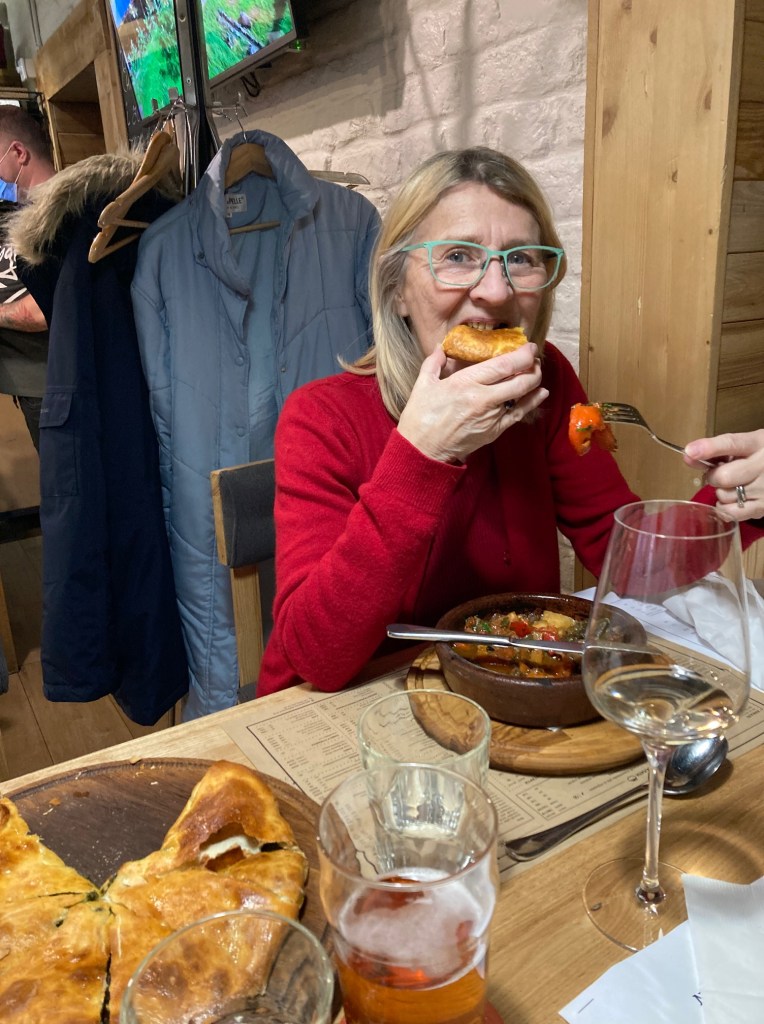
There are lots of restaurants in Lviv. We had lunch one day at Green, a well-regarded vegan restaurant. My beetroot and pear and avocado salad with sun-dried tomatoes was excellent, accompanied by fresh pressed grapefruit juice and a very eco-friendly drinking straw. Beetroot featured again the next day when we ate an early dinner at the Trapezna Idey. a quirky basement restaurant below a small art gallery in what was formerly a Bernadine monastery. Susie and I shared a beetroot and horse-radish starter. The food was excellent. I had borsch, all beetroot and garlic and herbs and cream, white Susie had goulash, which was equally good. Followed by poached pear and home-made ice-cream. As well as the food and drink, the neighbouring table gave added value. It was a three generation family group: an alpha male dressed in what looked like a baking foil shirt and an ear-ring; his wife in minute, back and white, dog-tooth hot-pants; two solid, respectable grand-mothers; and the daughter, dressed either as a Christmas angel or for her first Communion.
Monastic borsch
Now it is time to go back to Kiev for our final Sunday. And to prepare, paperwork, Passenger Locator Forms [the stuff of nightmares – the gov.uk website is not fit for purpose] , and pre-departure PCR tests permitting, to return to Edinburgh.
Christmas itself was predictably quiet. The Carol Service on Christmas Eve went as well as could be expected, on a very cold night with a small handful of people. On Christmas Day morning we went to mass at St Alexander’s Roman Catholic cathedral. There were maybe 200 people, and excellent music with a small choir ad musicians in the gallery. Lunch was at a Georgian basement restaurant.
Christmas Day lunch
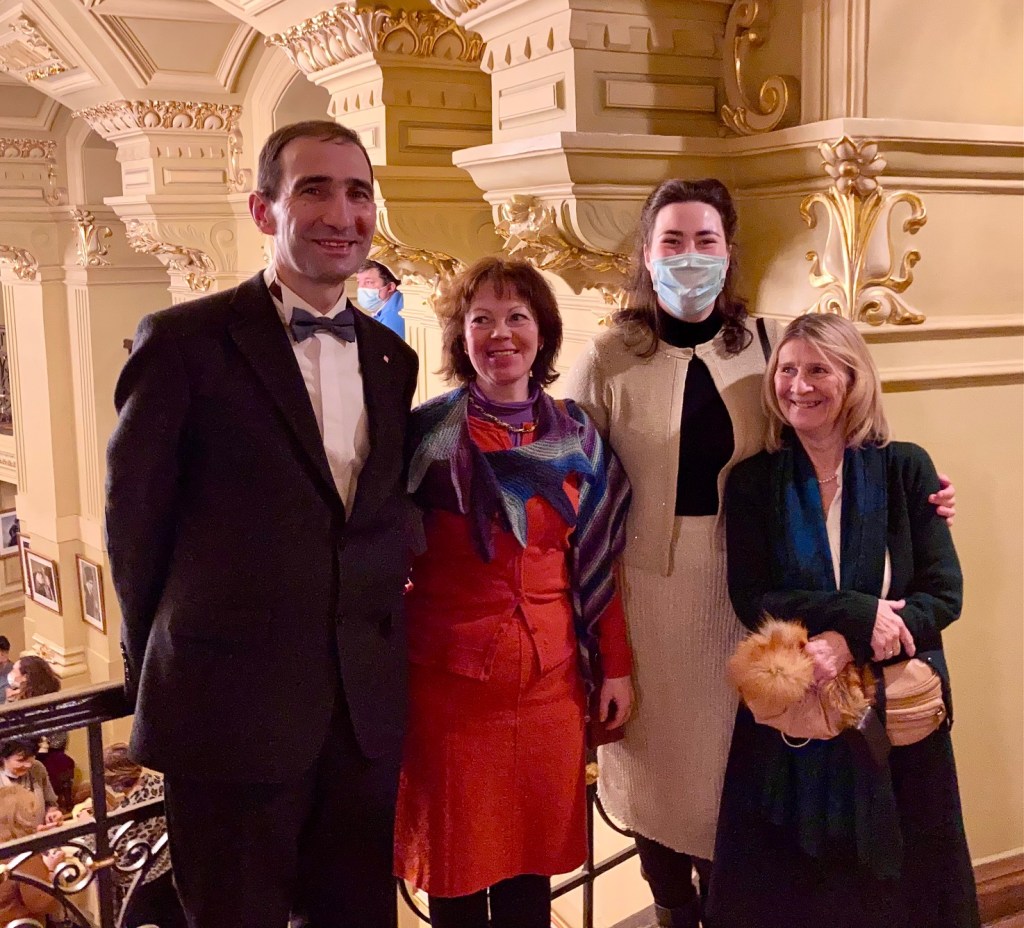
On Boxing Day our service included the baptism of Arthur, a rather active three-year-old. His father is in the Embassy here; a soldier and a Russian specialist. He and his family were previously in Belarus and in Georgia, and they will move on from here to Albania. Arthur got a bit nervous as we approached the key moment when, as his mother explained the next day, he was nervous that it might be another vaccination. In the evening we went to the Opera with Christina and Vlad, and their daughter Margarita. It was a splendid occasion: a melange of music, light operatic pieces, and ballet performed by favourite local performers in an ornate nineteenth century opera house. With crowds of people.
At the Opera: Vlad, Christina, Margarita, and Susie
I am puzzled about cars here. This is said to be a poor country. But I haven’t yet seen a single old car. On the contrary there are a lot of Range Rovers and Discoveries and top-end, big Mercedes. As a general rule it is always the biggest car, usually with tinted windows, that jumps the lights at the numerous pedestrian crossings. Just as the pedestrian light turns green a big black car always barges through. And, on our rare taxi journeys, it is apparently compulsory to drive with one hand while using the other to access southing [the route ?] on a mobile phone
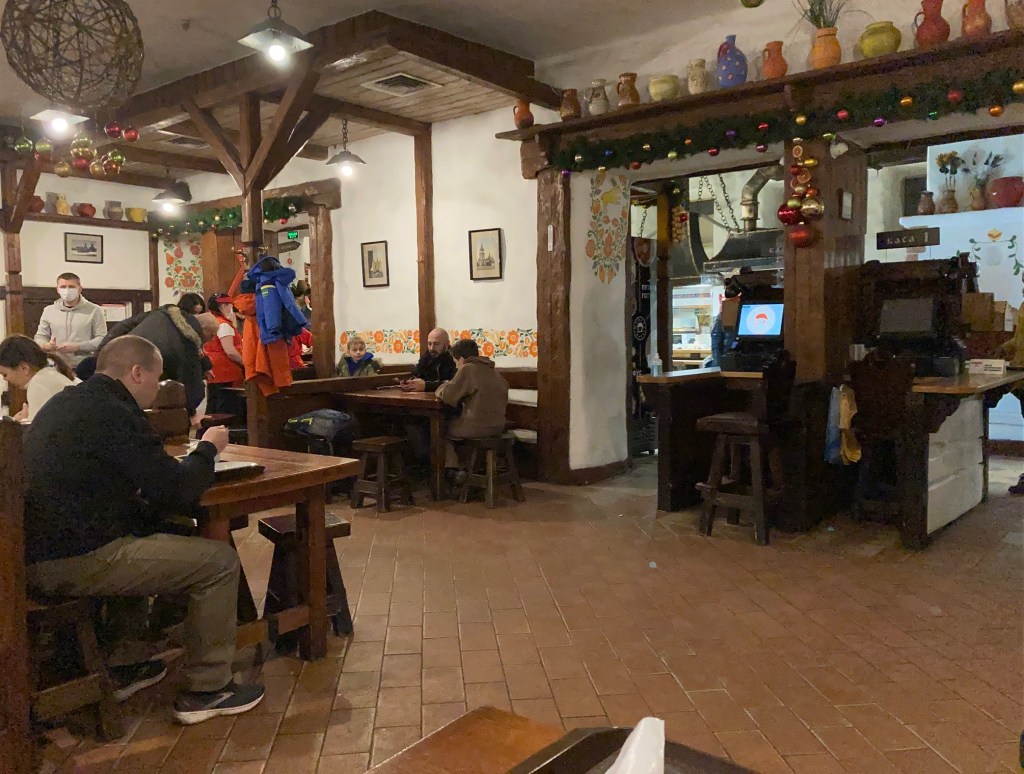
Christmas to New Year is generally a season for finding inventive ways of recycling the turkey [I am very fond of turkey and cranberry sandwiches on wholemeal bread] and finishing off anything left over from the Christmas pudding. Neither of those options have been available to us. Instead we have continued to patronise the several branches of Pusata Hata. The food is generally fine, through rarely hot. And there is plenty of choice. I assume that the budget prices are only made possible by the very high turnover of customers.
Puzata Hata
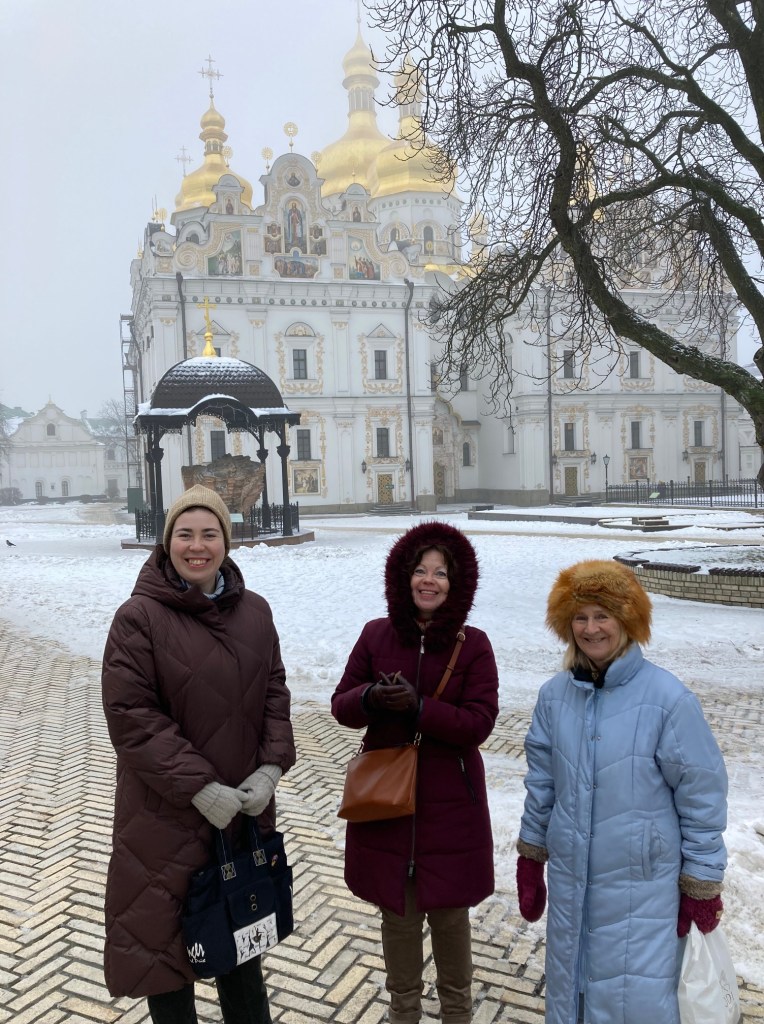
The best meal we have eaten in Kiev came on New Year’s Eve. It was a damp, dank, misty morning. [Think Oxford in November, or out on Otmoor.] And very cold. Susie and I went for a tour of the Lavra monastic churches with Christina and Margarita. A lavra is the senior monastery, and pecherska means dug out of the caves. The monastery was founded in 1051 by St Antony, shortly after Orthodoxy was adopted as the religion of the Kievan Rus. The monastery grew rapidly, and soon became the intellectual and artistic centre of the country, training scribes and painters of icons and builders. Most of the churches have been rebuilt and made into museums, under the authority of the Ukrainian Orthodox Church, the Moscow Patriarchy.
Margarita, Christina, and Susie at Lavra
After a visit to the Museum of Micro-Miniatures [the world’s smallest book, a flea with golden boots – all so small they can only be viewed through a microscope] Christina’s husband Vlad joined us for late lunch at la Coupole, a bijou restaurant within the Lavra complex. I had a large chicken breast stuffed with spinach, with a sauce made of apples and calvados; followed by a cherry pie with crème anglaise. Both excellent.
Now after a quiet few days we are heading to Lviv, in the west of Ukraine, towards the Carpathian Mountains and towards Poland. It is about six hours journey on a high-speed train, which seems to continue to Vienna. In Lviv we shall be staying in the George Hotel. I am excited about the prospect of going there …









 Through a glass darkly