The trivial round: 1
It has been freezing cold in Edinburgh in recent weeks. Our lives have been much enriched by a new walk-in shower and the purchase of an electric blanket. Which makes it easier to go to bed on cold nights. But harder to get up on cold mornings. I hobble around the park and along to Duddingston Loch leaning on a stick. And we had an excellent cross-town bus excursion down to Cramond village by the edge of the Forth.

And discovered a very good new cafe.

Black Mischief
I have been continuing my reading of Evelyn Waugh’s books, taking them in chronological order. Following the breakdown of his marriage to She-Evelyn, Waugh travelled widely, both in England and overseas, making a reputation for himself as a journalist and travel writer. In October 1930, although he had no knowledge or experience of Africa, he travelled to Abyssinia to cover for several newspapers the coronation of the Emperor Haile Selassie. After the coronation Waugh travelled on to Zanzibar, and then by stages across central Africa and the Congo before returning by ship from South Africa. His travels were recounted in Remote People [published in 1931], which highlighted the unpredictable nature of African life. His impressions oscillate between wild excitement and deep depression.
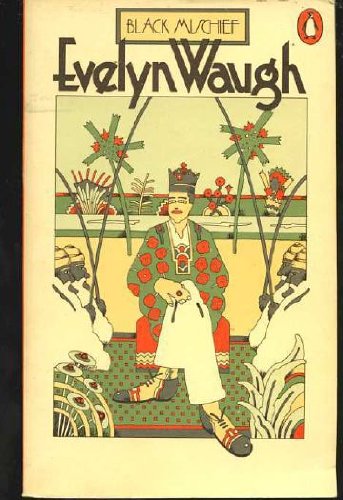
Black Mischief, published in 1932, also leans on the Abyssinian experience. The primitive cruelty, treachery, and cannibalism of Azania are confronted by the young Emperor Seth’s commitment to Modernity and the New Age. The British-educated Seth wants to put his Oxford degree to good use by dragging this primitive country into the twentieth century. And in this endeavour he is assisted by Basil Seal, an upper class chancer and contemporary at Oxford, and by the slippery Armenian trader Mr Krikor Youkoumian. Other characters include Sir Samson Courteney, the ineffectual Head of the British Delegation, and his romantically inclined daughter Prudence; General Connolly, a former Irish game warden, now Head of the Army; Connolly’s local wife, known as the ‘Black Bitch’; and Monsieur Balloon, the French freemason Consul.
Azania is not Abyssinia, but is based rather on Zanzibar. And Seth is certainly not a portrait of Ras Tafari, the new Emperor, who appears in Waugh’s travel writings as an exotic but enigmatic figure.. Where Haile Selassie was seen as a distinctly African figure, proud to be the only independent native monarch in Africa, Seth is wholly divorced from his African culture, a fervent believer in the concept of ‘Progress’. Waugh portrays Seth as a man with no discernible religious faith, who is confronted by a world of treachery and fear. The spy scuttling away from the door is a recurring image in Black Mischief.
The book was written in a stop-start manner, partly at the hotel at Chagford, partly at the Lygon family’s country seat at Madresfield, as Waugh juggled an increasing number of journalistic and reviewing commitments. It was published in October 1932 and attracted hugely varied reviews. Favourable reviews in the Spectator and the Telegraph and the Listener found the book original and well-written, with an increased seriousness, and tinged with Eliot’s Waste Land vision of western society, an unsentimental pessimism. But other reviewers were unconvinced, using word like vapid and fatuous. James Agate in the Express wrote: “‘this book is an extravaganza … I assume that Mr Waugh’s plan was to think of an island of cannibals to whose vile bodies he could add Lottie Crump’s clientele out of an earlier novel. The book will be deemed wildly funny by the intelligentsia, and there is always a chance it is too clever for me.”
I don’t recall what I made of this book reading it some sixty-plus years ago in Lamb A dayroom. But these decades later I find the book funny but slight. An insubstantial work, easily read and discarded. And I surprised too that Waugh has not been denounced for his casual [but period] use of the nigger word.
A Handful of Dust
In December !932 Waugh set out [by himself] for British Guiana, a then little-known outpost of the British Empire. He knew nothing about the country, and on the outward voyage suffered alternating panic attacks that the trip might be either suicidally dangerous or tediously uneventful. After a dull Christmas Day with the Governor, Lord Denham, Waugh travelled up-country with a middle aged, creole district commissioner. Much of the next three months travelling in Guiana and Surinam, and Brazil, were a profound disappointment; Waugh knew and cared nothing for the flora and fauna of the jungle as they made their way by dismal stages from one ‘rest-house’ to another.But the journey provided a memorable encounter for his next novel. In 1946 Waugh wrote that “A Handful of Dust began at the end. I had written a short story about a man trapped in the jungle reading Dickens aloud. The idea came quite naturally from the experience of visiting a lonely settler of that kind and reflecting how easily he could hold me prisoner …”. Shaken by a fall and suffering from exhaustion, he arrived at the ranch of Mr Christie, a five-star religious maniac, almost totally isolated in the jungle, and one of Waugh’s rich treasury of eccentrics.
A Handful of Dust, published in 1934, marks a transition between Waugh’s early comic novels and his later, more substantial fiction. Tony Last is an English country squire living with his wife Brenda and their eight-year-old son John Andrew at Hetton Abbey, their ancestral home. Tony is inordinately proud of the family home, and is oblivious to Brenda’s boredom and John Andrew’s waywardness. Tony is unaware when Brenda starts an affair with the dull and poor John Beaver, and when she spends time with him in a flat rented from his mother, a fashionable interior designer. Brenda’s friends fail to fix Tony up with a mistress; John Andrew is killed in a riding accident; and Beaver and Brenda’s brother lean on Tony to provide a divorce and a divorce settlement which would force him to sell the family home. At which point Tony finally shows some character. He refuses the financial settlement, and goes travelling for six months in remote parts of the Amazon basin. Abandoned by his incompetent guide Tony is rescued by Mr Todd, the eccentric owner of a remote ranch. He is held against his will by the illiterate Mr Todd, and forced endlessly to read the novels of Dickens to him. Mr Todd astutely diverts a European search party, fobbing them off with Tony’s wristwatch. Back in England, Beaver loses interest in Brenda when it is clear that no money will be forthcoming; Tony’s social circle assume that Tony is dead, and Brenda marries Jock, one of Tony’s friends.
The book incorporates several autobiographical elements. The story of Tony and Brenda’s marriage reflects the breakdown of Waugh’s own marriage, and Brenda’s casual affair with Beaver echoes She-Evelyn’s infidelity. Waugh had married in December 1928 Evelyn Gardner, the daughter of Lord and Lady Burghclere. Her parents were strongly opposed to the marriage, and thought that Waugh was a disreputable character with no money and disreputable friends. The two Evelyns married anyway, but within a few months She-Evelyn told Waugh that she had fallen in love with John Heygate, an Old Etonian and mutual friend, and that she wanted a divorce. [And that she had never loved him. And had only married him to get away from parental oppression.] An attempted reconciliation failed, and after lengthy ecclesiastical proceedings the marriage was annulled a few years later. Tony’s bewilderment in A Handful of Dust reflects Waugh’s own nagging regrets and sorrow about Evelyn Gardner’s behaviour.
Waugh had travelled extensively in South America in 1932-33, and several incidents from these travels appear in the novel. [And also in Waugh’s travel book Ninety Two Days.] Tony’s fate in the jungle was first used by Waugh in a short story of 1933 called The Man Who Liked Dickens. And, he later wrote, he wanted to explore how the prisoner had got here.
As Martin Stannard, author of a full and magisterial two-volume life of Evelyn Waugh, notes, A Handful of Dust is widely regarded as Waugh’s masterpiece. It was chosen by the Book Society as Book of the Month, but the reviewers were not wholly convinced by the book. Cyril Connolly for one complained that [what he detected as] country house snobbery was evidence of Waugh’s failing powers. One of the problems was that Waugh had already published a version of the book in five monthly instalments, with a different ending in which Tony returns from the jungle; so the story may have come across a something bit stale. My own feeling is that, while there are some gloriously funny scenes, such as Tony and Jock getting drunk in The Old Hundredth, and Tony’s comic outing to Brighton with the tart Milly as ‘proof’ of his adultery, the lead characters are only two dimensional. Tony is a prig and a bore, and Brenda is shallow, unimaginative wife. Yes, Waugh has written a moral book, a depiction of life without religious belief. But the characters don’t engage me, and I don’t really care that much when the marriage falls apart.
The trivial round: 2
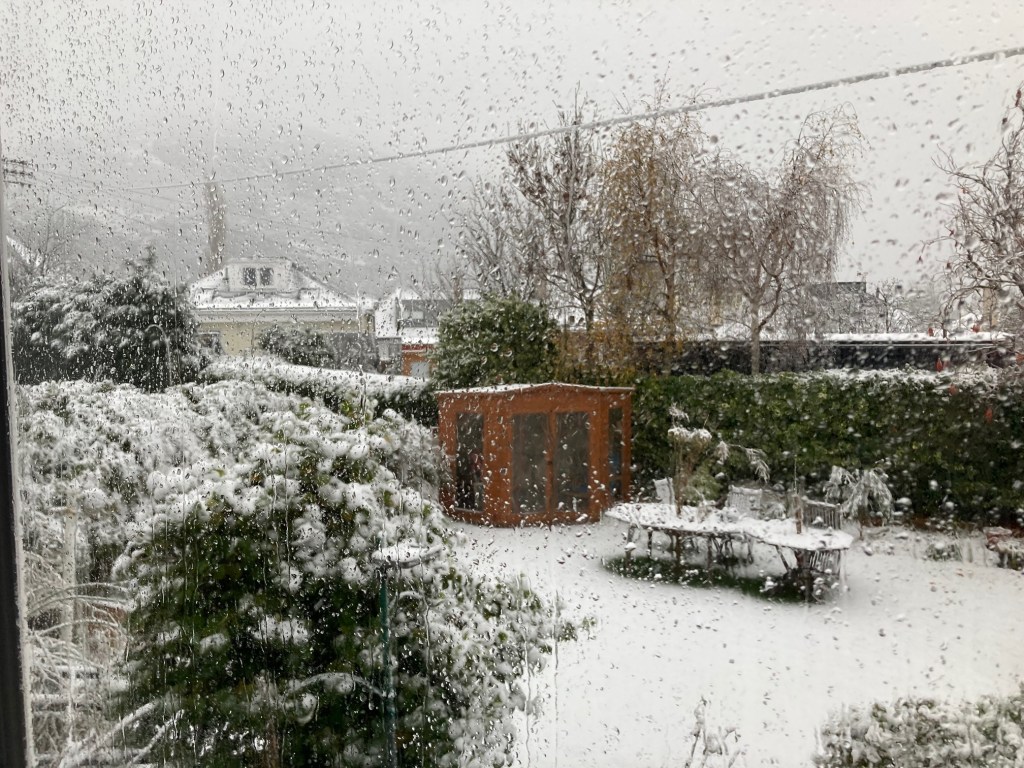
We had a day of heavy snow last weekend. But it soon melted. And we have had much less rain than down south. My CH schoolfriend Pete came to stay on Tuesday night, driving up from Gloucestershire; and we had a real Senior Citizens’ [Old Farts’] conversation about broken nights and living with diabetes and energy bills. It is cold enough for Susie to override the heating on a regular basis. For complicated reasons we haven’t had a gas bill for months. Which makes me fear that we shall be in a Debtors’ Prison early in the new year. Meanwhile we had a day out with Mike and Wendy down in Stockbridge yesterday, a village atmosphere and a galaxy of charity shops. I bought a very clean copy of Anthony Beevor’s big book on the Spanish Civil War for £5.00 in the Stockbridge OXFAM shop. And we had a good lunch and mulled cider in a new cafe.

Scoop
In August 1935 Waugh returned to Abyssinia to report on the Italo-Abyssinian war for the Daily Mail. According to his fellow journalist William Deedes, Waugh thought that Abyssinia was “a savage place which Mussolini was doing well to tame”. In Abyssinia Waugh saw little of the fighting, and complained that his fellow reporters were not up to the standards of his friends at home. His trip led to two books: Waugh in Abyssinia [published in 1936], which Rose Macaulay described as “a fascist tract”; and the novel Scoop [published in 1938] in which the central character, William Boot, is loosely based on William Deedes.

Scoop opens with a wonderful set-piece account of a morning chez Lady Stitch, clearly based on Lady Diana Cooper. She along with Diana Guinness [née Mitford, later Mosley] was one of the cool, upper class beauties to whom Waugh was deeply [but chastely] attached at the time. [Diana Cooper’s husband, Duff Cooper, a Tory MP and cabinet minister, loathed Waugh, whom he thought a social climber and parvenu.] Through Lady Stitch’s patronage, one Boot is sent to Abyssinia, renamed Ishmaelia, as a war reporter. Through confusion of name, instead of Lady’s Stitch’s protege John Boot, a fashionable young novelist, they send his second cousin, William Boot, a dim writer of nature notes from an eccentric family of landowners in deepest Somerset. Much humour comes from this confusion. William Boot is another innocent abroad to whom things happen.
Once upon a time.I thought Scoop was the best of Waugh’s early novels. It pokes fun mercilessly at Diana Cooper, and at Lord Beaverbrook on whom the newspaper magnate Lord Copper is clearly based, – and who had a long-lived dislike of Waugh; and a variety of ‘Special Reporters’ who accompany Boot to Ishmaelia. These reporters vie with each other in inventing stories about a country of which they know very little, and wholly by chance William Boot gets the sensational ‘scoop’ of the book’s title.
Now I am less convinced of the quality of the book. It was a long time in gestation. partly because Waugh had a great many distractions. He had secured through his faithful agent A.D. Peters a lot of profitable journalism; he had married Laura Herbert, a cousin of She-Evelyn in December 1937; and he was seeking to establish himself as both a country landowner and a Roman Catholic apologist, roles which could be mutually antagonistic. The books starts more strongly than it ends. Brigid Brophy, reviewing a Uniform Edition of Waugh’s books in 1964, found Scoop “a mere, though entertaining, after-flutter of the fine imaginative flight which had produced Black Mischief”. Waugh himself writing in 1957 said that the book was “a light satire of modern journalism”. If we are going to rate Waugh as a major novelist, it will have to depend on his latter books, Brideshead Revisited [published in 1945] and the Sword of Honour trilogy [published between 1952 and 1961]. I’ll have another look at them. But it may not be until after Christmas.
November 2024.
 Through a glass darkly
Thank you for shuffling my memory with Evelyn Waugh’s ‘Scoop’. When I was a teenager I used to moan about not having enough books to read and my mother suggested ‘Scoop’ which I enjoyed, and this surprised my family. Given the comment that it’s “a mere, though entertaining, after-flutter” I wonder how I would view it in my senior years? I will seek out a copy! G. 🌼
LikeLike