Through a glass darkly – 80

State of the Nation

The UK is not currently in a good place. Lots of things are going wrong at the same time. First there is a huge cost-of-living crisis. Relatedly inflation is now running at 10% and is forecast to hit 15% sometime next year. Interest rates have gone up in the past few days. Not that there is any corresponding rise in income for savers. [That’s us.] But it does mean a hefty monthly increase for mortgage-holders [both our children]. Energy prices have spiralled in the past 12 months; and the OFGEM price-cap will rise again in September, and at at three-monthly intervals thereafter.

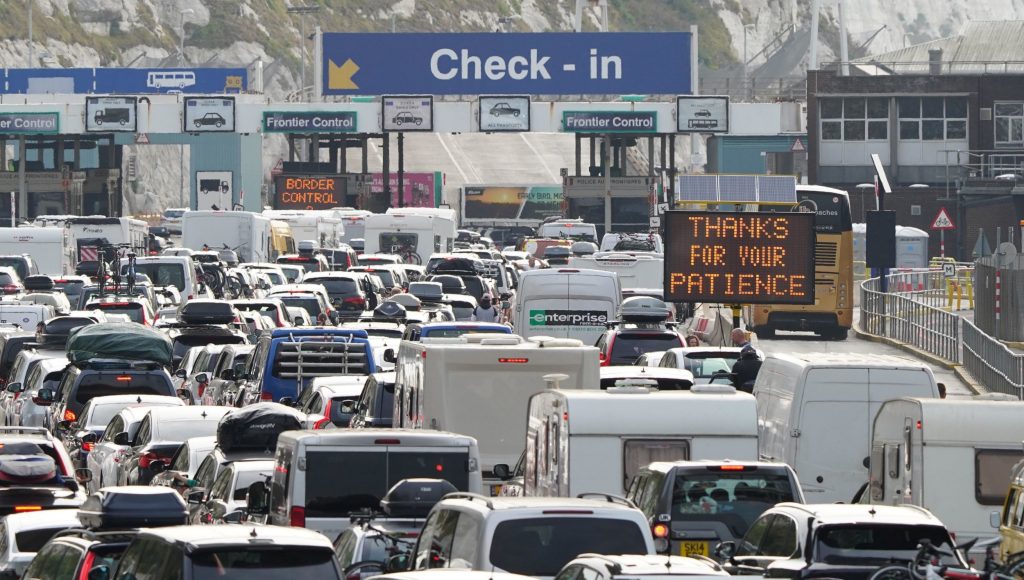
It is the holiday season and all known forms of transport are suffering cancellations and delays. Heathrow and other major airports are cancelling flights. The cost of flying from Heathrow to Edinburgh is currently running at about £950, and involves changing planes in Paris or in Brussels. Gatwick Airport ran out of water a couple of weeks ago. We know that the train is a better bet environmentally. But assorted rail unions are running a series of one-day and two=day strikes which are forecast to continue into the autumn. As post-COVID lockdown holidaymakers head for the Channel in their cars, there have been unprecedented delays at Dover with both cars and commercial vehicles backed-up for miles on the M2. 

Off on holiday

How are our politicians coping with this chaos. Boris evidently feels he is on gardening leave. He is said to be on a honeymoon in Slovenia with is current bidie-in. Since his not-quite resignation, his only reported activities have been a delayed wedding reception at the home of a wealthy Tory Party donor, and preparation of a resignation honours list. Which will send the unspeakable Nadine Dorries and a gang of equally unsuitable cronies to the House of Lords. [There is a theory that ‘Mad Nad’ is being elevated so that Boris can then inherit her ‘safe seat’ when he loses his current more marginal one in Uxbridge.] 

At a time of unparalleled financial woes, the Chancellor of the Exchequer is also on holiday. No, it’s not Rishi Sunak these days. It’s Nadhim Zahawi, a 56-year-old Kurdish property millionaire, under investigation by HMRC for tax evasion and other suspicious dealings.  But don’t worry. A Treasury spokesperson said that he is looking at his screen ‘on a daily basis’. Probably placing bets on Pop Idol which has made him a lot of money in the past. What about the Minister for Transport, that juvenile lead Grant Shapps, another man with a very iffy business past. [Which he has sought to airbrush from his Wikipedia entry.] No-one knows whether he is on holiday or not. But it doesn’t seem to make any difference as far as our transport problems are  concerned.

Sunak v. Truss

What passes for political activity during what the papers used to call the silly season is an interminable set of ‘hustings’ at which Rishi Sunak and Lis Truss are concerned to sell themselves to tiny groups of Conservative Party members around the country.. ‘Swivel-eyed loons’, as a former Conservative cabinet minister described them.  In this travesty of democracy the next Tory Party leader, and more significantly our next Prime Minister, will be elected by a small group of people, who make up less than 0.5% of the electorate. Not only is this a tiny group of people. But there  is data that shows that they are wholly unrepresentative of the country whose leader they will elect. They are predominantly white. They are predominantly above average age. [I don’t necessarily quarrel with either of those things.] They are not interested in ‘levelling up’. They have no interest in foreign affairs. They are agreed that we have ‘too many immigrants’. They are opposed to gay marriage. They hark back to the ‘great days’ of Margaret Thatcher. They can’t understand why Boris was forced to resign. Their views are largely set by the Daily Mail and the Daily Telegraph.

Return of the Premiership

So – in order  to suck up to this tiny unrepresentative minority, the two candidates seek to outbid each other in ludicrous claims. We know that Rishi Sunak is a posh Wykehamist, married to a fabulously rich wife who is a serial tax evader. I don’t dislike the man. And I think he is honest about the country’s economic woes, and that he is right to warn against increased borrowing in order to finance uncosted tax cuts. But, given this government’s stated commitment to ‘levelling  up’, there is something deeply repugnant about his boasting to Tory party members about diverting funds from urban priority areas to Tory-voting councils. In Tunbridge Wells of all places.  

As for Lis Truss, the notion that she is fit to be Prime Minister is simply risible. She is charmless, wooden, and clueless. As her former Cabinet colleagues noted, her ambition has always outstripped her ability. She thinks she is Mrs. Thatcher re-incarnate. But in reality she is more like Marine Le Pen. She claims broad support for her much-heralded tax-cutting programme. But her only supporter is the maverick Cardiff academic Patrick Minford. A life-long admirer and personal friend of Margaret Thatcher. [I was at Balliol with him, but we never spoke.] Lis Truss speaks disparagingly about her old school, Roundhay a former grammar school in Leeds, which was judged ‘outstanding’ at its last OFSTED inspection in 2013. But it was good enough to get her into Oxford. [Yet another politician who read PPE.] And she now seems to think that sending all bright children to Oxford or Cambridge will be socially beneficial. And the academic year will start in January. Her other headline attracting policy initiative was to suggest that civil servants outside London and south-east England [teachers, nurses etc.] should all have a pay cut. This policy was enthusiastically talked up on television by the Minister for BREXIT Opportunities, the insufferable Jacob Rees-Mogg. A man who responded to BREXIT by moving all his family’s trust funds and inherited wealth out of the UK into an Irish bank.

I watched the first televised  ‘husting’. The only thing that the two candidates could agree on is that all the troubles at the port of Dover were “nothing to do with BREXIT”. For the Tory Party members, BREXIT is an article of faith. The idea that it has been an unparalleled act of political, economic, and cultural self-harm is beyond their comprehension. We know nothing of the candidates’ views on environmental matters and global warming. Nothing about how to deal with plastic pollution. Nothing about combatting falling educational standards. Nothing about how to recruit and train more hospital doctors and nurses. Nothing about cleaning up Britain’s rivers. Nothing about how they will deal with Russia. Or China. [Truss’s much vaunted trade deals, e.g. with Australia, have been cut-and-paste’ affairs which sold out on British farming and agriculture.]

Envoi

I won’t go on. It’s too depressing. Let’s try and end with some good news. Ships laden with grain and oil are finally leaving Ukraine.For Turkey and for Italy.  In a deal negotiated by the United Nations. The England ladies football team did good. Cue lots of media references to ‘the Spirit of 1966’ and all that. [Sadly the few survivors of that team all now have dementia.] I walked on the John Muir Way last week. By the sea.  Susie and I had lunch the other day at The Loft Cafe in Haddington. Which does the best Ploughman’s Lunch I know.  It is a vintage year for Scottish strawberries. They are of excellent quality, and the only thing that has gone down in price this year. We saw the Soweto Gospel Choir at the Fringe a couple of days ago; huge energy and lots of noise in the amphitheatre at New College on The Mound. And I am going to Be Bop a Lula at the Brunton Hall in Musselburgh tonight. To see Billy Fury and Buddy Holly, and Gene Vincent and Eddie Cochrane. Who said nostalgia ain’t what it used to be.

Rave On, in Musselburgh

August 2022

Through a glass darkly – 79

The Vercors

The Vercors is a rugged area of mountains and plateaux in south-east France, about 100 kilometres south-east of Lyon. The area measures about 50 kilometres from north to south, and thirty kilometres from east to west; straddling the departments of the Isère and the Drôme.  The corner of the Vercors is clearly visible from Grenoble. The plateau is guarded by almost sheer cliffs on all sides. Road access is limited. The most direct access from Grenoble is on the north eastern flank via Saint-Nizier du Moucherotte, the highest village in the northern Vercors. This was the route of an electric tram until the 1950s.

The Vercors from the chaplaincy flat, Grenoble

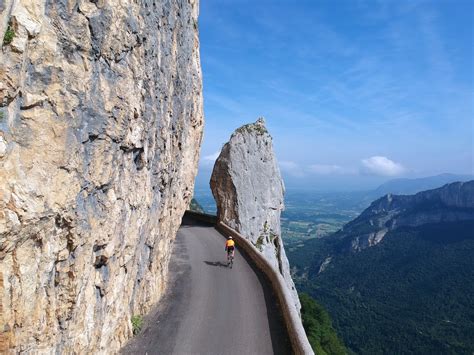
The bus from Grenoble to Lans-en-Vercour climbs up from Sassenage, and gains access to the plateau through the Gorges du Furon. Access from the west, from Romans and from Pont-en-Royans, involves balcony roads which cling to the cliffs high above the Gorges de la Bourne and Combe Laval and Grands Goulets. These vertiginous  roads were built in the 19th century, mainly to serve the forestry industry; they are a nightmare for acrophobes like me, but much prized by adventurous bikers. . From the south, from Die, a sinuous road climbs through many hairpins to the Col du Rousset [1,254 metres] and thence to la Chapelle. There are no roads at all on the eastern flank, merely a handful of hikers’ tracks. There are ten principal summits of about 2,000 metres; the highest le Grand Veymont at 2,341 metres. And there are more than a dozen road cols of more than 1,200 metres.The massif is a natural abode for brigade and fugitives. Francis Brook Richards described the plateau, fancifully, as being “like a great aircraft carrier steaming north from the middle of France towards the English Channel”.

Combe Lavaal, The Vercors

Plan Montagnards

What became known as the Vercors plan originated in 1941, in occupied France. The writer Jean Prévost, initially a pacifist but an energetic anti-fascist, was visiting his friend, Pierre Dalloz, an architect, writer and keen mountaineer, at the latter’s home at La Grande Vigne, close to Sassenage.  As they worked on cutting down an old walnut tree in Dalloz’s garden, they looked up at the cliffs of the Vercors, and speculated how paratroopers could be dropped clandestinely onto the plateau, which could then serve as an enormous resistance base behind enemy lines. Resistance men from the plain would join up with maquisards from the Vercors camps, and when the invasion of France came they would attack the Germans from the rear and cut off their supply lines.

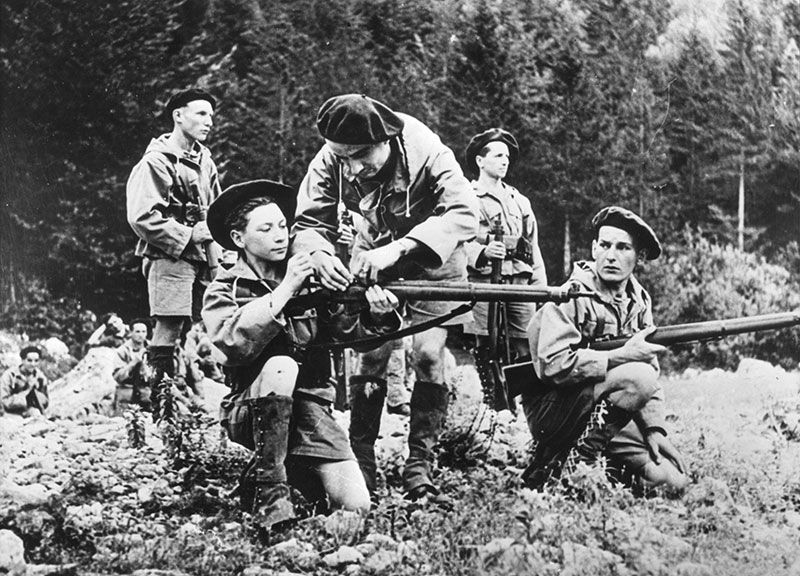
Maquisards

Over the next two years ‘Operation Montagnards’ was refined and warmly received  by French Resistance leaders. The plan was to transform the Vercors into a vast fortress base in the heart of German-occupied territory on the day that Europe was invaded. Support for the plan was expressed in both Algiers and in London, and it was said that General de Gaulle had personally approved it. But it remained to be seen when and where the invasion of Europe would take place. .

Eugène  Chavant, a veteran socialist politician and onetime red mayor of St Martin d’Hères, was the  unchallenged civilian leader, acknowledged as ‘Le Patron’ by everyone in the towns and villages across the Vercors. The first military commander of the Vercors was Alain le Ray, a young ex-Army officer and mountaineer; one of the few Frenchmen who had escaped from Colditz. But in December 1943 le Ray fell out with his superior, Marcel Descours and resigned. To replace him Descours chose Narcisse Geyer, a diminutive, haughty, right-wing cavalry officer, seen mostly in full uniform mounted on his favourite stallion. Geyer was brave and dashing, but insensitive and anathema to Chavant and his socialist colleagues. Who were affronted by Geyer’s  demeanour. In order to smooth relations, in May 1944 Descours appointed Major François Huet, another Catholic and regular soldier, tall, calm, and humourless, to take command over Geyer.

The Free Republic of the Vercors

By the opening months of 1944, there were significant tensions on the plateau. As more resisters and réfractaires made their way to the plateau, there was some resentment from the local community who had the most to suffer from any German reprisals.  In January 1944 the Germans had invaded the north-western village of Malléval, killed thirty alpine troops who had installed themselves there, and set the whole village on fire, burning eight of the inhabitants alive including a Jewish doctor and his wife. There was a polarisation between the maquisards, some of whom resisted any kind of discipline, and the regular soldiers under Geyer and Huet. The two soldiers maintained separate headquarters and rarely spoke to each other. 

As the French Resistance gained in confidence, so the Germans responded more forcefully executing punitive attacks on whole communities. News came to the plateau of assaults on resistance groups in other areas, including an awful massacre at Glières, a little to the north. For a week in April 1944, a large force of nearly a thousand miliciens in their dark-blue uniforms conducted a punitive operation in Vassieux and La Chapelle, conducting a reign of terror and interrogating villagers about maquis camps and arms dumps. Torture was regularly employed. 

When would the promised invasion come ? Why were there no clear orders ? In May 1944 Chavant made his way, clandestinely, to Algiers to seek clarification. Algiers in 1944 was home to a cumbersome set of French political and military structures hampered by continual in-fighting. Antoine de Saint-Exupéry, a fighter pilot there at the time, described it as a petaudière [literally, a fart chamber]; Chavant himself described it as a panier de crabes. Chavant had a plethora of meetings, including one with Jacques Soustelle, de Gaulle’s principal gate-keeper, who signed off on the plan. On June 7th Chavant returned in triumph. There were no longer any doubts about the  role of the Vercors; they must prepare to receive four thousand paratroops. De Gaulle had spoken. “The General will almost certainly be establishing his headquarters here in the Vercors … We must find him a suitable house”.

On June 6th crowds throughout the Vercors  celebrated the long-awaited D-Day. [On June 10th the SS Division Das Reich descended on Oradour-sur-Glane and massacred 624 civilians including 190 children, many of them burnt alive. The division was substantially from Alsace.] On June 8th Descours ordered Huet to mobilise the plateau. Huet as a good soldier obeyed, even against his better judgement. He had neither the men nor the arms to defend the Vercors. But he was persuaded that reinforcements – paratroopers, mortars, artillery – would arrive shortly.

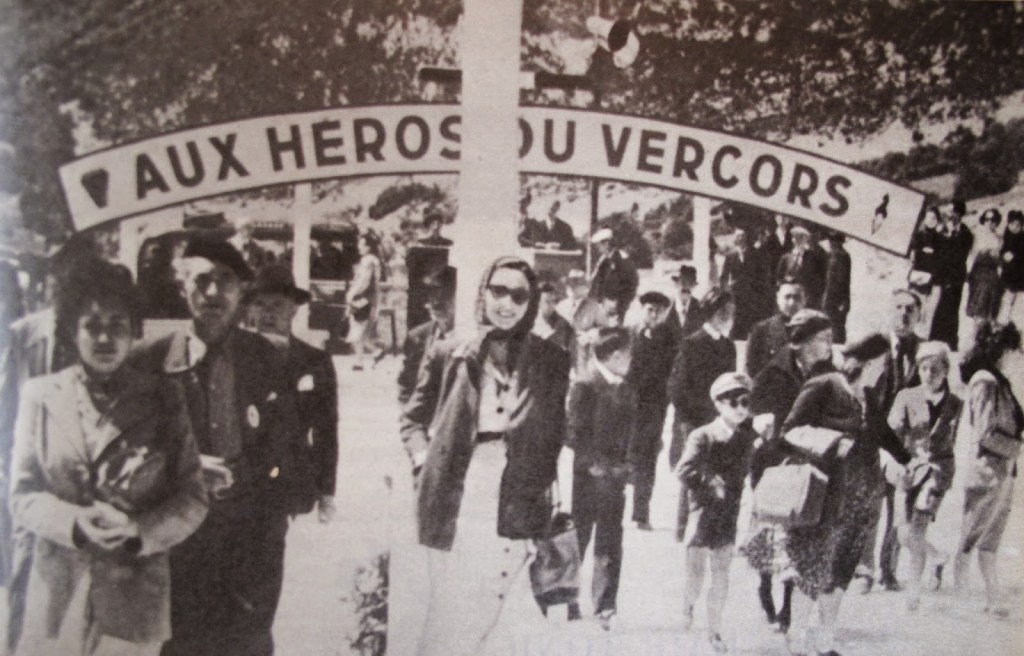
Heros of the Vercors

On June 11th the Germans invaded the Vercors with a reconnaissance-in-force against Saint-Nizier. On June 15th they returned with a larger force, including artillery, and forced the maquis to withdraw to the southern part of the plateau..

On July 3rd the Free Republic of the Vercors was proclaimed in an impressive ceremony in Saint-Martin. Chavant and Yves Farge were prominent in the Committee for National Liberation. Geyer, complete with kepi and white gloves, sitting erect on his horse, saluted with his sword. The Free Republic had its own flag, featuring the Cross of Lorraine and a V for Vercors, and its own coat of arms. It was the first independent territory in France since the German occupation of 1940. All the independent Maquis groups on the  plateau were now incorporated into regular army battalions and regiments. An airfield expert, Jean Tournissa, had been parachuted in; and work began on the creation of an airfield on the flat meadow at Vassieux. In order to receive Dakotas bringing paratroops and heavy weapons. It was to be ready for the August moon period, from the end of July.

The end of dreams

Repeated and increasingly urgent messages to Algiers went unanswered. Military men were preoccupied with the plans for Operation Anvil, the landing in the south of France, which would happen against Churchill’s preferences in mid-August. De Gaulle himself was distracted by Plan Caiman, his own wholly unrealistic project for landing an exclusively French force in the Massif Central. Meanwhile the German forces, commanded by General Karl Pflaum, drew up their plans for Operation Vercors. It was a classic ‘surround, attack, annihilate, destroy’ model, such as they had already used at Malleval and on the plateau de Glières. Pflaum’s plan called for 10,000 men, organised in three columns: one to attack from the north through Saint-Nizier and breaking through Huet’s forces at Valchevrière; one armoured column approaching from Die in the south and forcing the defensive line at the Col de Rousset; and a third column of Alpine battalions and mountain artillery forcing their way through the passes on Vercors’s forbidding eastern ramparts. Cruelly Pflaum inserted a fourth, airborne column, some twenty-two assault gliders which would carry troops in to the heart of the southern massif making use of Tournissa’s painfully constructed new airstrip at Vasssieux. The German assault came on Saturday, July 22nd.

The maquis fought bravely at Vassieux and at Valchevrière, and at the Pas de l’Aiguille in the east where a tiny group of maquisards held out for 24 hours. But they were outnumbered and outgunned.  At 16.00h on Sunday, July 23rd Huet gave the order for all troops to disperse. Different groups under Huet and Geyer and Beauregard went into hiding deep in the forests and high in the mountains. For the next two weeks the German forces mercilessly punished the Vercors farms and villages. Atrocities were committed by some of the troops. The total German casualties from the conflict and the subsequent harrowing are said to be 65 killed and 133 wounded. The French casualties are said to be 201 civilians and 639 maquisards killed. A post-war estimate is that 500 houses were burnt, a further 650 severely  damaged, and some 700 cattle driven from the plateau. If it was a victory, as some argue, it was a cruel and bloody one.

Paddy Ashdown: The Cruel Victory

Postcript

I first came across the story of the Vercors in  a book Tears of Glory: The Betrayal of the Vercors 1944 by Michael Pearson, which I must have bought in Shakespeare’s bookshop in Paris in the 1980s. And more recently I have been looking at Paddy Ashdown’s  2014 book, The Cruel Victory: The French Resistance, D-Day, and the Battle for the Vercors 1944. They are both very readable books, but Ashdown has more to say about the complexities of life in wartime Algiers, and more information about SOE’s role, and the involvement of Francis Cammaerts and Christine Granville. For Ashdown the hero of the story is François Huet, who was highly criticised after the war by some commentators. But Ashdown thinks he got all the major decisions right, including the final dispersal order. And the other heroes are the young maquisards, men and women, under-armed and massively outnumbered, who ultimately denied the Germans the success they sought – the total destruction of French resistance on the plateau.

In the Vercors, May 2019

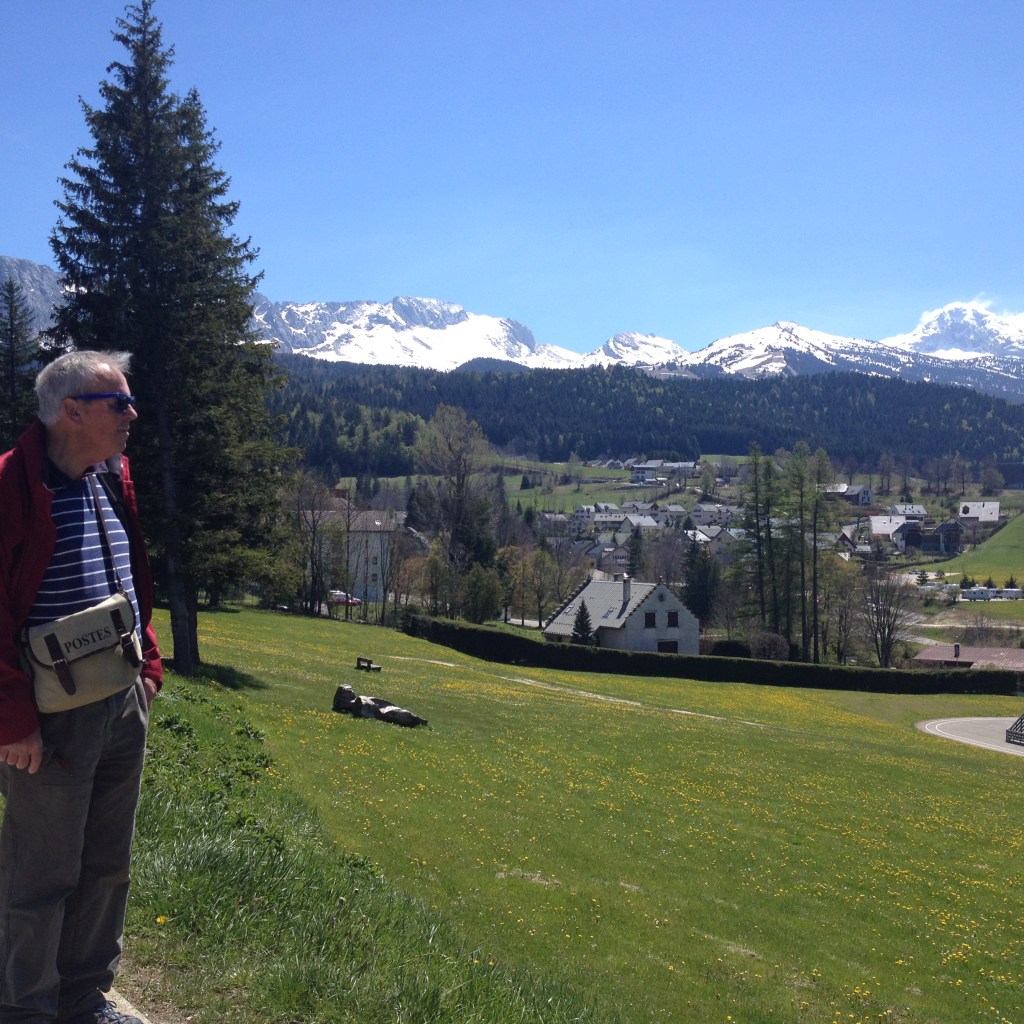
Susie and I could see Saint-Nizier and the Vercors from the chaplaincy flat in Grenoble when we were there in  2019. Very bravely, so I thought, we ventured up on the bus to Villard-de-Lans. It was a glorious sunny day, with snow on the hills. We took some photos, and had lunch, and admired the healthy brown-and-white cows in the fields. I was very pleased to be there. But it  felt a long way from the sad and bloody days of July 1944. Not quite eighty years ago.

July 2022
Through a glass darkly – 78

I’ve never been a wild swimmer. [Perhaps I’ve never been a wild anything ?] But swimming was part of my childhood. In the mid and late 1950s, we went, usually with my father and older brother to a variety of swimming pools. Some were municipal indoor baths, most often a 25 yard pool with greenish water and lots of white tiles. Wandsworth Baths, where we went from primary school, sited next to the polluted river Wandle and opposite Young’s Brewery, whose beer had not yet been ‘discovered’ by CAMRA, was not atypical. The baths at Bradford-on-Avon, where my grand-parents lived, next to the river Avon, were similar. And also one of the several pools in nearby Bath. Which also housed the more distinctive Cross Bath, a small oval shaped pool sourced by warm spring water. The British weather limited opportunities for outdoor pools. St George’s Park in Wandsworth was the nearest. The Surbiton Lagoon, built in 1934,  off the Kingston By-Pass, was a more self-consciously 1930s experience. Guildford Lido, where we only ever went once, was a similar between-the-wars creation. The water in the outdoor pool at Batheaston was always cold. And so it was at Weston-Super-Mare, a wind-swept, salt-water pool, complete with high diving boards, a stone’s throw from Weston’s enormous sandy beach. When the tide goes out the water retreats halfway to Cardiff. 

Weston-super-Mare, 1948

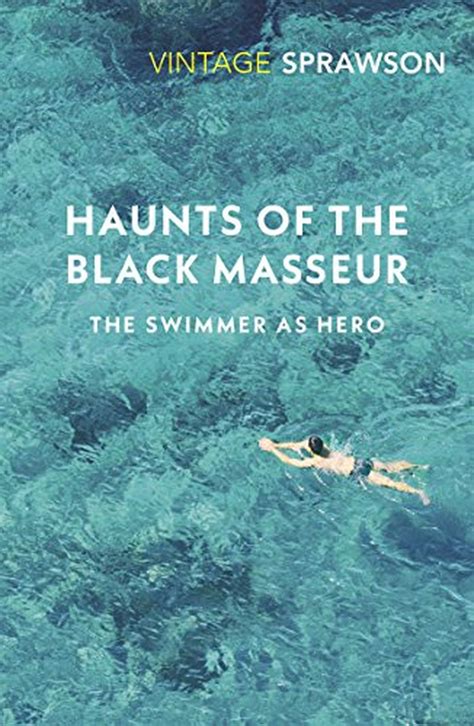
Stopping on our way north last month at Muir of Ord has occasioned this burst of nostalgia. It could well pass as a one-horse town. Though no horse was in evidence. But it has a wonderfully old-fashioned charity shop. Where I bought for 50p a perfectly decent copy of Haunts of the Black Masseur by the eccentric Charles Sprawson. Republished by Vintage in 2018.

Classical swimming

Sprawson’s book begins with memories of his exotic and peripatetic upbringing. He was born in Karachi, then part of British India, during the Second World War, and his father was a colonial headmaster, first in India and then in Libya. Sprawson writes of bathing in the “flooded subterranean vaults” of the palace of the Jam Sahib of Nawanagar, who was a pupil at his father’s school, and later among the sunken Greek ruins of Cyrene in North Africa. After being educated at Tonbridge and then at Trinity College, Dublin, he worked as pool attendant at the Dorchester Baths, Bayswater, and then took up an appointment [the job was advertised in Latin in the personal column of The Times] teaching classics at the University of Riyadh. 

Haunts of the Black Masseur The swimmer as hero

An early chapter in the book deals with swimming in Greek and Roman culture. For the Greeks water possessed magical, mysterious, and sometimes sinister properties. There was a spring that could make you mad, another that could make you teetotal for life. In another Hera renewed her virginity every year. The baths built by the Romans in Britain were the last to be built in this country before the Industrial Revolution. In Rome alone there were over 800 public baths. some of them able to accommodate over 1,000 people. Almost all the Roman emperors built baths.  The Baths of Diocletian were built by Christians over seven years; and those who were still Christian on its completion were put to death. Many of the Baths became the haunts of homosexuals and voyeurs. Those who were genitally well endowed apparently evoked applause from fellow bathers ! But after the fall of Rome, water lost something of its allure, and began to be thought of as a breeding ground for rats, a source of plague and of disease.

Writers and swimmers

For several centuries, Sprawson claims, there are few instances of swimming in England. Few people swam in rivers, and virtually no-one swam in the sea. In 1689 mention is first made of Parsons’s Pleasure, the naked-bathing place on the river Cherwell in Oxford. From the middle of the 18th century young aristocrats were embarking on the Grand Tour, and enthusiasts were encouraged by classical writers to trace the routes of ancient springs and rivers. For Shelley the inspiration behind his swimming was essentially classical; he was given to reading Greek texts by waterfalls, and was absorbed in the myths of Narcissus and Hermaphrodite. He had never learned to swim at Eton, and was drowned in the sea off Viareggio, with a volume of Sophocles in his hand.

Close to where Shelley drowned there is a plinth dedicated to ‘Lord Byron, Notable English Swimmer and Poet’. Byron, who swam in Scotland in his youth in the Dee and the Don, and then at school at Harrow, was extraordinarily proud of his swimming. Leigh Hunt’s first view of Byron was of him swimming in the Thames “rehearsing the part of Leander under the auspices of Mr Jackson the prizefighter”. Byron also swam frequently from Ravenna and in Venice where he was known as ‘the English fish’. [In 1933 his quasi-descendant, Robert Byron, swam at the Venice Lido, in “water that tasted like hot saliva , and cigar ends floated into one’s mouth”.] The self-styled Baron Corvo, attracted by the warm water and the naked boys, swam half a dozen times a day in Venice.

In emulation of Byron, Sprawson flies toTurkey to swim the Hellespont. His first attempt is a failure. But his second attempt, swimming with his daughter, is successful. And his daughter is presented with a purple-ribboned medallion and has her photo taken for the local paper. Sprawson also follows Byron in attempting to swim across the Tagus estuary at Lisbon. This time without his daughter. But he is picked up by a patrol boat and they have never heard of Byron.

In the writing of Swinburne, Goethe, Poe, Coleridge, Clough and, most of all, Byron, swimming represents freedom and self-dissolution, a way of making contact with the classical past but also with earlier, simpler stages of life. Sprawson writes that the “sense of the classical Golden Age merged in the minds of these swimmers into the unruffled, radiant years of their childhood, whose loss so many of them mourned … ” For Swinburne swimming and flogging were the two experiences of Eton life that were most closely engraved on his memory. [And his backside ?] This erotic affinity with water was shared by French writers that include Flaubert and Paul Valéry.

The first Swimming Association in England was formed by a group of Old Etonians in 1828. Before a swimming pool was built in the 1950s, Etonians bathed in the river. Where the banks were long prowled by the louche and learned classicist Oscar Browning, dismissed by a brave headmaster. Cyril Connolly recalled walking hand-in-hand to the bathing places as one of the most intense experiences of Eton days,  experiences that haunted his later life and doomed him to permanent adolescence. 

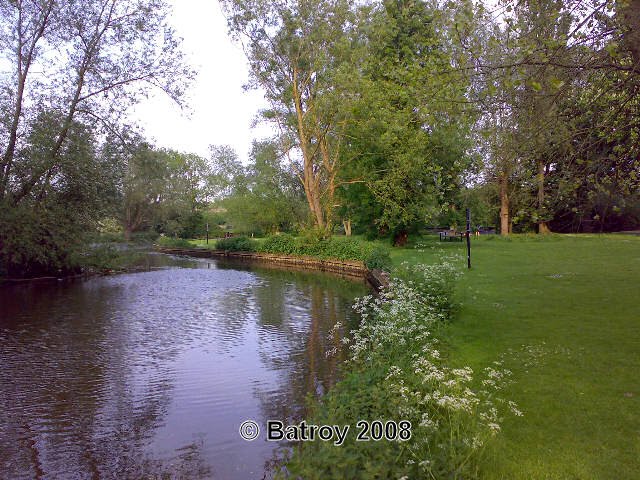
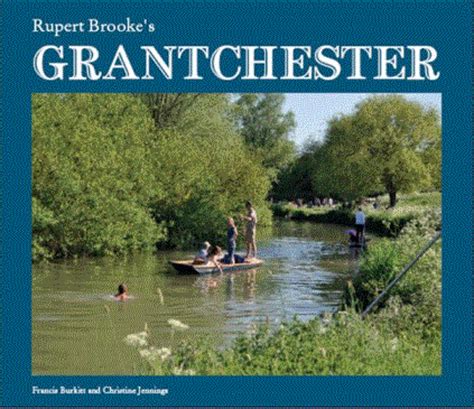
After he acquired lodgings close to the Vicarage in Grantchester, Rupert Brooke became a regular swimmer in the river Cam. He often bathed at night, like Byron, above the sluice-gates by the light of a bicycle lamp. It was here that he swam naked with Virginia Woolf, in dark water “smelling of mint and of mud”. Gallipoli was a swimmer’s war. Brooke never had a chance to swim the Hellespont, but he enjoyed swimming several times at the Dardanelles before he died.

Rupert Brooke’s Grantchester

The wider world

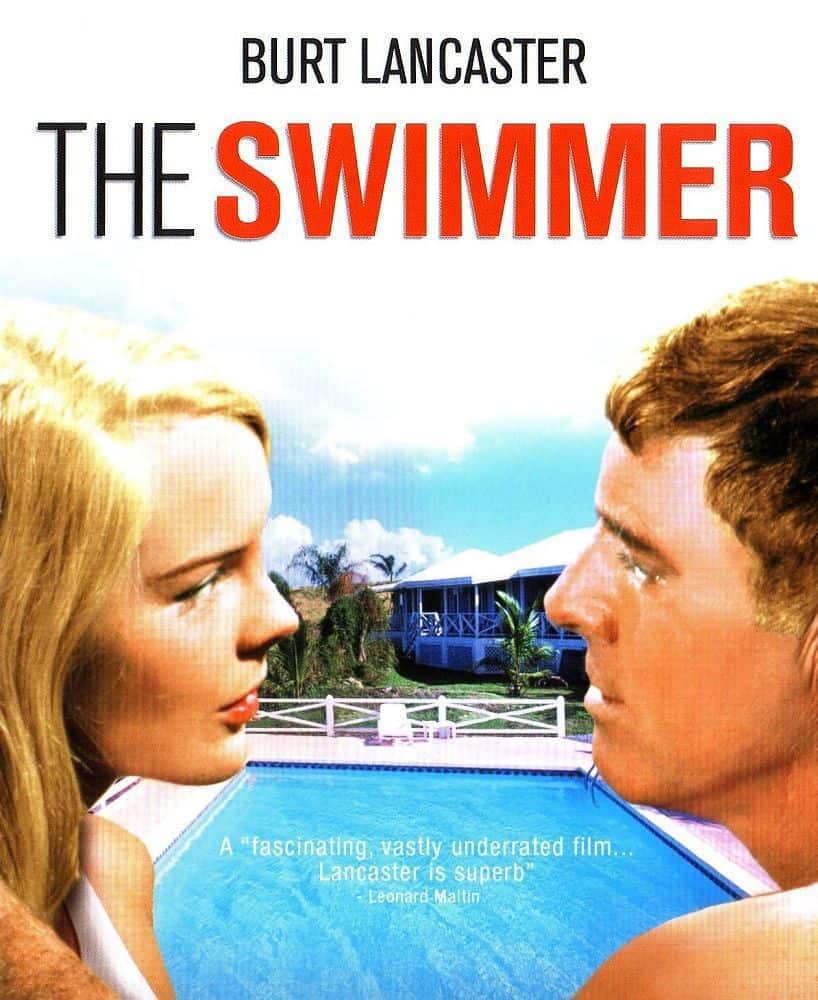
A later section deals with Nordic swimming:  with the ascendancy of the Swedish divers at the 1900 Paris Olympics; with the revolutionary camerawork of Riefenstahl’s Olympische Spiele, filmed at the Berlin Olympics of 1936; at the place of swimming in German Romanticism. And the penultimate chapter of the book charts the American Dream: Longfellow’s Hiawatha plunging “beneath the bubbling surface”; the paintings of Thomas Eakins; Jack London’s passion for boxers and swimmers. John Cheever’s short story ‘The Swimmer’, about a man deciding to swim home eight miles across his neighbours’ pools, was filmed with Burt Lancaster, who needed three months of swimming lessons to get over his mild hydrophobia. The great Sutro Baths of San Francisco were built in 1896; it was the largest glass-roofed building in existence, full of Palm trees, stuffed anacondas, a tropical beach, restaurants, and seven separate pools overlooking the ocean that held two million gallons of sea-water. The baths were dismantled in 1966.

The Swimmer

The problem of trunks

Everyone swam naked until bathing grew in popularity in the middle of the Victorian age. When mixed bathing was allowed at Llandudno, it met with general disapproval. Marie Lloyd sang: “Belle, along with Beau, went swimming in a throng/A terrible thing, but a regular thing on the naughty Continong”. The imposition of any form of clothing was strongly resisted in some quarters. The reserved Francis Kilvert, as a young curate, records in his diary how on holiday in Weston-super-Mare people were swimming naked. Which encouraged him to do the same the next morning. “There was a delicious sense of freedom in stripping in the open air and running naked down to the sea …” Two years later however in the more respectable resort of Shanklin on the Isle of Wight, he discovered he had to adopt the “detestable habit of bathing in drawers. If ladies don’t like to see men naked, then why don’t they keep away from the sight”.

It reminds me that in Jonathan Coe’s book The Rotters’ Club, Benjamin Trotter, as a sixth-form schoolboy,  offers up a swift prayer when he realises that he has left his swimming things at home. And thereby risks having to swim naked. When a pair of trunks materialise in the changing rooms unexpectedly he becomes a Christian believer. Until a more louche explanation is revealed. I had a similar experience in my first year at CH, when my trunks went missing. So I had to swim naked in swimming classes for a few weeks. It might have scarred me for life. But amazingly it is a painless memory. And I have no scar tissue.

Charles Sprawson

I first encountered the name of Charles Sprawson in Kindred Spirits by Jeremy Lewis, erstwhile publisher and commissioning editor for The Oldie. Sprawson and Lewis were friends from university. Jeremy Lewis writes: “Charles had for some years swum in and out of our life like a disconcerting, blue-eyed shark, a sportsman, a classicist, and an authority on low life in Hamburg, Paris, and  Amsterdam. He had, after leaving Trinity, Dublin, taught classics at a university in Saudi Arabia, where he was arrested by the Desert Patrol for dancing alone and naked among the sand-dunes to ‘La Bamba’ on a portable  gramophone, and upstaged a bandaged and goggled Stuntman by strolling up, towel on his arm, and casually diving ninety feet into a waterhole – a regular occurrence as far as Charles was concerned …”.

Charles Sprawson

Haunts of the Black Masseur is the only thing Strawson wrote, except for an article about the German pre-war tennis player von Cramm, commissioned by Alan Ross for the London Magazine. It is a weird and wonderful book, which attracted a bit of a cult following  in the UK and in the States. And was perhaps the precursor of Roger Deakins’ highly entertaining book Waterlog. I greatly enjoy dipping into both books. But I still have no real desire to plunge into the nearest loch.

July 2022
Glass Darkly 77 – Up the West Coast

Susie and I have just been ‘up north’ for a week, up the west coast. Based mainly in and around Gairloch, where we have spent time in each of the past three summers. We had initially thought of a two-island trip, to Arran and thence on to Islay. Named in anticipation no doubt of our third grand-daughter. But neither of us drink whisky, so Islay might have been wasted on us.

At Ullapool

Are we getting into a rut ? When we lived in France, initially in Paris in the 1970s, I noticed that many French families went on their summer holidays to the same place year after year. In the way that my friend Clive and his wife Ev went each year to Port Bail in Normandy. And they would drink each summer in the same bars, and eat in what became familiar restaurants.

Life in a pod

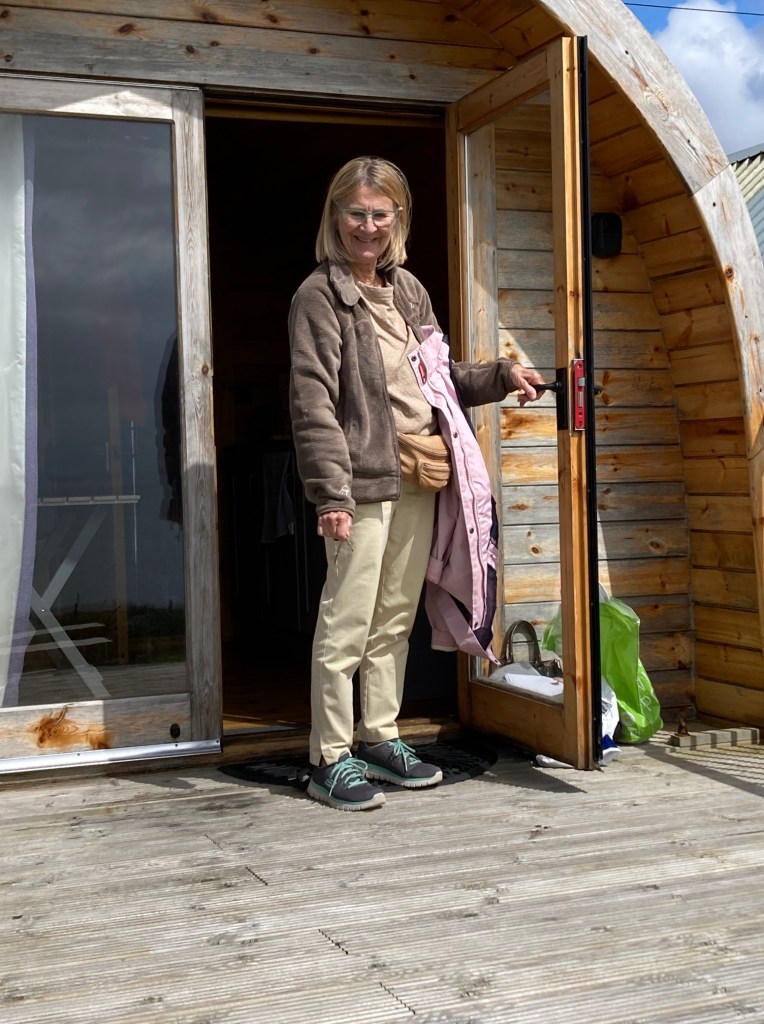
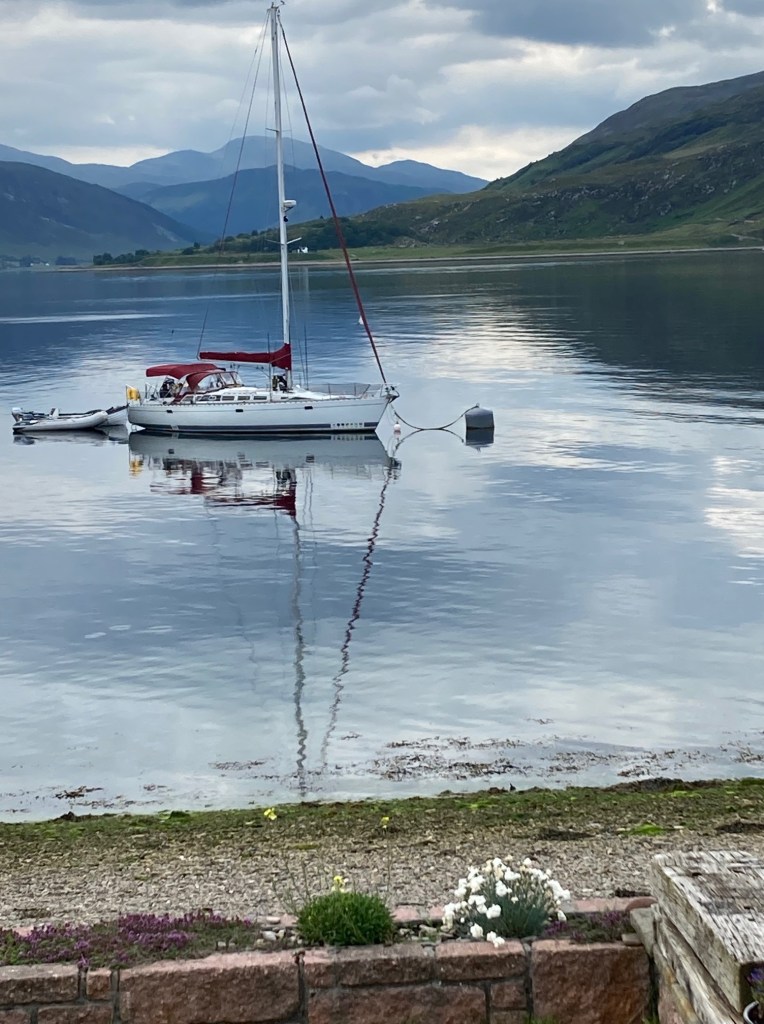
We spent the first 4 nights in a pod at Aultgrishin. You drive out of Gairloch past Big Sand, recently adjudged the best beach in Scotland, where we once camped many years, and then another 5 miles up a single track road. The pod was reminiscent of out new garden shed, but well equipped with a comfortable double bed, efficient hot water system, en-suite shower, television, microwave, electric kettle, and toaster. There wasn’t room to unpack nor to undress at the same time. But there was a splendid view over sheep across Loch Gairloch to the Shiant Islands and the Isle of Skye. The owner Mark [from Brighton], who lived next door, came out greet us when we arrived in driving rain and gale-force winds, but after that it was warm and sunny for the rest of our stay.

Shiskine Pod

Back to church in Gairloch

The two churches in Gairloch work well together. We were warmly welcomed at the Church of Scotland, across the road from the golf course. Stuart, the minister, preached an excellent sermon on Friendship, based on the story of David befriending Mehibosheth, Saul’s lame grandson, in 2 Samuel 9. And Stuart and Elspeth, whose father I knew back in the 1990s through the National Bible Society of Scotland, kindly invited us to dinner a couple of days later.

The church shares a car-park with the nine-hole golf course, which fits neatly between the main road and the beach. It was my first outing this year, with predictably mixed results. As an occasional golfer I find that I am happy enough with a few decent shots per round amid the dross. So I was delighted to score a par three on the ninth hole – which I had also done when I was last here !

At Gairloch golf course

North to Loch Ewe and Ullapool and beyond

Driving north brought us to the NATO fuel depot and the Russian Arctic Convoy Museum at Aultbea. Wartime convoys assembled here in Loch Ewe and the whole area was under military control. It isn’t really a good time to recall our wartime alliance with Stalin’s Russia. [My maternal grand-father called him Uncle Joe.] But Susie’s father as a young man served as a Surgeon-Lieutenant on the Russian convoys, and she has a soft spot for the museum. Who are encouraging her to apply, several decades late, for her father’s Arctic Star medal.

In Ullapool we spent two nights at Aardvark House [not its real name], which is an extraordinarily comfortable B&B a mile north of the town. It is a ten-room, purpose-built B&B, and the lounge and dining room have picture windows overlooking Loch Broom. So you can watch the Stornaway ferry coming in as you eat your breakfast. And there is also tea and freshly-made home-made cake in the lounge in the afternoons. 

Ullapool

Up at Lochinver I walked on the Glencanisp Estate. Glencanisp Lodge was originally built in 1850 as a farmhouse for the Duke of Sutherland’s new sheep farm.When sheep ranching declined it became a shooting lodge for red deer stalking, and was owned by the fabulously wealthy Vestey family. It is now owned by an Assynt community group. It would make an excellent school journey or outward bound centre, but currently seems to lying fallow. There are fine views of Suilven, which from this direction looks almost unclimbable.  

A few miles north is Achmelvich, an excellent beach in the sunshine. We were last here camping at Clachtoll in the 1970s. And then we retreated to the Lochinver Larder, a relatively new venture right on the front which offers a wide variety of very fine pies. Susie had poached salmon and I had lamb with mash and gravy. Both recommended.

Achmelvich

Inverewe Gardens and Mellon Charles perfumery

After a couple of days we came back south again. The perfumery at Mellon Charles, at the far end of the crofting village overlooking the sea, has a wide variety of artisan soaps and skin care products, many based on locally sourced ingredients. And then, in spite of several coach parties, we were pleased to revisit Inverewe Gardens. These were created from barren land by Osgood Mackenzie in the late 19th century, on an 850 hectare estate bought for him by his mother. He planted a great variety of trees and shrubs, including Corsican Pines, Douglas Fir etc., with the intention of growing as many exotic plants as possible. Planting was continued after his death by his daughter Mairi Sawyer, who gifted the garden and estate to the National Trust for Scotland in 1952. 

Inverewe Gardens

Back down the A9 – in the rain

We came home across the giant Meccano  bridge at Kessock and down the A9. After a week of almost undiluted sunshine it began to rain as we approached Aviemore. Which felt familiar. My suspicion is that it always rains when we drive south on the A9. An anticipated welcome lunch break at BIrnam went badly wrong when the cafe at the Birnam Arts and Conference Centre lost our order. So we came home to Edinburgh instead. Grateful for our time away. And grateful too not to have been struck down by a reported recurrence of COVID in Scotland. And not to have been groped anywhere by a drunken Tory MP. 

July 2022
Through a glass darkly – 76

Montebourg

Montebourg is a small town in the Cotentin peninsula, just off the N13 road that leads up to Cherbourg. The town was 90% destroyed by fighting in 1944, so there are very few historic buildings in the town centre. But there are three bakeries, two butchers, one advertising prize-winning tripes and pieds de porc, both local specialities in the Manche, and a fishmongers with a big basket of spider crabs. We had rented a house there for a twice-postponed, three generation family holiday for May half-term.

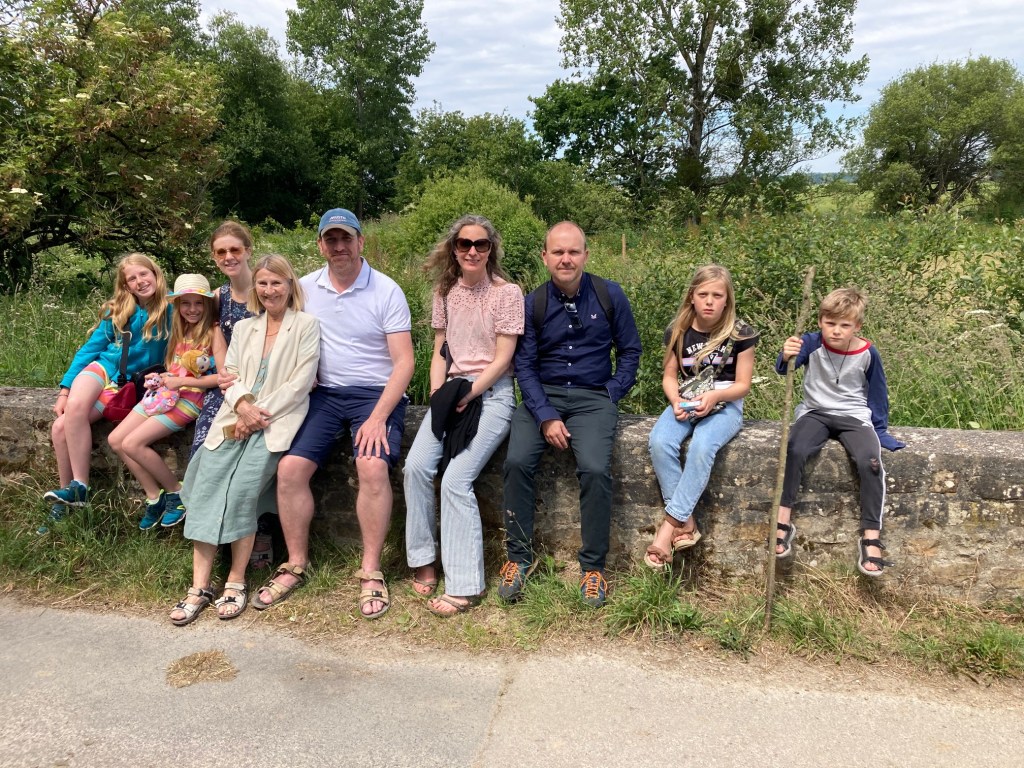
Family walk

It was a curious house, with eleven or so rooms on three floors,  not counting the basement, shielded from the road by some leylandia trees that would have benefitted from pruning. The owner who came to open up on our arrival is a Belgian vet from Liège. He was coolly unfriendly and showed us round the three floors in a rather perfunctory manner. The rooms were in good condition with well-painted walls and wooden floors, but the decor was totally random: a vast collection of toy animals, some very big colourful paintings including Mickey Mouse, a blow-up rabbit, a brown leather chesterfield with US army style cushions flanked by plastic chairs. There were enough plates and glasses and cooking pots for about forty people. Sadly some of the crockery was broken and a couple of glasses cracked. The garden was a delight for the children. Part jungle it housed a small swimming pool, sadly out of operation during our visit, and swings and a rope ladder up a tree and a giant trampoline.

Getting there

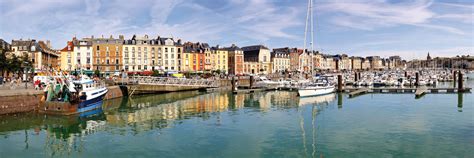
Susie and I had trained down from Edinburgh to Newhaven. We had a night in the Premier Inn, where we met up with children and grand-children. Newhaven-Dieppe is perhaps the oldest of the cross-channel routes, and the car ferry service dates from the early 1960s. But it has lost ground to the Dover ferries and the Channel Tunnel in recent years. We used this route a lot in the 1970s; when we lived in Paris and my parents were living in Sussex. And we were happy enough in those days to miss the ferry on a couple of occasions, which gave the opportunity for a leisurely lunch at a restaurant outside Dieppe.

Dieppe

Leaving Newhaven there is a good view of the Seven Sisters, the rolling chalk cliffs of the English coast. And there are similar chalk cliffs on the other side of the Channel, most strikingly at Etretat. As you approach Dieppe you can see very clearly the massive problems encountered by the disastrous Dieppe raid of 1942. Landings on the flanks totally failed to knock out the heavy German gun batteries on the cliffs at each end of the beach, leaving the Canadian soldiers dreadfully exposed as they attempted to get off the beach and across the wide esplanade. There is a new book on the Dieppe Raid by Patrick Bishop coming out next month. I see that my copy of Terence Robertson’s book Dieppe: The Shame and the Glory is stamped Shakespeare and Co., in Paris, where I must have bought it in about 1976. . 

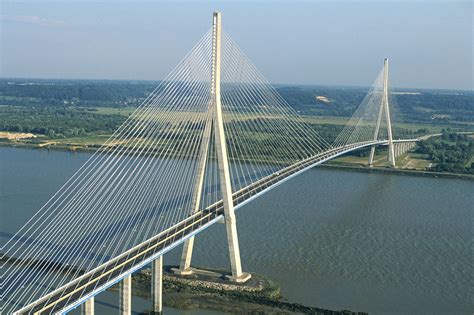
From Dieppe we drove [were driven, to be precise] inland to pick up the Le Havre motorway. In the 1980s I often used the night ferry into le Havre, and drove down to Paris across the Pont de Tancarville, an imposing suspension bridge that was first sanctioned by Pétain in 1940, but not actually completed until 1959. But the motorway now crosses the significantly newer and bigger Pont de Normandie. At a total length of just over 2,100 metres it was when it was built in 1995 the longest cable-stayed bridge in the world. There are splendid views from the bridge across the river Seine. Being a total wimp about heights and mountain roads and big bridges, I was glad that I was not driving.

Pont de Normandie

Utah beach

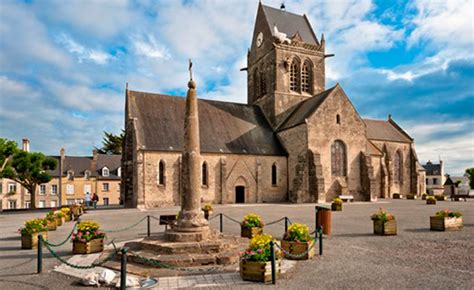
Montebourg is a short drive from Ste Mère Eglise, where units of the US 82nd Airborne and the US 101st Airborne divisions landed in the early morning of June 6th, 1944. In the central square a dummy paratrooper hangs from the church tower. This commemorates the story of paratrooper John Steele whose parachute caught on the tower. He hung there limply for two hours witnessing the fierce fighting below until the Germans cut him down and took him prisoner. [He is played by Red Buttons in the film The Longest Day.] Ste Mère Eglise is today effectively the centre of the Utah Beach tourist industry. When we were there we saw large numbers of American military personnel, who are currently deployed in Poland but temporarily in Normandy for the D-Day commemoration ceremonies. Replica US Army jeeps were for hire in the square, and significant numbers of American tourists were driving around channeling their inner Lee Marvin. The Airborne Museum at Ste Mère Eglise is the biggest of several local museums. We were struck by the frailty of the WACO gliders, each carrying 13 troops in addition to the pilot and co-pilot. They were made of fabric-covered wood and broke up all too easily on landing.

Ste Mere Eglise

l’Auberge de l’Ouve

Eating is of course a serious activity in France. In our Montebourg house different branches of the family took it in turns to cook for us to eat at the splendid dining table. One day we went out to lunch at l’Auberge de l’Ouve, an address which I had found in a 2008 Routard guide. It turned out to be a stone building in a hamlet overlooking the quiet river Ouve, flanked by mature trees. We were very fortunate. The inn had been closed for four years, but reopened earlier this year. 

‘lAuberge de l’Ouve

Our hosts were a young Norman chef who previously worked in Corsica and his Thai wife. From a quite short menu, the adults variously ate effiloché de porc [pulled pork in a cider sauce], filet d’eglefin linguine [haddock on linguine with slivers of chorizo and leek], lamb chops, and a steak. Followed by a chocolate pudding and an almond and pear tart. And we drank rosé and local cider. All their produce is locally sourced. The food was excellent. I want to go back for my birthday !

lunch at l’Auberge de l”Ouve

Back home

We came back by boat and train, and realised that we had missed all the Jubilee Celebrations. The photo  on the front page of the Sunday Times made me wonder whether the Queen was inviting Paddington Bear to form a new government. [Before he is deported to Rwanda as an illegal immigrant.] I am very sorry that we did not celebrate the jubilee by taking the opportunity to remove Boris as prime minister. Martin Kettle writing in The Guardian accuses the Tory party, and the Cabinet in particular, of being spineless and gutless for their failure to act. I think he is right. 

June 2022
Through a glass darkly – 75

Family matters

We went south for Peter’s funeral. Lucky to find a train given the growing chaos on Scotrail. which has just substantially reduced train numbers because of the shortage of drivers and threatened industrial action. We stayed with Jem and Anna in Watlington, the first time that we have seen them since they moved into their brand new house

Watlington is an attractive market town, a bit south of the M40, close to the Chilterns and to the Oxfordshire-Buckinghamshire border. It is often said to be the smallest town in England. But the historical records go back to the 8th century, and the town features as Watelintone in the Domesday Book of 1086. It was once distinguished for a large number of inns, owned by a local brewing family; but in the 19th century a wealthy Methodist bought six of them and promptly closed them down. In their place there is a flourishing artisan bakery and a well-stocked delicatessen and cafe. Watlington is also the red kite centre of southern England. A small group of Swedish and Welsh kites were introduced in 1989, and there are now said to be over 150 breeding pairs.

On the Ridgeway

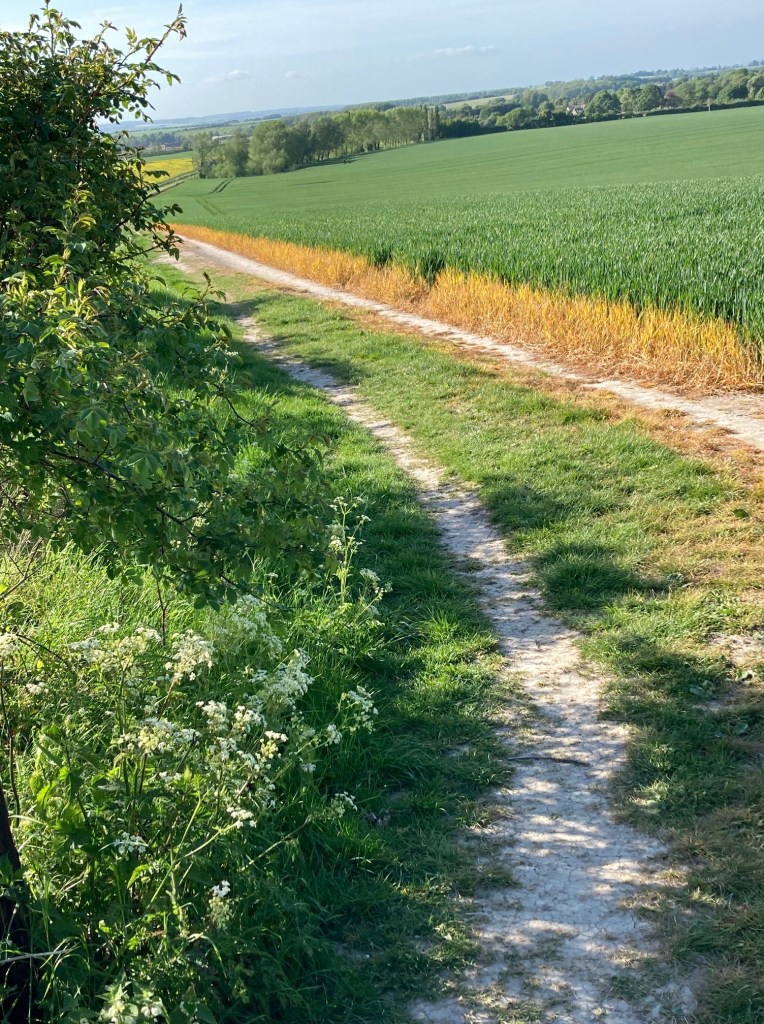
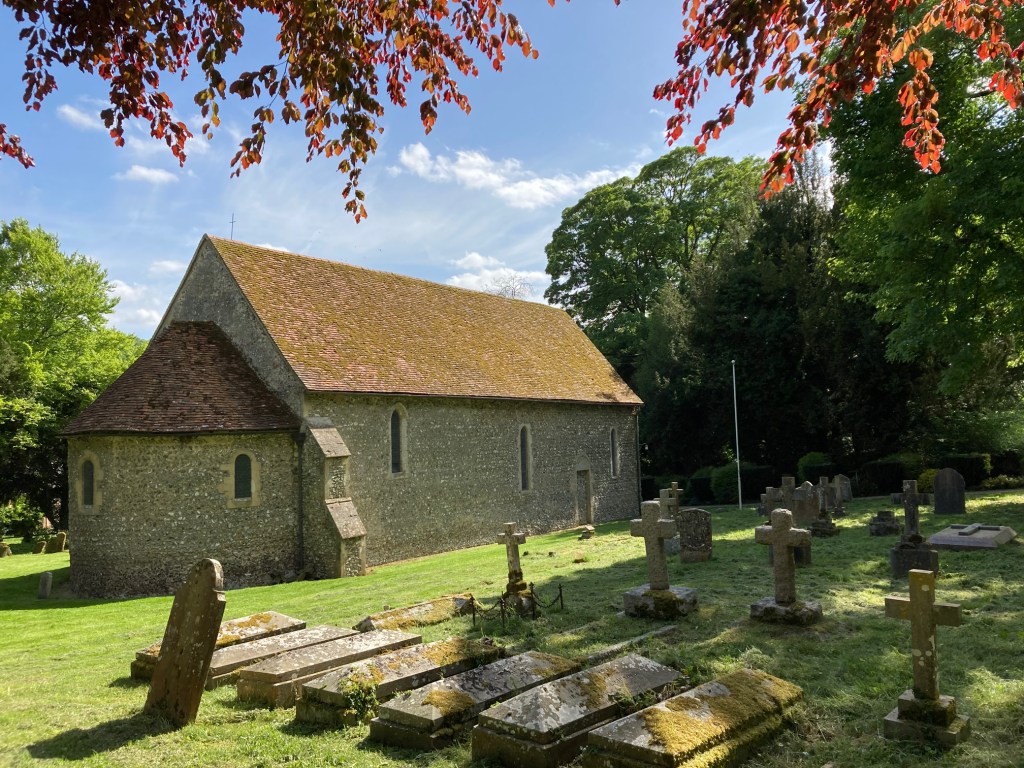
From Watlington there is easy access to the Ridgeway, an ancient track, part of the longer Icknield Way. The Ridgeway, which is sometimes described as Britain’s oldest road, runs for 100 or more miles across the chalk uplands of Wiltshire, Oxfordshire, and Buckinghamshire. On the Friday I walked down the Ridgeway to St Botolph’s church at Swynbrooke, a 1000-year-old church connected to St Botolph, a 7th century Benedictine monk and missionary. The church building dates from the late 11th century, but was extensively restored in the 19th century. The stained glass windows show links to the Benedictine abbey at Bec in Normandy. I met two cyclists in the churchyard, but otherwise the church showed little sign of visitors.

St Botolph’s church, Swynbrooke

On the Saturday I walked, again partly on the Ridgeway, to Ewelme, to meet up with the family for lunch [excellent] at The Shepherd and Hut. It was a very hot day [it seems to be generally warmer down south], and we  had to move from the garden to a table inside.

Pub lunch at Ewelme

Disgracefully I had got lost when my footpath disappeared close to Ewelme, and I ended up walking in a circle on field edges and had to hitch a lift from a passing farmer in a battered Land Rover.  I re-met the farmer, Mr Mearns, the following day, when we went to an evening Rogation service in the adjacent village of Britwell Salome. The service was held in his large barn behind the farm shop. About 70 people sat on hay bales, facing an array of tractors, and were joined by a cow and calf, a noisy cockerel and clutch of hens, an enclosure of piglets, another enclosure of young lambs, and another of adult sheep.  This is Vicar of Dibley country, and the service might well have featured in that series. I thought it was great; earthed, engaging, and quite short. And followed by excellent sausages and home-made cup cakes. All of which would encourage Oskar to go to church on a regular basis.

Rogation service, Berrick Salome

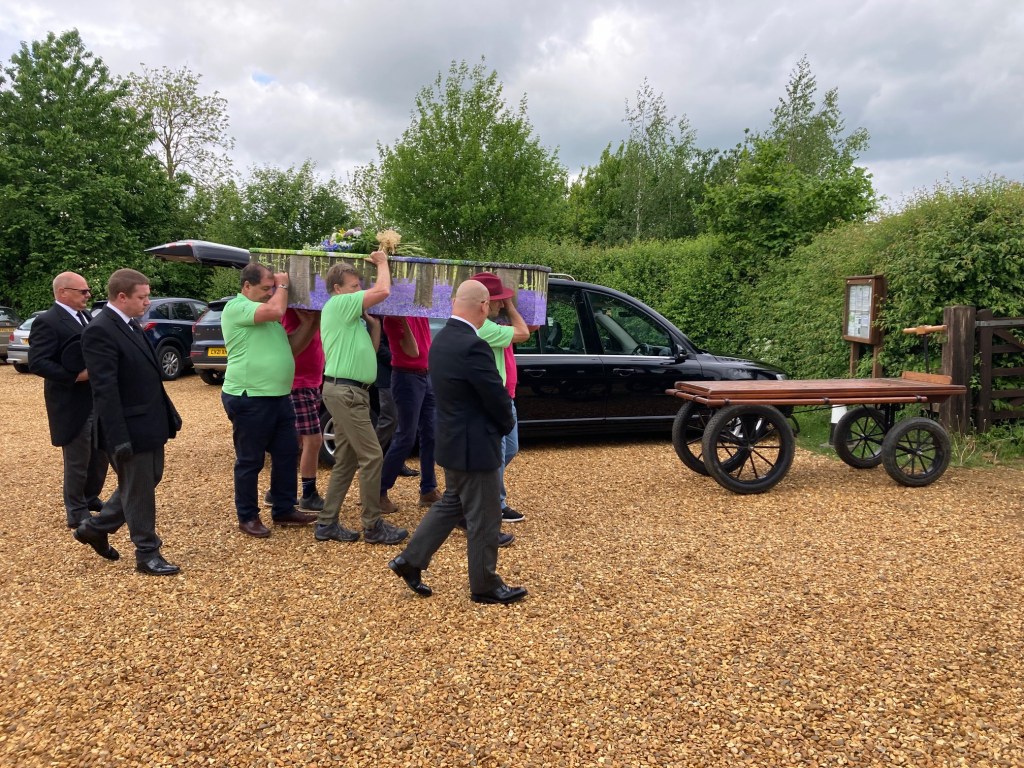
Jem drove us up to Sun Rising burial ground, between Banbury and Stratford, on the Monday. It was a dry, clear morning for Peter’s funeral. About 30 of us stood around the grave for the [humanist by choice] interment, but with a reading from Ecclesiasticus and a prayer of John Henry Newman. The pall-bearers were dressed in pink and lime green, mates from recent golf tours abroad. .And a lark sang overhead. Afterwards there were about 150 people at Compton Verney arts centre for a buffet lunch and ‘Celebration’. Dave, the humanist celebrant and MC, spoke well in his Eulogy, and other poems and memories followed. It was a colourful occasion with a lot of laughter.

Sun Rising burial ground

Susie and I trained back to Edinburgh after a couple of days in my other brother’s very comfortable house in Birmingham. When we got home we watched a programme on the tele about two people who had no known family or living relatives; one a woman in her late 70s who is the daughter of an unknown GI; the other a Jewish man of a similar age who had survived an early childhood in a Nazi concentration camp. The programme took DNA samples from them, and was able  to introduce both the people to cousins and family whom they never knew existed. We are fortunate to be part of a loving family network. Which is too easy to take for granted. And we are going away with the children and grand-children again next week, on a twice-postponed family holiday in Normandy. Of which more anon.

May 2022

Through a glass darkly – 74

A gloomy few months

As I’ve already indicated it has been quite a gloomy few months.  The news from Ukraine continues to be depressing; an unknown number of civilians including children are still trapped in bunkers beneath the giant steelworks, and the Russians seem unwilling to abide by the promised cease-fire and the humanitarian corridors. Closer to home there is a huge looming financial crisis. For families, I mean, not for energy companies. Shell have posted an unprecedented three-month profit for the last quarter of some £7 billion. Meanwhile our monthly energy bill threatens to rise to the level of mortgage repayments on a small house. Government policy seems to amount to no more than purchasing a small hotel in Rwanda and, thanks to George ‘Useless’ Eustice, advice on how to economise by buying own-brand baked beans at the supermarket.  In a generous gesture [forced on her by her husband’s colleagues] the Chancellors’s wife is now to pay UK tax on her significant overseas and investment income. But not to pay it retrospectively. No wonder that Blustering Boris looks like a decorative candle left on a radiator overnight. This morning there are rumours that a person in Scotland voted Conservative in yesterday’s elections. But that rumour is not yet substantiated.

Escaping the gloom

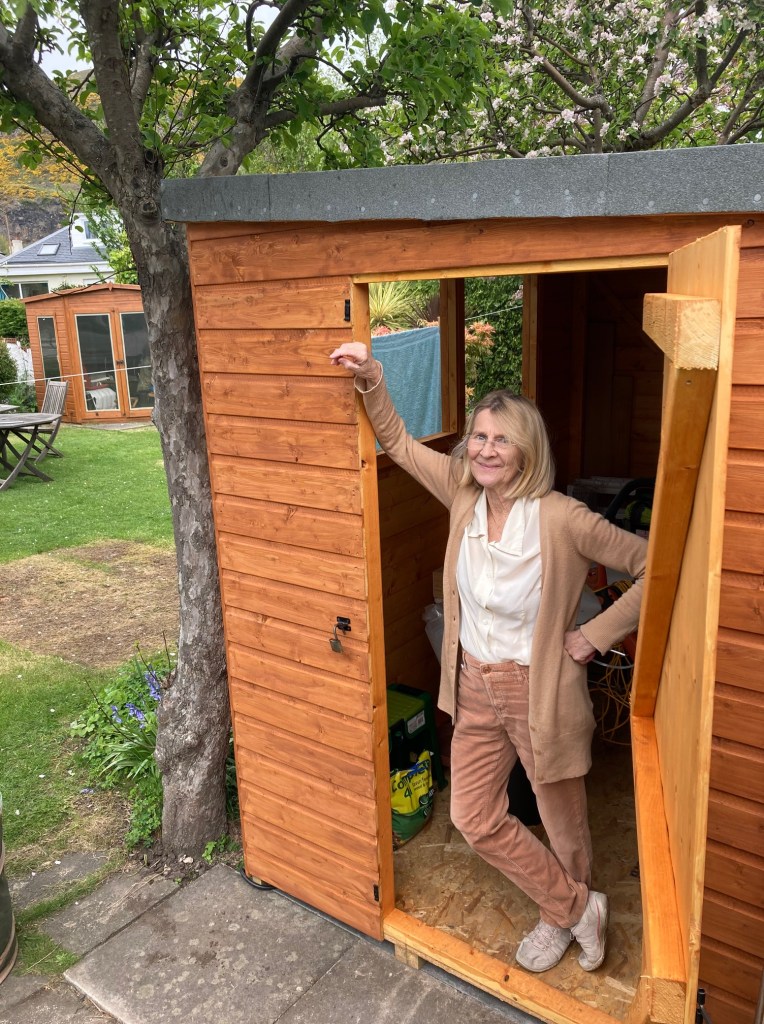
Personally I have retreated from the gloomy news by painting our very handsome new shed with Cuprinol. For the first coat I used a ageing, square tin [jerry-can] of Cuprinol which I found in the garage. Sadly I failed to ‘Shake well before use’. So the first coat began as akin to transparent nail polish, but at the bottom of the tin it morphed into something like old mushroom soup.  A second coat of nut brown has restored some kind of equilibrium.

Susie and the new shed

After a lengthy exposure to the grim history of twentieth century Ukraine [see TaGD, passim], I turned back to the pleasure of Donna Leon. Beastly Affairs, is the 21st [I think] of her Brunetti books. A dead man is found in a canal with no identification. He has Madelung’s disease. a rare disorder of fat metabolism. And is identified as a vet from the mainland. The trail takes Brunetti and his colleague Vianello to Mestre, to an uncomfortable encounter with the widow and her small son. And then on a nightmare visit to a slaughter-house, all blood and guts and sadism, described in uncomfortable detail. As ever with Leon’s books it is a story of private greed and institutional corruption. Which she takes as normative in the Italy which Brunetti inhabits. The final chapter, in which Brunetti and Vianello attend a funeral mass for the dead vet, and are  distracted by a variety of unusual and unexpected noises is an engaging and whimsical event. Very unusual for Leon.

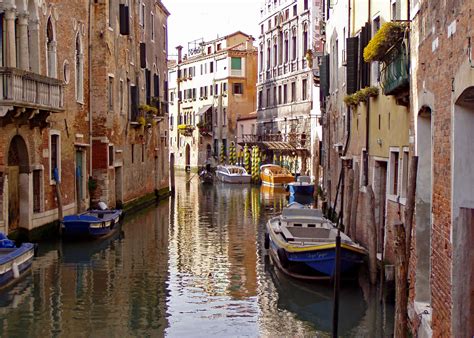
Venice

Her books give a pleasure for a mix of reasons. Yes, there is the Venice backdrop. But more important is the depth of Brunetti’s relationships: with the solid Vianello, now a vegetarian and ecologist; with the striking Signorina Elettra, flower lover and computer sleuth, brilliantly able to seek out a lot of supposedly secret information; with Elettra’s boss, Vice-Questore Guiseppe Patta; and with his wife Paola, daughter of a noble Venetian family, university teacher, and passionate admirer of Henry James. I wonder how much Paola is based on Donna Leon herself, who has lived and taught in Venice for some thirty years.

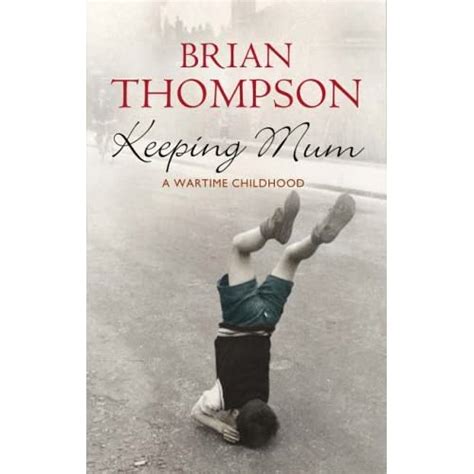
Keeping Mum

Scanning The Times one Saturday, I came across an obituary for Brian Thompson, a writer of whom I had never heard, with high praise for his book Keeping Mum: A wartime childhood, published in 2006.I found a copy in the central library on George IV Bridge. [Along with Patrick Marnham’s War in the Shadows, of which more another time.]

Brian Thompson: Keeping Mum

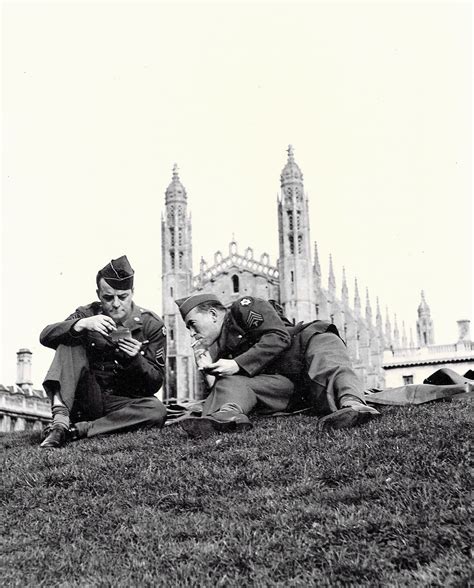
Thompson grew up on the outskirts of Cambridge during the Second World War. He was the first child of a loveless [dysfunctional] marriage. His dad, Bert, was a Post Office engineer [linesman], from a poor London background, but determined to get on in the world. Which he does in 1940 by volunteering for RAF aircrew. As he explains to his young son:

I realised he was giving me his Clark Gable. My mother [a rather crazed Vivien Leigh] joined us with two flowered tea cups. There was much more of this suppressed danger in the adult conversation that followed. I utterly failed to register the importance of what was being said and wandered away … … Soon , what had been promised arrived. The shouting began and there was the sound of breaking crockery.”

With his father gone, the radio is turned to dance music, tea is sweetened with jam, and his mum sleeps in her fake fur coat. And takes up with Yanks from the base. Thompson is farmed out to aunt Elsie in New Malden, whose house has an Anderson shelter erected indoors. They spend the nights there with a bottle of tap water, and the family Bible, and a first aid kit in a pink biscuit tin. A flying bomb, a V1 rocket, lands uncomfortably close, and they are dug out the following morning by the emergency services. “The house had been cut in half as if by a bread knife.”  Thompson returns to the house in Cambridge, now smelling of Lucky Strike tobacco and a cheap perfume called Blue Moon. He helps to draw seams down the back of his mum’s legs with an eyebrow pencil. “She was probably at her happiest in the three or four brief years the Yanks chased after her. She loved dancing, wore clothes with a wild, untutored flair, and milked the men she met unmercifully for love and romance. Her sense of her own worth was non-existent.

Cambridge in the 1940s

Away from Cambridge the boy visits his father’s parents; Jockie and Queenie Thompson who live in a tiny house crammed with bicycle gear in Lambeth Walk. Laid out in empty tobacco tins are odd nuts and bolts that his grandfather had scavenged from the gutters of Lambeth Bridge Road. Jockie had served in a cycle battalion in the Great War, and sang the songs of that war still “in a voice like a choking dog.” He has an occasional job bundling up copies of the Evening Standard. From which he is wont to return ‘a bit aeriated’.

Thompson acquires a bicycle and is offered a place at the County High School for Boys.

I consulted Gloria Wilkes, the girl who considered me common.  She gave the grammar school the thumbs up, since it was her uncle’s old alma mater and Uncle Richard, as she called him, had gone on to be an assistant harbour-master in Dover. Gloria was aiming higher: she was going to be a doctor when she grew up.”

He goes to the grammar school, discovers books, joins the library. He and Gloria hang out in the evenings, swapping notes about school, leaning on their handle-bars. His education progresses in other ways when Gloria invites him into her father’s shed one Saturday morning. She tells him how her grandfather was killed falling out of a car in Snowdonia. The romance does not last. “Thank you for coming to see me on Saturday. I learnt a lot about you. Yours sincerely, Gloria Wilkes.

What might have been a ‘misery memoir’ is rescued by Thompson’s humorous depiction of his younger self. And by a series of set-piece comic moments. Such as his school dance:

A five-piece band was hired, of elderly men in claret blazers, their hair pasted down with Brylcream … … The pianist was at least my grandfather Jockie’s age.  The quicksteps were poorly supported but there was much pleasure in watching the staff arise en masse for the waltz and the foxtrot. This was the first school dance since the winter of 1940 … … As [the Headmaster] spoke, the swing doors opened silently behind him, and my mother slipped into the hall, her hair pinned up, wearing a button-through floral dress. On her feet were the famous Cuban cork sandals. With the genius of the deaf, she had caught the mood of the moment and was smiling demurely. As the headmaster finished with a command to the band to let rip, he glanced round, saw her standing there, and walked towards her with both hands extended …” A triumph for them both.

The first ever family holiday, in a boarding house in Clacton, with his father in knee-length khaki shorts and a copy of the Daily Telegraph under his arm, is a major disaster. “Have you come far ?,” the Good Samaritan asked me. ‘From Paris’. “Lucky chap. And what did you like about it best ?” ‘The Eiffel Tower’ … …’ The man patted my shoulder and lit a Gold Flake.”

Thompson gropes a beefy backstreet girl, Sonia, behind the garden shed. He plays rugby for the school against other local schools, including the feared Bedford Modern. He is beaten by the headmaster for mistreating a young probationer science teacher known as Voodoo Lil. Forming a school jazz club widens his horizons. Mahalia Jackson is booked to appear at the No. 3 touring theatre in Cambridge. When the curtain goes up, the audience comprises seven schoolboys, and she bursts into tears. She is persuaded to sing one song. “Hop it, boys”, says the stage manager.

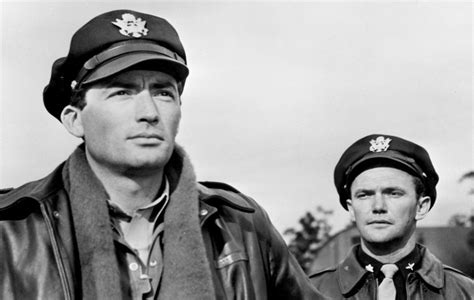
Thompson’s screen heroes are Robert Mitchum and, supremely, Gregory Peck in Twelve O’Clock High. “Are you American ?’, asks a woman outside the cinema, “staring at my newly purchased zoot suit and a haircut that was known to the barbers as a duck’s arse.” He looks carefully in the mirror at his Cecil Gee suit. “This was a suit made for homicide on the sidewalk . … … In Cambridge, modelled by some skinny kid who had yet to shave, its magic was diluted.”

Gregory Peck in Twelve O’Clock High

Suddenly O levels are on the horizon. He falls for a girl with grey eyes called Figgie who barges into him in Boots, and he takes her to Joe Lyons. Figgie likes Al Martino and worships Gregory Peck. Together they have an almost adult night out, down in the West End, at South Pacific.

When the exams are over he sets off by bike with Teeth Harris, planning to take the ferry to Calais and to cycle down to Paris. Their first day in France is severely curtailed by an encounter with four drunk Swedish sailors. After which they wobble onwards to camp in a potato field, pausing only to buy two bottle of peach brandy “which we supposed to be the drink of Parisian sophisticates”. They never get to Paris, defeated by cobbled roads and cheap alcohol. 

The lowest point of the trip came when we wandered through a stand of pines by the coast and found a sandy hollow to our liking. It was night and we pitched the tents at least to the extent of inserting the poles and spreading out the stained cotton. In the morning we were woken by three polite Frenchmen who pointed out that we were in a fairway bunker of the very prestigious Le Touquet golf course. One of the player’s balls was trapped under our bikes.”

Le Touquet golf course

Read it if you can find a second-hand copy. I’m now looking out for the sequel which is called Clever Girl. It’s certainly more fun than watching the tv news or reading about blustering Boris.

May 2022

Through a glass darkly – 73

My younger brother died on Tuesday evening. Peacefully in a hospice some two miles from their home in Leamington Spa. In the middle of the twentieth century about 14 million people were killed in Eastern Europe; today’s Poland, Belarus, Ukraine, and western Russia. I guess it may be a preaching cliché to say that one death is a tragedy; a million deaths are a statistic.

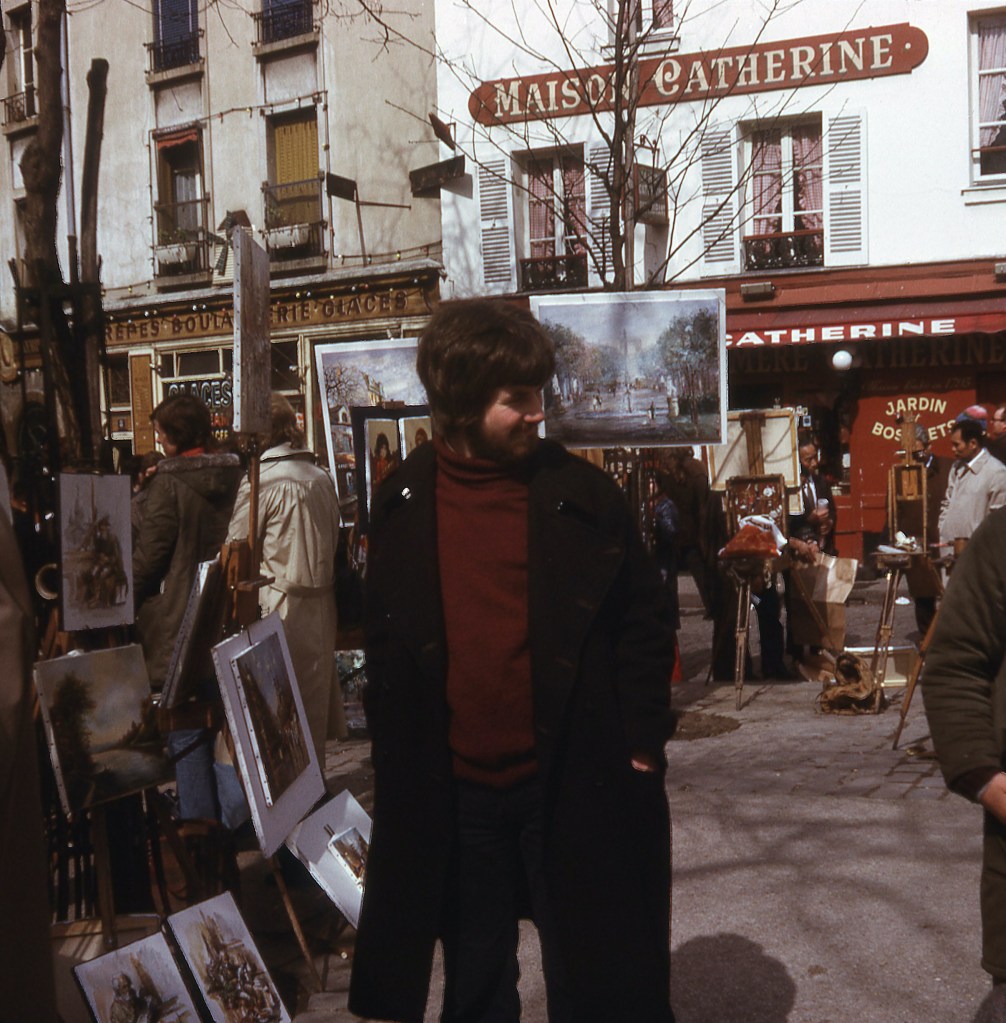
Peter, in Montmartre, 1975

When we were in Kyiv at Christmas [it starts to seem a long time ago], a friend in Lyon said that I ought to read Timothy Snyder’s Bloodlands. I have just finished reading it, and it is one of the gloomiest books that  have read for a long time.

Timothy Snyder is an American writer and historian, born in 1969 in Dayton, Ohio He did a doctorate at Oxford, subsequently held fellowships in Paris and in Vienna, and is now Professor of History at Yale. He is said to speak five languages and to read ten, and he specialises in the history of Eastern Europe. His best-known book, Bloodlands: Europe between Hitler and Stalin, was published in 2010. Reviews rated from the rapturous – “An original, wonderful, and horrifying book … … this beautifully written and superbly researched work is undoubtedly one of the most important to emerge for a long time”, wrote Antony Beevor,  to the highly critical. One Holocaust scholar, Andrew Ezergailis, thought the title was eye-catching and the writing good, but maintained “it is not a book of high scholarship”.

Snyder’s ‘Bloodlands’ extended from central Poland to western Russia, embracing Ukraine, Belarus, and the Baltic States. During the consolidation of National Socialism and Stalinism [1933-1938], the joint German-Russian occupation of Poland [1939-41], and the German-Soviet War [1941-45], mass violence was visited on this region on an unprecedented scale. Snyder calculates that the Nazi and Soviet regimes together murdered some 14 million people. The victims were chiefly Jews, Belarussians, Ukrainians, Poles, Russians, and Balts. The majority of them were the victims of murderous policy rather than casualties of war. The majority of them were women and children, and the elderly; none were bearing weapons, and many of them were stripped of all their possessions, including their clothes. The worst of the killing began when Hitler betrayed Stalin, and the German forces invaded the recently enlarged Soviet Union in June 1941.

Snyder acknowledges that the sheer scale of the killings can blunt our response. Compassion fatigue. “I’d like to call you all by name”, wrote the Russian poet Anna Akhmatova in her Requiem, “but the list has been removed and there is nowhere else to look.” Snyder’s book looks at the Nazi and Soviet regimes that perpetrated the atrocities; it describes the ideologies and the plans, and the systems employed, for killing on an industrial scale. At the same time, by calling as witnesses some of the survivors, such as Anna Akhmatova and Hannah Arendt and Günter Grass and Vasily Grossman,  it seeks to give a voice to the victims and their families.

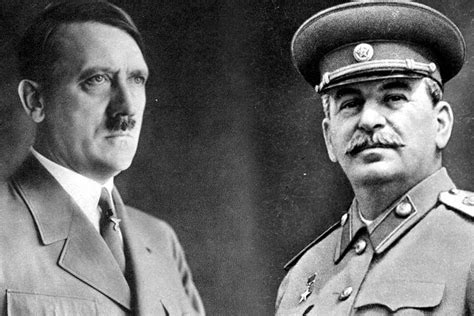
Hitler and Stalin

In the early 1930s both the Soviet and Nazi governments seemed to offer a response to the world economic collapse; a more dynamic vision than liberal democracies who seemed unable to rescue people from poverty. The Nazis proposed to address Germany’s shortage of foodstuffs by exporting its farmers to a new eastern empire, by taking agricultural land from Polish and Soviet peasants. Stalin’s first Five Year Plan was based on the expansion of heavy industry, which in turn depended on collectivised agriculture. The policy was a disaster, especially for the Soviet Ukraine. Famine was widespread; a boy born in 1933 had a life expectancy of seven years. Rafal Lemkin, the international lawyer, called the Ukrainian action “the classic example of Soviet genocide”.

Stalin’s second revolution in the Soviet Union, collectivisation and the subsequent famine, was overshadowed by Hitler’s rise to power in Germany. Both Stalin and Hitler worked to build one-party states with a powerful police apparatus capable of massive violence. Both Nazi Germany and Soviet Russia declared war on internal enemies. For the Nazis this meant the Jews, and also “asocial elements”, homosexuals, vagrants, alcoholics and drug addicts, and Jehovah’s Witnesses. The repression of these undesirable groups led to the creation of a network of concentration camps. Meanwhile, in the Soviet Union, Stalin and Yezhov embarked on the physical liquidation [shooting] of the entire ‘counter-revolution’,  prominently the kulaks and Ukrainian nationalists.

People belonging to national minorities “should be forced to their knees and shot like mad dogs”. This is not an SS officer speaking, but a communist party leader in the spirit of Stalin’s Great Terror. Stalin was a pioneer of national mass murder and Poles were the leading victims among the Soviet nationalities. Nazi Germany and the Soviet Union found common ground in their shared desire to destroy Poland. In the twenty-one months that followed the joint German-Soviet invasion of Poland in 1939, the Germans and the Soviets would kill Polish civilians in roughly equal numbers as the two allies each sought to master its half of occupied Poland.

Things in eastern Europe got even worse in June 1941 with the German invasion of the Soviet Union, Operation Barbarossa. Some ten million soldiers died fighting on the eastern front. And during this war Snyder estimates that the Germans killed another ten million civilians, including five million Jews and three million prisoners of war. The German prisoner-of-war camps in the East were deadlier than the German concentration camps. Ivan Shulinskyi, a Ukrainian prisoner, the son of a deported kulak, kept himself alive in German captivity by singing a Ukrainian song:

If I only had wings,

I would lift myself to the sky

To the clouds

Where there is no pain and no punishment.”

As many Soviet prisoners of war died on a single day in autumn 1941 as did British and American prisoners over the course of the entire Second World War.

Belarus was the centre of the confrontation between Nazi Germany and the Soviet Union. Its cities were battlefields for advancing and retreating armies; its towns contained Jewish settlements destroyed in the Holocaust. Minsk was a centrepiece of Nazi destructiveness. German policy in occupied Minsk was one of savage and unpredictable terror. The Nazis planned to level Minsk to the ground and to replace it with a new city, Asgard, named after the mythical home of the Norse gods. But Jewish resistance in Minsk and in Belarus was stronger than elsewhere in Europe, and young people were caught in a deadly confrontation between German forces and Soviet partisans.

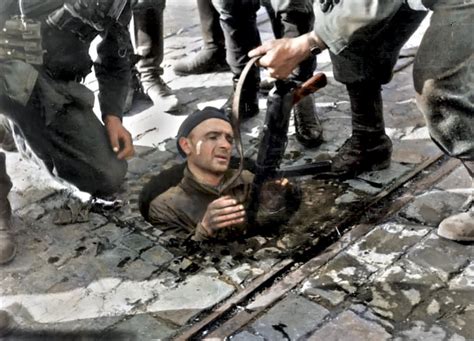
The centre of urban resistance to Nazi rule in occupied Europe was in Warsaw. Both Poles and Jews led uprisings against Nazi rule, separately and together, in April 1943 and August 1944. The Warsaw Uprising of August 1944 was planned as part of Operation Tempest, a national uprising that would give Poles a prominent place in the liberation of pre-war Polish territory. Neither the British nor the Americans were in a position to offer any meaningful support. Stalin appeared to encourage the uprising, but then declined to provide any Soviet assistance, as the Red Army halted operations at the Vistula. Both George Orwell and Arthur Koestler protested: Orwell wrote of the “dishonesty and cowardice” of the Allies who refused to become involved; and Koestler called Stalin’s inaction “one of the great infamies of the war”. No other European capital suffered as Warsaw did: the city was destroyed physically and lost perhaps half of its population. Churchill seemingly did ask Stalin to help the Poles, but received no response. Snyder points up the irony with great precision: “Great Britain had gone to war five years earlier on the question of Polish independence, which it was now unable to protect from its Soviet ally”. 

Many years ago, as a would-be cineaste, I sat in the Vogue cinema in Tooting to watch  the Polish director Andrzej Wajda’s war trilogy. [As I recall the Vogue still had usherettes selling Kia-Ora drinks from trays in between films. And I think the usherettes also sold cups of tea. It was certainly a very draughty cinema. But I may be confusing it with the Tooting Classic.]   A Generation [1955] is about a group of young men and women fighting in Occupied Poland; Kanal [1956] is the terrible story of the Warsaw Uprising; and Ashes and Diamonds [1958] is about a bungled attempt to assassinate a newly arrived Communist party official. Derek Malcolm calls the trilogy “one of the finest achievements of Eastern European cinema”. The films are characterised by a deep sense of a fractured national identity, yet pay tribute to the resilience of the human spirit and the struggle for personal and national freedom.

I didn’t enjoy reading Bloodlands. There were just too many acts of bestiality and too many killings. But Robert Gerwarth, in the Irish Times, thought that “the book brings back to life some of the forgotten voices of those who died in the bloodlands. The Nazi and Soviet regimes turned people into numbers, but Snyder reconnects the broad narrative of Eastern Europe’s unparalleled tragedy with its intimate impact on the lives of individuals.

Bloodlands

Sadly, the book reminded me that the recent atrocities and war crimes committed by Russian forces in places like Bucha and Chernihiv and Izyum, and above all in the wastelands of  Mariupol, are nothing new in that part of Europe. We pray on, for peace for the people of Ukraine, and for a better world.

April 2022

Through a glass darkly – 72

Passion Week

Question:   What’s the difference between a lawyer and a wounded buffalo ?

Answer: A lawyer charges more.

A well-dressed man goes into a pub with a crocodile on a lead and asks ‘Do you serve lawyers here ?’ ‘Yes, certainly, Sir’, says the barman. ‘In that case, I’ll have a pint of bitter for me and a lawyer for my crocodile.

Man with a large crocodile

That was how the minister began his reflection this morning on the latter verses of Mark 12, the condemnation of the scribes by Jesus. The minister in question was himself a lawyer before his ordination, so I guess he knows what he is talking about.

By tradition Newington Churches together have a shared service daily at 7.45am during Passion Week. Held in Craigmillar Park Church of Scotland. The local ministers take it in turns to offer a bible reading and a short-ish reflection, and we sing a couple of hymns. And there is breakfast in the hall afterwards; muesli or cornflakes, white rolls and butter and marmalade, tea and coffee. All served by an efficient team from Craigmillar Park. There are familiar faces from the local congregations, and it seems an appropriate way to mark the transition from Lent into the Passion Story. Although it sometimes feels as if there is a table marked ‘Ministers and scribes only’ !

Palm Sunday 

Palm Sunday has always felt like a significant festival to me. The liturgical colour is red. Which is appropriate for the story of Jesus’s triumphal entry into Jerusalem with the crowd waving palm branches as they shouted:  

Hosanna to the Son of David. 

Blessed is he who comes in the name of the Lord.

Palm Sunday procession

We never managed to source a donkey [or two] for the service, neither in Duns nor in Lyon. And I suspect that too often our Palm Sunday liturgy failed to do justice to the excitement and the sense of anticipation and the raw energy of the original entry into Jerusalem. I am reminded of David Leitch’s account [in God stand up for bastards]  of his covering the very dramatic, eleven-hour visit of Pope Paul to Jerusalem in 1964, at a time when the Vatican did not officially recognise the state of Israel. A visit attended by hysterical crowds.

But the red also signifies danger. As Harold Wilson once said, ‘A week is a very long time in politics.’And we know as we gather on Palm Sunday that the coming days will bring rejection and betrayal, arrest and a trumped up trial, and [almost] finally a very public execution. Which is why we pray the Palm Sunday Collect:

True and humble king,

hailed by the crowd as Messiah:

grant us the faith to know you and love you,

that we may be found beside you

on the way of the cross,

which is the path of glory.

Passion Week

It was good to be at Melrose Sevens last Saturday afternoon, though cold in the sunshine. I realise that I have been going there on and off, on the second Saturday in April, since 1979. When Stewart’s Melville FP beat Kelso in the final. In recent years the number of guest teams has increased, as has the number of catering outlets. There were certainly some very classy guest sevens on Saturday.

At Melrose Sevens, 2022

Rugby apart, I am finding Passion Week difficult this year. Partly because of the continuing bad news from Ukraine. The encouragement of the withdrawal of Russian troops from the north and from menacing Kyiv has been totally negated by the uncovering of a succession of war crimes, perpetrated by [very young] Russian soldiers against civilians, Ukrainian women and children. We are doing a talk at a local church tomorrow on our time in Kyiv. And it almost seems indecent to propose to show a lot of photographs of the city and the country as it was prior to the invasion.

Closer to home my younger brother has been in a hospice since last Thursday. His life seems to be drawing to a close, but we have no idea how many days, or possibly weeks, are left. We were very pleased to see him down in Warwickshire last month. And we have no plans to dash down and see him. But his wife and their two daughters are much in my thoughts and prayers. Perhaps relatedly I feel a sense of heaviness in recent days, and find that is much easier to fall asleep after lunch. Meanwhile, I will be taking Communion to Bob this afternoon in the Royal Infirmary where he is recovering from invasive surgery.

Peter in Berwick-on-Tweed, 2021

I may not make the Passion Week early service tomorrow. But I very much doubt if there will be any jokes about crocodiles.

Collect for Good Friday

Eternal God,

in the cross of Jesus

we see the cost of sin

and the depth of your love:

in humble hope and fear

may we place at his feet

all that we have and all that we are,

through Jesus Christ our Lord.

April 2022

Through a glass darkly – 71

All religions will pass, but this will  remain,

simply sitting in a chair and looking into the distance.”

Vasili Rozanov

This aphorism prefaces the opening chapter of Richard Holloway’s 2004 book Looking in the distance. Richard notes that the words served as a prompt to his own life; as he was drawn from his first encounter with romantic, incense-filled religion in his hometown in the west of Scotland into a heroic quest for something that remained too often elusive. The story is told in his 2012 book Leaving Alexandria: A Memoir of Faith and Doubt. A beautifully written memoir which drew admiring reviews from Christians and non-christians alike. “So compelling and so intense. Nobody, whether interested in religion or not, could fail to be intensely moved”, wrote Mary Warnock in the Observer, “… What a deeply lovable man; and what a wonderful book.” 

Leaving Alexandria

In Looking into the distance, Richard claims to recognise himself in the A.S.J. Tessimond poem Portrait of a romantic

He is in love with the land that is always over

The next hill, and the next, with the bird that is never

Caught, with the room beyond the looking-glass 

… … 

He is haunted by the face behind the face

He searches for last frontiers and lost doors

He tries to climb the wall around the world.

He gave his life to that search, becoming successively an Anglican priest, a bishop, and then  Primus {presiding bishop] of the Scottish Episcopal Church. “Now forty years, and many battles later, it has passed and I am left sitting in the chair and looking into the distance.

Richard Holloway

Clearly Richard doesn’t spend all his time sitting in a chair gazing quizzically into the distance. Since he retired as Bishop of Edinburgh in 2000 he has written almost a dozen books, many of them looking at the Christian faith from a sympathetic, fellow-travelling stance. Some have liked to label him as a post-Christian bishop. Though I think that may be a bit simplistic. He was my bishop during the twelve years that I served in the Edinburgh Diocese. It is a small enough diocese to have direct contact with the bishop. I liked him a lot, but I found myself out of sympathy with his generally liberal views abut all sorts of issues. And his frequent declarations of support for gay and lesbian Christians, and for the recognition of same-sex relationships, didn’t play well in my own parish in the predominantly conservative church culture of the Scottish Borders. But I recall he wrote me a very nice letter when we went off to Lyon in autumn 2000.

Shortly before we left for France he came down to preach in Duns. And used as a text something he had found on a fridge door in New York. “I get most of my theology from fridge doors nowadays”, he said.  And later “ I’ll read you a couple of lines from a poem by Philip Larkin, and I’ll bowdlerise them in case there is a reporter from the Daily Mail present.” [There was. Lord Palmer’s brother] The Duns congregation loved him.

A couple of weeks ago Richard came to speak, at St John’s, Princes Street, to an occasional meeting of SARAC. An association of retired Anglican clergy in Scotland, which was encouraged into [a precarious] life a few years ago by the late Ken Gordon from Aberdeen. The topic was Forgiveness. The turnout was very modest, and we sat round a couple of tables as Richard spoke before we moved into a general conversation.. 

Forgiveness

Much of what he said was in his 2002 book Forgiveness. He wanted to believe that scripture has given us many of the best stories and metaphors. He quoted from Hannah Arendt; to the effect that things [and relationships] remain stuck until forgiveness takes place. He distinguished between corporate forgiveness and individual forgiveness. He didn’t suggest that any of it was easy.

There was the inevitable question about Putin’s invasion of Ukraine and the unfolding war crimes. Richard pointed to what had happened in South Africa, the work of the Peace and Reconciliation Commission, inspired by Desmond Tutu, and to the Good Friday agreement in Northern Ireland, as examples of intractable problems being turned around by a willingness to forgive. There was more discussion about individual forgiveness. And about how difficult it can be to forgive ourselves. Richard encouraged us not to set impossibly high standards for ourselves. Acknowledging that we will always fall short. He acknowledged too that, even when we forgive ourselves, our dream life does not always get the message !

The attendance was disappointing. And some of the problems continue to be difficult. But Richard is an excellent communicator; wise, humane, and, as Mary Warnock noted, lovable. Which is perhaps not something that you could say about a lot of Anglican bishops.

April 2022