Through a glass darkly – 26

Generally I don’t read a lot of theology. Perhaps not as much as I should. But I’ve been reading an excellent new book [published this year] by David Smith: Stumbling towards Zion: Recovering the Biblical Tradition of Lament in the era of World Christianity. It’s quite a long title, but the book itself is a manageable 130 pages plus two appendices and a wide-ranging bibliography. The book comes from Langham Global Library in a sombre cover, which reflects a part of the content.

Before going further, I should declare an interest: I have known and appreciated David for some three decades, since the time when he was Principal of Northumbria Bible College, in Berwick on Tweed, and we were along the road at Christ Church, Duns. During that time he has encouraged me to do some serious reading, and to think more widely and more creatively about ministry and the Christian faith. He encouraged me to sign up for the MTh course on Mission in an Urban World at ICC, Glasgow, 2006-09, on which he was the lead tutor. During that course he led the cohort study visit to Nairobi, which was an eye-opener for several of us coming from a very different church culture here in the UK. David preached for us at Duns and then again at the Lyon Anglican Church, always offering us a new and different perspective. He has written several challenging books, including Mission after Christendom, which I found immensely helpful. And he and Joyce were good friends to Susie and me; before Joyce’s untimely death in 2014.

As the title suggests, the new book is about the way in which we present ourselves and our lives to God in worship and prayer. David has a gift for bringing together biblical exegesis, a wide variety of theological writings, many from outside Europe, and his own personal experience. In the preface, David recounts how his wife Joyce’s suffering and death from a brain tumour brought him a renewed appreciation of the biblical tradition of lament. Too often the contemporary emphasis on celebration in worship  ignores the real suffering and struggles of people within the congregation, and also the crises that threaten the future of our world,. This seeming indifference to many of the serious issues that threaten our planet undermines the credibility of our faith.

Back in 1981 Robert Davidson wrote a book called The Courage to Doubt: Exploring an Old Testament Theme, which highlighted the tradition of lament in the Old Testament. The book resonated with David at a time when he was experiencing reverse culture-shock after years of teaching in Eastern Nigeria. “How could the Christian community be so relentlessly happy and untroubled in a world filled with injustice, oppression and violence ?”  In the university world of Aberdeen, David met people who were alienated from institutional Christianity but keen to ask profound questions about the meaning of human existence. Claus Westermann wrote in his work on the Psalms: “Praise can retain its authenticity and naturalness only in polarity with lamentation.”

The disappearance of lament was particularly strange at a time when historians, looking at two World Wars and the Holocaust, were labelling the twentieth century as ‘the age of catastrophe’.

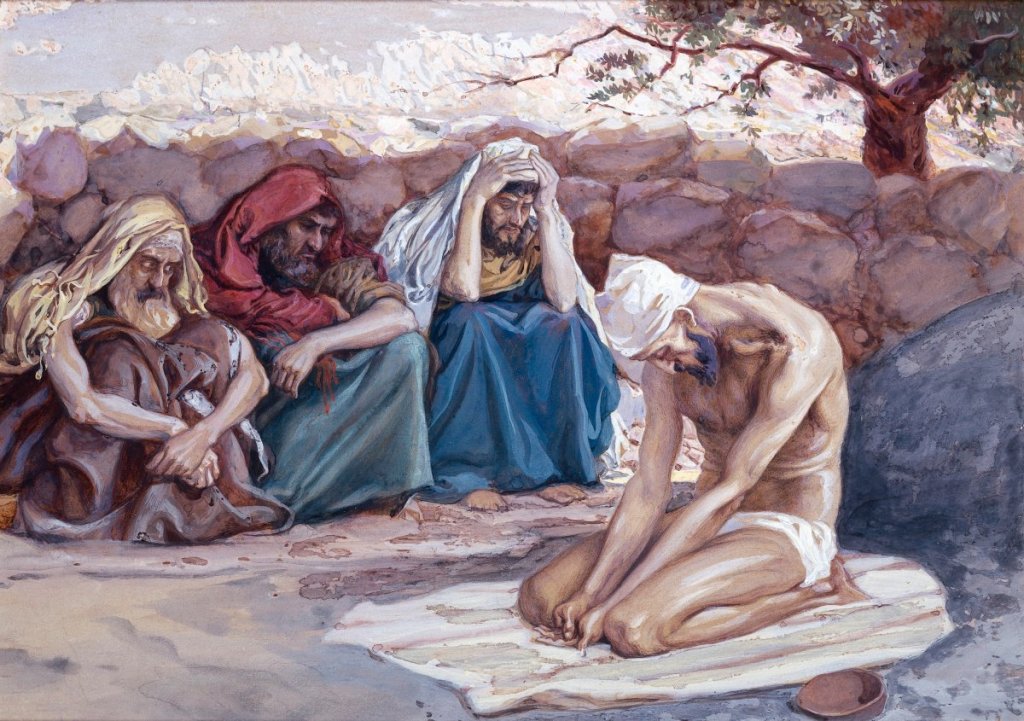
When David travelled to Pakistan in 2017 to lead studies for poor pastors from the Sindh, he was guided to offer reflections on the story of Job; “the clearest expression of the counter-testimony of Israel” The book of Job first describes the external events which devastated Job’s life, and then the internal anguish which followed. Alienated from his dogmatic friends, Job reveals an awareness of other human beings whose lives have been marked by oppression and injustice [24: 1-22]. And he also recognises that much of this evil and injustice has human causes. In his response [42:7-8], God seems to reject the theology of the ‘comforters’; and hints at God’s own struggle to restrain the powers and evil and to bring about the promised healing of a broken world.

Job and His Three Friends , Artist: Tissot, Photographer: Richard Goodbody, Photo © The Jewish Museum, New York

Where Job reveals the depths of spiritual crisis in the life of an individual, Lamentations reflects the impact of catastrophe on an entire community. The repeated cry of the desolate survivors of the destruction of Jerusalem is that ‘there is no-one to comfort them’ [Lam 1:9, 16, 21; 2:9; 3:8, 44]. This is a very contemporary message. Kathleen O’Connor notes “for the survivors of civil wars, destroyed cities and genocides, for refugees, and for those who subsist in famine and destitute poverty, the poetry mirrors reality with frightening exactitude”. A sentiment echoed by the Filipino scholar Federico Villanueva. Ironically Lamentations is best known to many for the verses that mark the sudden appearance of hope in chapter 3 [Lam 3: 22-24]. Verses wrenched inappropriately from their context. But David acknowledges that light can break through at the darkest moments; close encounters with death or wickedness can provide the soil in which faith comes to birth.

It is sometimes assumed that lament has no further place after the coming of Jesus. Not so. Commenting on the birth narrative, Ulrich Mauser contrasts the peace of God with the Pax Romana, in the name of which Jesus was executed. Mauser insists that peace on earth is initiated by Jesus, but it has not yet conquered the world. Salvation is both now and not yet. The gospels are “not fairy stories in which a paradise restored is offered without regard to competing and hostile realities”. The public horror of the Cross left Jesus’s supporters weeping and wailing [Luke 23:27]. David argues that “there is a danger that we move too quickly from the cross to the empty tomb with the result that theology becomes associated with abstract theories of atonement  which are invariably divorced from the harsh reality of the historical death of Jesus at Calvary”.

David draws attention to Easter Saturday, to the reality of “that long, desolate Sabbath” which bisects death and resurrection; which is too often ignored as a meaningless hyphen. He sees the Grunewald altar-piece in Colmar as a visual aid for the Easter story. Contemporary, western culture is often marked  by despair and a sense of abandonment. So,  So, David concludes, “the gospel  …  must be shared, not with a triumphalistic spirit, but with humility, compassion, and a transparent honesty concerning faith’s own struggles with the tragedies that persist in an Easter Saturday culture”.

In the latter chapters, the book encourages us in our prayers to go beyond a passive acceptance of what the world gives us. And to ask questions which demands answers. When Christianity comes to be influenced by Greek philosophy, we come to Aristotle’s concept of God as “the unmoved Mover”. Jewish writers complain that this is a betrayal of the Hebrew scriptures. And their complaints are echoed by Third World theologians whose thinking owes nothing to the Graeco-Roman culture. The Japanese theologian Kitamori, writing after Hiroshima and Nagasaki, is critical of a theology that emphasises God’s transcendent glory, but which is “deaf to the cries for justice in a world where power is often used in ways that are oppressive and destructive”.

Lamentations 2

Bonhoeffer, awaiting execution in his prison cell, wrote that rather than looking for the intervention of a supremely powerful deity, “the gospel directs us to the powerlessness of God”. Subsequently, Moltmann’s writings have placed the cross of Jesus at the heart and foundation of the knowledge of God.Hisemphasison the crucified God has struck a chord with many uprooted people in the Majority World. Christianity is ceasing to be a western religion. Slavery was a cause of trauma for many, deeply religious African peoples. African-American spirituals frequently return to the crucifixion; for Calvary resonates with their own lives.

In the final chapter, David sees a convergence between the Biblical tradition of lament and the emergence of a world Christianity. He suggests that Orthodoxy and Catholicism and Protestantism are all essentially local forms [inculturations] of the Christian faith. And that the emergence of new forms of faith in the global South will mean an end to the [old] Christendom model.  As Kenneth Cragg wrote [back in 1968]: “As the Christ of Galilee and Jerusalem in New Testament times become the Christ of the Mediterranean, of Athens and Rome, so the Christ of the West must become more evidently the Christ of the world …”.  The hope is that this emerging world Christianity will grow into a multicultural community in which the interaction of praise and lament sustains the hope of shalom and healing for a broken world.

Patmos Christian Fellowship, Kibera, 2007

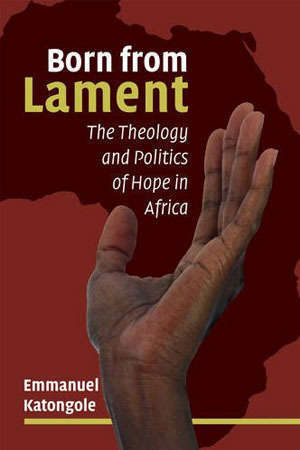
David’s experience of church in the Majority world makes him hopeful. He cites Emmanuel Katangole, who believes that the public expression of pain and loss throughout Africa can give birth to an alternative vision for the future of that continent. But the church in the West must both share in that and learn from it;  “the refusal of lament at such a time as this would be a symbol of apostasy on the part of the comfortable and wealthy church of the Western world”; and all the more because the example of Christianity in the Majority world offers a new and deeper grasp of the gospel.

Born from Lament

Envoi

Stumbling towards Zion is a challenging book. Not because it is difficult to read. It isn’t. But because it challenges some of the things we too often take for granted in our faith journey. And in our comfortable [middle class] church life. Our tacit acceptance of things as they are. And our ignorance of what God may be doing elsewhere in the world. On a personal note, I was immensely grateful to spend more than a decade in a gathered, multi-cultural, multi-confessional church in the Diocese of Europe. With a significant proportion of Africans, nearly all of whom were refugees. Many of whom had painful stories to tell. But I am embarrassed to recall that we were criticised by one of our bishops for “not being sufficiently Anglican” in our church culture ! 

October 2020

Though a glass darkly – Index 1-25

This is just for my own benefit, to allow me to see what I’ve written over the past 6 months. In case I wake up one day and get it into my head that I’ve written War and Peace.

0. Getting Started March 2020

  1. Gratitude, and Desert Places March 2020

2. Peter Frankopan: The Silk Roads March 2020

2. The daily round March 2020

3. Cold Turkey April 2020

4. Dem Bones  The Easter Message Easter Saturday 2020

5. COVID 19: Bouquets and Brickbats April 2020

6. Tim Keller: Walking with God through Pain and Suffering May 2020

7. Spotlight on dark happenings May 2020

8. The Missing Centuries: E.L. Woodward’s History of England May 2020

9. Postcards from Normandy May 2020

10. Life in lock-down June 2020

11. The Scottish Episcopal Church June 2020

12. Jürgen Moltmann: Theology of Hope June 2020

13. Donna Leon’s Venice June 2020

14. Out to lunch July 2020

15. Being Seventy Five July 2020

16. Albert Camus: The Plague [La peste] July 2020

17. E.L. Woodward: History of England, part 2 July 2020

18. John le Carre August 2020

19. Blustering Boris August 2020

20. Theodore Zeldin: France 1848-1945 August 2020

21. Going North September 2020
22. Alistair Horne: The Fall of Paris: the Siege and the Commune September 2020

23. Going back up north September 2020

24. Why American Christians vote for Trump October 2020

25. Gordon Ogilvie, RIP October 2020

October 20th, 2020
Through a glass darkly – 25

Gordon Ogilvie RIP

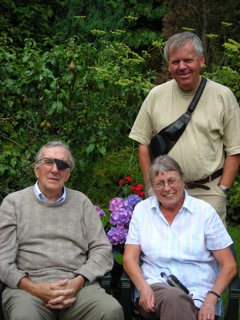
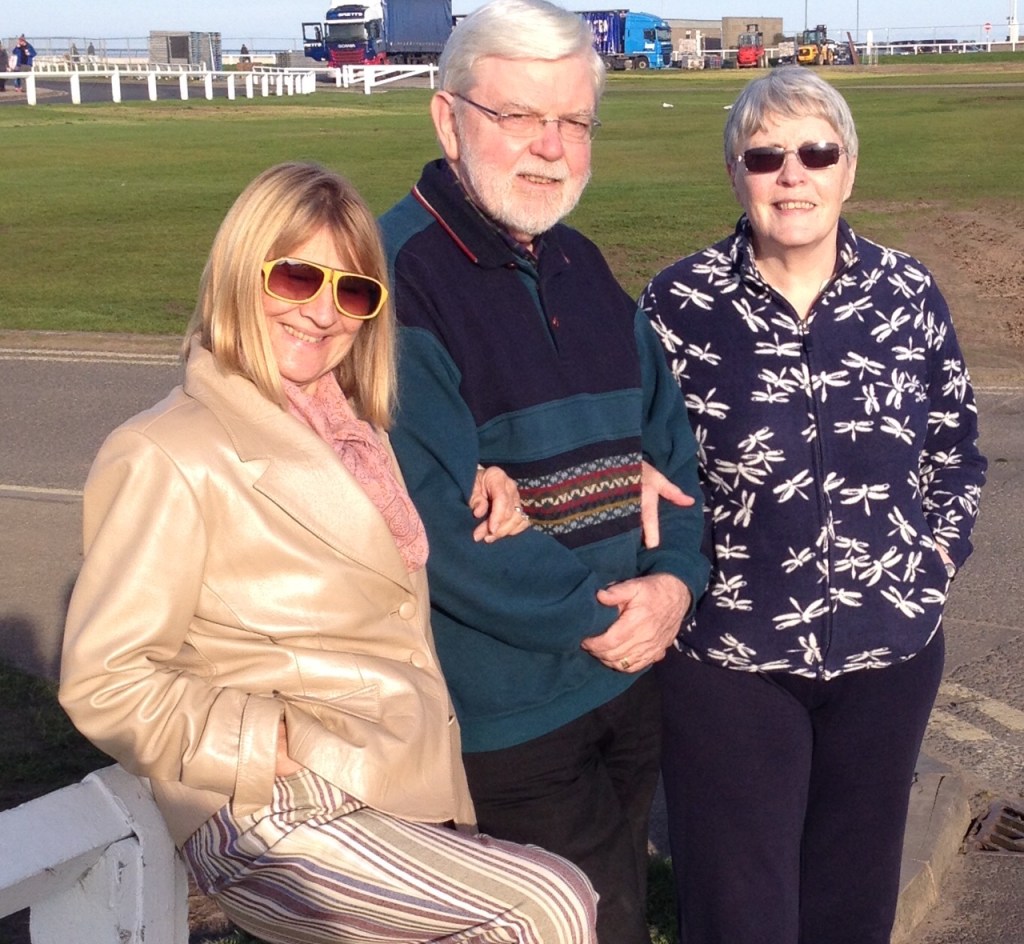
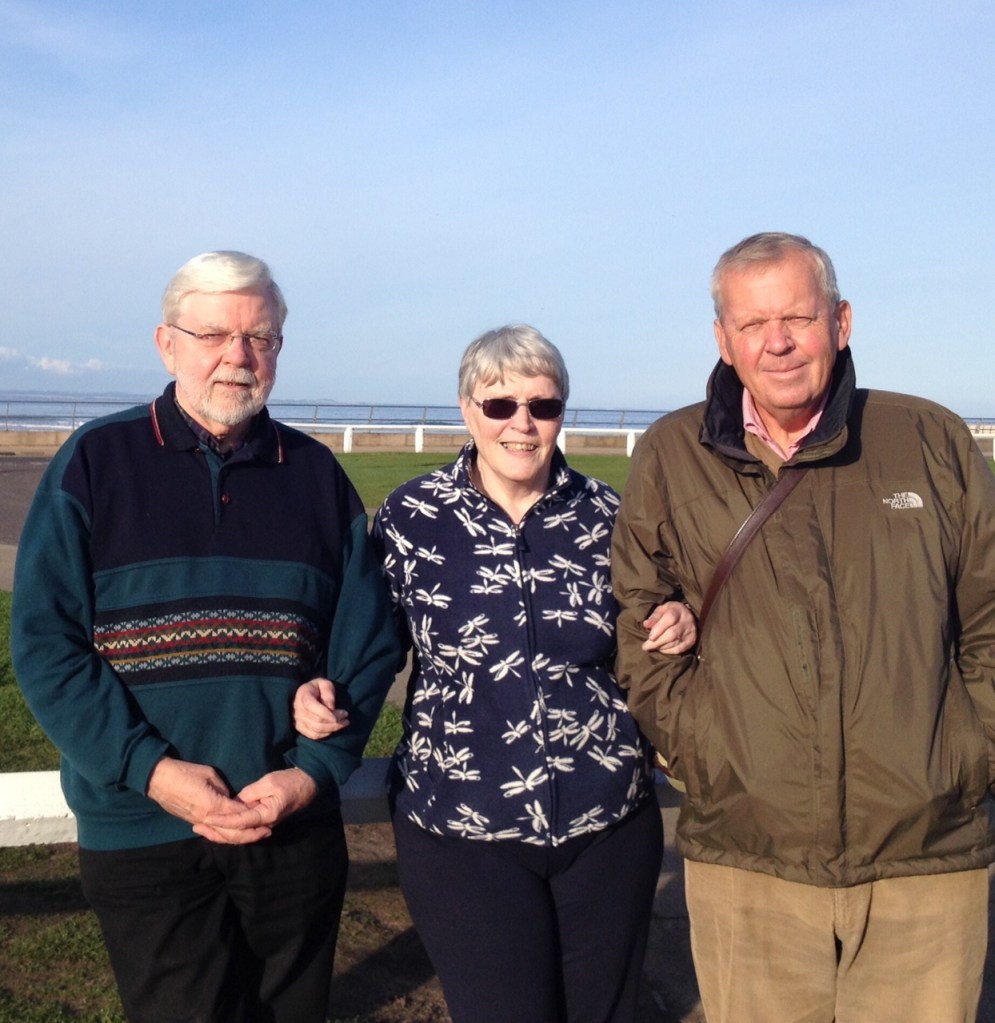
Susie, Gordon, & Sylvia at St Andrews, 2015

Gordon Ogilvie died on September 29th, at the age of 78. Gordon and Sylvia had both been living in a care home in St Andrews since the start of this year. He died of a heart attack, having been diagnosed with Parkinson’s disease and with Lewy body dementia [LBD]. Susie and I hope to attend the funeral in St Andrews at the end of this week. Provided that we can safely do so within the parameters of the current Scottish COVID regulations.

We first met Gordon and Sylvia at St Andrew’s, Linton Road, Oxford at the beginning of the 1980s. Susie and I were [becoming] new Christians. Gordon had come from being Vicar of New Barnet to become Director of Pastoral Studies at Wycliffe Hall. Not always a very rewarding role. He was, I think, the first member of staff at Wycliffe who had not trained there as a student. If that suggests that Wycliffe was a bit in-bred in those days, then I think that is probably true. But perhaps no more so than any other Anglican training college. When I consulted Gordon a few years later about the idea of my training for ordination at Wycliffe, he was characteristically guarded. But this may have been more about me than about Wycliffe.

This is not the place for a full cv. [Even if I was sure of all the facts.] I believe that Gordon grew up in Glasgow, that he went to church at St Silas’s, and that his first degree was at uni in Glasgow, where he was involved with the CU.  And then he went south to train for ordination at the London College of Divinity, before it grew into St John’s, Nottingham.  Prior to New Barnet, Gordon did his curacy at Ashtead, in the Guildford Diocese. In 1989 he moved on from Wycliffe to become first Priest-in-Charge and then Team Rector at Harlow New Town, in the Chelmsford Diocese. And in 1996 Gordon moved to his final job as Archdeacon of Nottingham, in the Southwell Diocese. He retired in 2007, after which he and Sylvia returned to Scotland to live in St Andrews.

My memories are of an engaging character, always well informed, a good and thoughtful preacher, a sometimes quizzical look, and a good friend. As I discovered when I consulted him about applying to Wycliffe, his responses were often elliptical. If you asked Gordon the test score, his reply might well encompass a short history of the rules of cricket, a sketch of the architecture of the pavilion where the match was being played, and a summary of the five-day weather forecast for the area. But the score would come. Eventually. Anyway we talked more about rugby than cricket. Early in our acquaintance he came to preach at the Christmas Eve, midnight service in Woodstock, where we then lived, and where preaching was a bit perfunctory. [A polite term.] But Gordon preached a scriptural, expository sermon of some twenty five minutes, and the congregation grumbled a bit at being home later than they had anticipated. A year or two later I recall his helpful expositions of 1 Peter at the Wycliffe Wednesday afternoon Communion services.

Gordon’s extra-parochial activities included a major involvement with Grove Books, alongside Colin Buchanan, [his successor as Chair of Grove Books was Bishop Robert Innes];  patronage work with Simeon’s Trustees over many years; and support for the church in rural Uganda. Which stemmed from a continuing friendship with a former student at Wycliffe. During the Wycliffe years Susie and I went with him and Sylvia on a long day’s outing to Brussels to try and sort out a Rwandan visa for him. We had, as I recall, breakfast at La Légende in the rue de l’Etuve, and lunch in Aux Armes de Bruxelles; and, visa secured, Gordon drove home rather fast in the fog. Word was that he really liked fast cars. Did he perhaps have a day in an E-type Jag for his 60th birthday ?

Gordon came and preached for us at Christ Church, Duns, recognising an Old Hutchies’ tie in the congregation. [It was a visitor.] He preached in Lyon too, and played the piano for us there.  And he was the main speaker at an ICS Family Conference at Le Pas Opton, a rather chilly camp-site and caravan park on the west coast of France. After his retirement in 2007, we met up periodically with Gordon and Sylvia in St Andrews, sometimes for golf, and in Edinburgh, once at Murrayfield but more often for lunch in a Thai restaurant. And in latter years for a meal at South Queensferry. 

Gordon and Sylvia, and CM, St Andrews, 2015

Perhaps related to his patronage work, Gordon had a near encyclopaedic knowledge of Church of England clergy. I would mention names to him sometimes, and he would effortlessly supply dates and parishes. He liked detail and getting things right. When he came to stay in Lyon the book that interested him most was Hart’s Rules, an authoritative reference book and style guide published by the Oxford University Press.

I guess that under COVID guidelines there will only be very few people at the funeral. But there is talk of a thanksgiving service at a later day. We shall miss him. Meanwhile I reflect that Gordon would have been an excellent Bishop of Glasgow. Certainly better than all those that I can remember !

October 2020
Through a glass darkly – 24

A few months ago a friend who was reading this blog asked me to address the glaring question: Why do so many American [evangelical] Christians vote for Trump ? 

Nuns with the Little Sisters of the Poor give a thumbs up at a National Day of Prayer event with President Donald Trump and other religious leaders in the Rose Garden at the White House, in Washington, May 4, 2017. At the event Trump signed an executive order aimed at easing restrictions on political activity by tax-exempt churches and charities. (Stephen Crowley/The New York Times)

I didn’t rush to respond; partly because I don’t know the answer, and mainly because I don’t know enough about the States.   [My direct experience of American churches amounts to one Sunday morning at Redeemer Upper West Side, New York, some five years ago. Tim Keller was preaching, and he was excellent. And one Sunday morning, a week later, at First Presbyterian Church in Denver, Colorado. Which was rather less rewarding.] So, I don’t really feel equipped to tackle a question that puzzles many Europeans. But I did read something recently that throws some light on the question.

I was reading the new book by David Smith: Stumbling towards Zion. The central theme of the book is the disappearance from western church worship of the biblical [Hebrew] tradition of lament, and the rediscovery of this tradition by churches emerging in, for example, the global South.. It’s an excellent and challenging book, and I hope to write more about it in a week or so. If we accept David’s main thesis, it helps to explain why in the very healthy, non-denominational church my daughter and her family attend, it is always Easter morning. There are lots of people, and lots of young people; there is a good praise band, and even better coffee. And the church does valuable work in the local community through links with people like CAP [Christians against Poverty]. But the emphasis is constantly on praise and the victory of the empty cross.

David’s book notes that after the destruction of Jerusalem in AD 70, the centre of gravity of the nascent Christian world moves from Jerusalem to Rome. From the Jewish world to the Gentile world. And by extension Christianity develops within Greek thought and culture rather than in Hebrew thinking. In consequence some of the Hebrew tradition about the relationship between God and his creation, God’s dealings with men and women, is lost; and God is described by Aristotle as “the unmoved Mover”. Greek thinking acknowledges God as the supreme being, a God of power and might. But God is now seen as remote and impassible. For Tertullian, writing in the 3rd century, since God the Father was without passions he could “not suffer with the Son”; while even “the Son is unable to suffer in virtue of his divinity”. As David notes, the idea of an omnipotent deity who is unable to feel the misery of others [in, for example, the death camps and repeated civil wars and genocide of our world] is quite simply a betrayal of the God of Israel who was profoundly engaged with the struggles and suffering of his people.

As he awaited execution in his prison cell, Dietrich Bonhoeffer famously wrote that “God had allowed himself to be edged out of the world and onto the cross”. Bonhoeffer encouraged us to see that the gospel directs us, not to expect the dramatic intervention of an all-powerful deity but,  to reflect on the powerlessness of God as demonstrated in the suffering of Christ. This theme is developed by Jürgen Moltmann whose writings have been concerned to place the cross of Christ at the very centre of Christian thinking and belief.

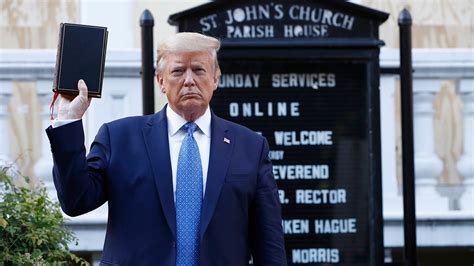
What has this got to do with President Trump ? Press reports suggest that his reading skills [and his attention span] are limited, so he is unlikely to study German theologians. In fact I suspect that his Bible knowledge is equally limited. [His closest biblical model may be the golden calf of Exodus 32. Or possibly King Nebuchadnezzar who, in Daniel 3, orders all subjects to prostrate themselves before the golden statue.] Trump is by all accounts a greedy, boastful narcissist with a limited understanding of the world and a greatly inflated idea of his own abilities. But he presents himself as a Christian, more recently as a Presbyterian, and as a Pro-Life candidate, which plays well with his supporters; and he has spoken very positively about some Christian leaders. His Christian faith makes him anti-Muslim. He seems to think that his recent experience of COVID was a gift from God, although he made it clear that he himself had taken the initiative by nudging God in this direction.  A few months ago, faced with street protests in Washington running out of control,  he cleared the streets with tear gas and stage-managed a press conference in front of St John’s Episcopal Cathedral, with a bible [unread] in his hand, to demonstrate that he was God’s man and God was on his side.

What sort of God could that be ? It may well be that Trump’s understanding of God was significantly shaped by Norman Vincent Peale, whose church he attended as a young man, Peale is a controversial figure, who exercised a fifty-two-year ministry at Marble Collegiate church in New York City. He is best known for his advocacy of the Power of Positive Thinking,[the book which was published in 1952 reputedly sold 5 million copies]; he was a 33º Scottish Rifle Freemason, a personal friend of Richard Nixon and his family, and was eventually awarded the Presidential Medal of Freedom by Ronald Reagan for his life-long services to theology ! His writing and his preaching seem to blend a defective theology with a defective psychology:

One of the most powerful concepts, one which is a sure cure for lack of confidence, is the thought that God is with you and helping you. This is one of the simplest teachings in religion, namely, that Almighty God will be your companion, will stand by you, help you, and see you through. No other idea is so powerful in developing self-confidence as this simple belief when practiced. To practice it simply affirm “God is with me; God is helping me; God is guiding me.” Spend several minutes each day visualizing his presence. Then practice believing that affirmation.”

In other words, God is an all powerful deity ‘out there’, and he will help those who help themselves.  This is not so different from the prosperity gospel; give your lives to the Lord and he will bless you richly, in this world. It is a seductive message, but one which has nothing to say to those living with sorrow or a sense of failure. I am reminded that when Margaret Thatcher spoke to the Church of Scotland General Assembly in 1988, in what became known as The Sermon on the Mound, she insisted that Christianity was about [personal] spiritual redemption, and not about social reform; and she seemed to quote approvingly from St Paul, ”If a man will not work, he shall not eat”.

We always appreciated newly-arriving Americans in the church in Lyon; they were generous with their time and money and energies. Many shared an individualistic, self-starter, can-do, get stuck-in philosophy. So I suppose that many such Christians may vote for Trump as a strong man; someone who will defend them against leftist revolutionaries and Islamic terrorists. They believe that St Paul taught us that God ordained leaders to preserve civil order,  and they approve of Trump’s stance on abortion, and school vouchers, and religious liberty. And no doubt on gun control. Or rather the lack of it.

The downside is that there is no indication that Trump’s beliefs allow for a suffering Christ or an in-dwelling Holy Spirit. I suspect that he thinks the crucified Christ is ‘just a loser’. Like people that pay their taxes. Or lose their jobs because of corporate restructuring. Or the 200,000 Americans who have died so far of COVID 19. I very much hope that he loses the forthcoming presidential election. I don’t have a lot of faith in Joe Biden, who sounds a bit sleepy and a bit slow. But I think that [almost] anyone would be better than Trump.

October 2020
PS

If any American reads this and thinks that I am wrong, please feel free to say so.

Through a glass darkly – 23

May or September are [said to be]  the best months for visiting Scotland. After a couple of distinctly autumnal weeks we went north in mid-September more in hope than in expectation. Or to be more precise we went north in a dark red Kia Ceed [they dropped the bizarre apostrophe in 2018]., rented from a friendly garage in Dalkeith. As any septuagenarians reading this will know, hiring a car gets more difficult when you reach seventy-five. Either the answer is a straight ‘No’, or you get landed with a substantially hiked insurance cost.

There were tedious queues on the A9 north of Perth, where they are working on dualling the section towards Dunkeld. But fortified by coffee from the excellent Birnam Arts Centre

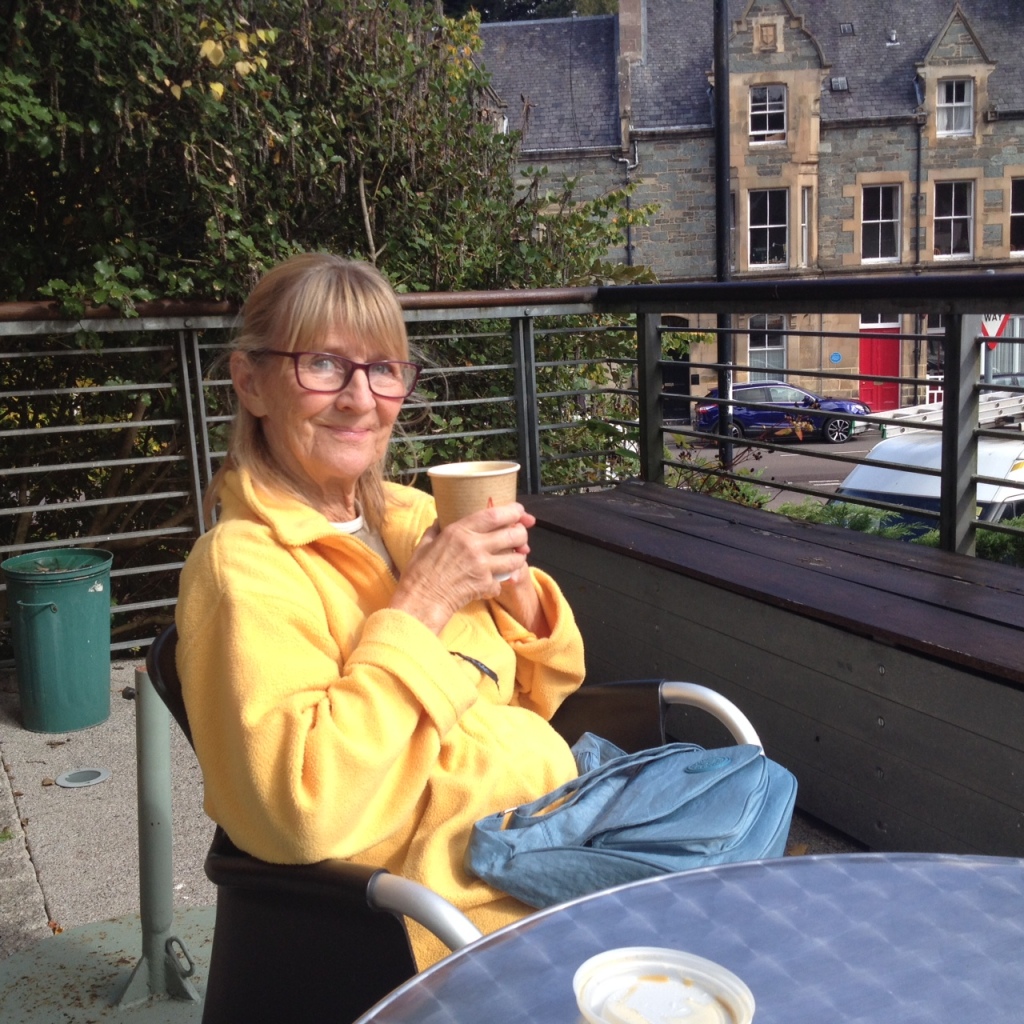
Susie, Birnham Arts Centre cafe

cafe, we were in Inverness by the middle of the afternoon. We had booked B&Bs in Inverness and two subsequent stops, but I hadn’t realised that in these COVID times you need to book ahead for meals too. We walked along the river into town, and eventually got a table at the fifth place we tried. It was an Indian restaurant  which was refurbishing, but was serving meals in the adjacent cafe.

Inverness

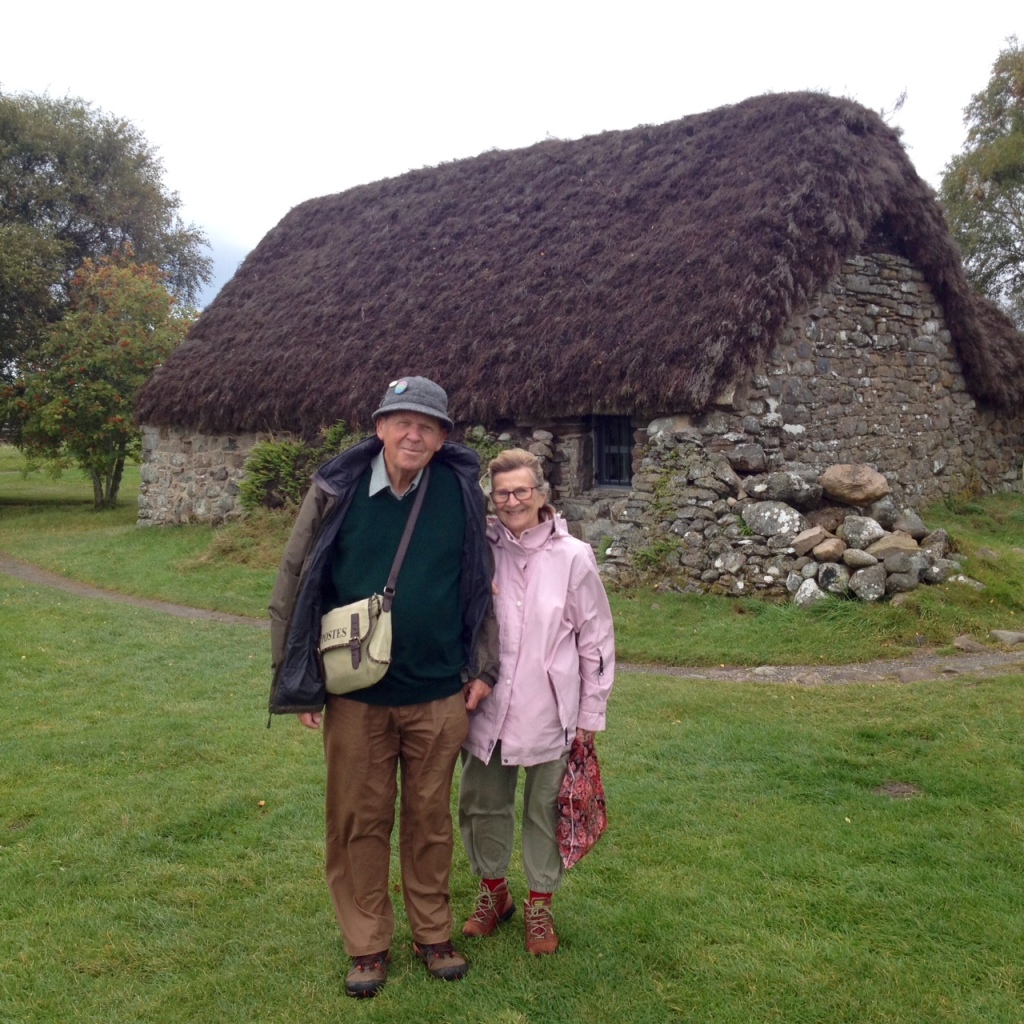
Confession. We gave church a miss on Sunday morning. [The last time I was in Inverness on a Sunday, I tried with difficulty to find an evening service. Eventually I was directed to the Episcopal cathedral, where I was part of a congregation of four and the service was in the Gaelic !] Instead we had booked a visit to the Culloden Visitors’ centre- advance booking now essential at National Trust properties. The centre didn’t exist when we were last at Culloden. Now the panels tell the story of the background to the 1745 rising, the Hanoverian story on one side, the Jacobite story on the other. The Jacobite army, exhausted after a fruitless night march and hungry because of inadequate provisioning, was destroyed on Culloden Moor in April 1746 by the Hanoverian army under the Duke of Cumberland.

Culloden

[John Prebble tells me that Cumberland was younger than I had realised. And he seems in some ways to have  been a model for the current Prince Andrew.] After a rather slow tour of the exhibition it was good to walk on the battle-field; the lines of the opposing armies marked with flags, and memorial stones showing where the clan chiefs fell. 

In the afternoon we visited Fort George, also booked on line. It is an impressive, stone-built eighteenth century barracks, one of a series of Hanoverian military bases [Fort George, Fort Augustus, Fort William] which were built after the 1745 uprising. The Fort sits on a neck of land at the narrowest point of the Moray Firth, looking across to Rosemarkie and Chanonry Point. It contains the Highlanders’ Regimental Museum; dress uniforms, sepia photos, and medals from assorted highland regiments. All fascinating if you like that sort of thing. Which I quite do.

Fort George

Then on north to Sutherland, named Suôrland [Southern Land] by the Norse in relation to their settlements in Orkney and Shetland. Our base was Armadale House, a Victorian B&B close to the sea, run by Detta, originally from Groningen but who has lived here for the past two decades.

Armadale House

This is rugged, thinly populated country, with a sprinkling of chambered cairns, standing stones, hill forts, and deserted  settlements. It sprinkled with rain on Strathy Point, where we failed to spot the whales. But the sun shone on the sea at Torrisdale Bay at Bettyhill. A plaque on the disused ice house overlooking the mouth of the river Naver told us that as late as the 1960s almost a thousand salmon were netted here on a single day. 

Sutherland is strongly associated with the Highland Clearances of the early nineteenth century, when villagers were driven off their crofts by landowners who wanted the land for sheep farming. The villains of the story are traditionally the English, epitomised by George Granville Leveson-Gower[1758-1833], an Old Etonian, English aristocrat, landowner and politician, said to the the richest man in England. In addition to his extensive land-holdings in Staffordshire, Shropshire, and Yorkshire, he acquired vast estates in Scotland by his marriage to Elizabeth, 19th Countess of Sutherland. As part of the ‘improvements’ to the Sutherland estate hundred of villagers were forcibly evicted in Strathnaver by Patrick Sellar, one of the Duke’s factors. Bad things certainly happened in Strathnaver, where people were treated cruelly. But it is now generally recognised that the clearances were at least in part the work of the clan chiefs and of incoming Lowland Scots. [Interestingly, in the light of recent controversy about public statues, there is a 100 foot high monument to the Duke of Sutherland on top of Ben Bhraggie, a prominent hill overlooking the village of Golspie in eastern Sutherland. And for a decade or more there have been campaigns to demolish the statue and replace it with a monument to the victims of the Clearances.]

Stratnaver

We spent a day meandering down Strathnaver, starting with the deserted clearance village at Aberlochy. Then a roadside monument commemorating the first gathering of The Argyll and Sutherland Highlanders (Princess Louise’s), known after  Baklava in the Crimean War as ‘The Thin Red Line’.  Then a stone marking the grave of the ‘Red Priest’, an eighth century priest killed by Viking raiders, sometimes identified [wrongly] with Saint Maelrubha. the Irish monk who founded the monastery at Applecross.. Nearby, in a clearing in woodland, what is said to be the Red Priest’s dwelling is in reality a Neolithic chambered cairn. Lunch was a picnic in Naver Forest, and we walked up to Rosal, one of the larger clearance villages set on a hillside above the river.

Rosal Clearance Village

We came home to Armadale via The Flow Country, a rolling expanse of peatland and wetland, the largest expanse of blanket bog in Europe. It is both a significant wildlife habitat and a major carbon store.

Later in the week we drove west, through Bettyhill and across the causeway at Tongue. A combination of staycations [an ugly neologism] and promotion in recent years of the North Coast 500 has led to a significant increase in visitor numbers. We drove round the bottom end of Loch Eriboll in a procession that included five camper-vans and two Aston-Martins with the hoods down. And we failed to spot where we rough camped forty-plus years ago  [see TaGD – 21].

Pete’s Beach

In Durness both Smoo Cave and the John Lennon Memorial Garden  [he came here regularly for holidays as a child; and there is an ongoing debate as to whether Durness inspired the song In my life] had both attracted a bunch of camper-vans. We went straight on to Balnakeil where I played golf [very badly] on the nine-hole course overlooking the sea, the most northerly course in the UK; and afterwards  we had a hot chocolate from the reputed Cocoa Mountain in the Balnakeil Craft Village.. All melted chocolate and cream and calories.

Balnakeil Beach

Our final two nights were at Laide on the edge of Gruinard Bay. We visited the North Sea Convoy Museum at Aultbea. Susie’s father, George Malloch, was a very young medical doctor on the North Sea Convoys, but rarely spoke about the experience. And we re-visited the excellent Inverewe Gardens, a two thousand acre botanical garden created in the 1860s by Osgood Mackenzie and his daughter Mhairi.

Inverewe Gardens

And I played golf again at Gairloch in the sunshine, rather better this time, or at least not quite so badly as before, on the charming nine-hole course tucked in behind the beach. And Susie finally swam in the sea at Mellon Udrigle.

And now we are back in Edinburgh again, grateful for a trip away. And wondering when we might get a chance to go away again. Probably not in the near future in view of the rampant second wave.

September 2020

Through a glass darkly – 22

After finishing the Zeldin book [see TaGD – 20], I thought that I would look again at Alistair Horne’s book The Fall of Paris: the Siege and the Commune. Horne was a journalist, biographer, and European historian, who died in 2017. 

My copy of the book first published in 1965 is a bit water damaged after a long spell in the garage. Unfortunately the subsequent two books in Horne’s trilogy, The Price of Glory: Verdun 1916 [1962] and To Lose a Battle: France 1940 [1969] have both disappeared; I think they too both succumbed to water damage.

The Siege

The Franco-Prussian War of 1870-71 was a disaster for the French. In July 1870 France declared  war on her neighbour; partly because the countries fell out over the vacant throne of Spain, and partly because France felt threatened by the growing power of Prussia. On July 28th Louis-Napoleon rode forth in command of his armies. Within six weeks the divided French armies were defeated on both sides of the Vosges, at Woerth and at Spicheren; Bazaine’s army was besieged at Metz; MacMahon’s army surrendered at Sedan; and Bismarck imposed harsh terms on Louis-Napoleon who was sent into imprisonment in Germany. The Prussian armies under Moltke advanced  rapidly on Paris, and by the end of September the city was under siege. It was now cut off from the rest of France. “It is in Paris that the beating of Europe’s heart is felt”, wrote Victor Hugo, a vigorous septuagenarian, “ Germany extinguishing Paris … Can you Germans become Vandals again; personify barbarism decapitating civilisation.”

General Trochu, aged fifty-five, had been recalled from an obscure command in the Pyrenees to form the new XII Corps, and then to become Military Governor of Paris. When in September amid chaotic scenes at the Hotel de Ville Gambetta, standing on a window sill, proclaimed the Republic, the post of President was offered to Trochu. Who accepted it with no great enthusiasm. The city of Paris was surrounded by an enceinte wall, some thirty feet high, divided into ninety three bastions linked by masonry ‘curtains’; and behind the moat were a chain of powerful forts equipped with powerful guns. The line of forts filled out a circumference of some forty miles. Within the city there were some 60,000 troops, some of whom had escaped from Sedan and elsewhere. And there were, very soon, some 350,000 members of the National Guard; a great mass of untrained [working] men, attracted by the pay of 1.50 francs a day, and the right to elect their own officers. Notionally Paris was a powerful armed fortress. But there was no strategy as to how their considerable assets were to be managed. Trochu himself was a military theorist rather than a man of action. Washburne, the American Minister, who was received by the new President in his slipper and dressing-gown, thought “he did not look much of a soldier”.

Prussian siege guns

All one ever remembers of the siege of Paris are the balloonists and the rats. Balloons had always been a French thing. Since De Montgolfier’s first hot-air balloon of 1783; a perilous device in which the passengers had to stoke a fire of straw and wood directly below the highly inflammable paper envelope. When the siege of Paris began there were only seven existing balloons, but a series of balloon making workshops were set up across the city and a highly profitable Balloon Post was established.

Balloon factory

Balloons took off at the rate of two or three a week, either from Montmartre or from outside the Gare du Nord. The problem of course was this was a one-sided means of communication. And that the balloons were blown to every corner of France. When the idea was mooted in September of ballooning a delegate to Tours, Gambetta, the Minister of the Interior, was one of the few volunteers. Gambetta left Paris on October 7th and after an eventful flight arrived forty-eight hours later in Tours where he declared himself Minister of War. Altogether some 65 manned balloons left Paris during the siege; six landed in Belgium, four in Holland, two in Germany, one in central Norway, and two were lost at sea. The knowledge that the city was not entirely cut off from the rest of the world served to restore some Parisian morale.

As half-hearted attempts to break out of the city failed, the lack of news was replaced by a lack of food. Hunger became a real problem. Goncourt noted “People are talking only of what they eat”; and found Théophile Gautier lamenting that “he has to wear braces for the first time, his abdomen no longer supporting his trousers”. Cheese, butter, and milk were all little more than a memory; the cattle and sheep had vanished from the city; and fresh vegetables had run out. The zoos were forced to surrender their precious inmates: Hugo was sent some joints of bear, deer, and antelope by the curator of the Jardin des Plantes; and two young elephants, Castor and Pollux, were bought by Roos, the wealthy proprietor of the Boucherie Anglaise. Horse-meat became commonplace, as even valued race-horses ended their days at the butchers. Horne records that the signs ‘Feline and Canine Butchers’ made their debut. The journalist Henry Labouchère reported without comment that he had met a man who was fattening up a large cat for Christmas Day, intending to serve it “surrounded with mice like sausages”. The rat was the most fabled animal of the Siege of Paris, and from December a good rat-hunt was a favoured occupation of the National Guard.

German bombardment of the southern forts began in January. The nightly bombardment did relatively little damage, but there was great anger when six small children were killed by a single shell. Fuel shortages in the winter months, malnutrition, and diseases, both smallpox and typhoid, began to take their toll. Another projected sortie at Buzenval failed dismally, for which the leadership was violently criticised by the Mayors, led by Clemenceau of Montmartre. While the pious Trochu prayed for deliverance, his influential deputy, Favre, now favoured capitulation. On January 27th Favre secretly met with Bismarck in Versailles to negotiate a cease-fire, pending the drawing up of a definitive peace treaty.

The Commune

Favre’s armistice was received in Paris with a mixture of rage and stupor. Needed foodstuffs poured into the city, but Republican Paris felt betrayed by the capitulation, and further betrayed by a February election which resulted in an overwhelming victory for the ‘list for peace’. A rift had opened up between Paris and the provinces, and this was aggravated by every step taken by the new administration headed by Thiers. On February 26th, the day that Thiers signed the Peace Treaty, mass demonstrations of the National Guard erupted across the city, and two hundred cannon were hauled from the artillery parks to Montmartre. An attempt by the French Army to retrieve the cannon failed, and General Lecomte and the elderly General Thomas were lynched by an angry mob. When Clemenceau saw what had happened he burst into tears; the only time the tough doctor-politician wept in public until the victory of 1918.

The government move on Montmartre and the killing of the two generals took everyone by surprise. But a group of National Guards led by Brunel marched on the Hotel de Ville, and, as the gendarmes and government troops melted away, 20,000 National Guards took possession of the building. As the government withdrew, legal authority in Paris passed to the Mayors of the twenty arrondissements. Heated discussions between the Comité Central and the mayors ensued, fighting broke out on the streets of the city, the rift between Paris and Versailles widened, and on Tuesday, March 28th, the Commune was officially declared at the Hotel de Ville.

Now that our Commune is elected”, wrote Corporal Louis Péguret of the National Guard, “we shall await with impatience the acts by which it will make itself known to us. May God wish that this energetic medium … will procure for us genuinely honest and durable institutions”. All Parisians wondered what the Commune would do. In fact, what was the Commune ? Contrary to what many bourgeois believed, it had nothing to do with the Socialist International. The Commune came to power in 1871 with no ideology and no programme; other than looking back over its shoulder to 1793. There was certainly a sense that the working class had been swindled out of their inheritance of the Great Revolution. It was born partly out of general discontent with the poor social conditions under the Second Empire. “What is it to me”, someone asked in Goncourt’s hearing, “that there should be monuments, operas, cafe-concerts, where I have never set foot because I have no money ?” And there was also an element of demanding municipal independence for industrial Paris from the rest of predominantly rural France. In consequence the Commune was invariably riven with disputes between Blanquist socialists and radical Jacobins; between anarchists, intellectuals, Bohemians, Gambettists, and disgruntled petit bourgeois. 

Disunity was the death of the Commune. The brave and capable Louis Rossel, a professional soldier, son of a Breton father and a Scottish mother, was appointed Minister of War, but was soon accused [wrongly] of treachery and deposed. A Parisian mob tore down the massive Vendôme Column erected by Napoleon I on the sight of the former equestrian statue of Louis XIV. The Paris house of Thiers was demolished and his belongings and works of art were carried away by the mob. Raoul Rigault the unsavoury Police Chief ordered the arrest of a number of ‘hostages’ including the Archbishop of Paris. Clemenceau and his fellow mayors, and other bodies including the Paris Freemasons, tried to open negotiations between Paris and Versailles. But all failed. Thiers’ unvarying response was: “Do you come in the name of the Commune ? If so, I shall not listen to you; I do not recognise belligerents … I have no conditions to offer”.

On May 21st Government troops entered the city through an unguarded gate at Point-du-Jour. Ten days of bloody fighting followed. A frenzy of energy seized the Commune and hundreds of street barricades were thrown up as the Versailles troops advanced steadily through the west of Paris. Small pockets of Communards fought bravely. Rumours of mass terror spread swiftly through the city’s inhabitants. It was widely believed that an army of pétroleuses were at large in the city flinging fire-balls through the windows of bourgeois houses. On the evening of May 24th the aged Archbishop of Paris and four other priests were shot in La Roquette prison. National Guards ripped open his body with bayonets, and threw it into an open ditch at Père-Lachaise cemetery.

The Communards were forced back towards Montmartre and towards Belleville. The leaders of the Commune were falling. The sixty-one year old Delescluze, moral leader of the Commune, an old style Jacobin, now dying of consumption, made his way to the Avenue Voltaire dressed in top hat, black trousers, and frock coat with a red sash round his waist; and was promptly shot on an abandoned barricade. There were savage killings on both sides. Many captured Communards were shot on the spot. The Prussians obligingly moved up 10,000 troops behind the Communards’ rear to cut off any possible escape eastwards. On Whit Sunday morning, May 28th, Thiers’s army moved in for the kill. On that day when they discovered the unburied body of the murdered Archbishop, 147 captured Communards were lined up and shot against the eastern wall of the cemetery.

Government soldiers advancing into Paris to suppress the Commune, 24th May 1871. The Paris Commune was established when the citizens of Paris, many of them armed National Guards, rebelled against the policies of the conservative government formed after the end of the Franco-Prussian War. The left-wing regime of the Commune held sway in Paris for two months until government troops retook the city in bloody fighting in May 1871. From a private collection. (Photo by Art Media/Print Collector/Getty Images)

On June 22nd the Paris-Journal implored:  “Let us kill no more, not even murderers and incendiaries !  Let us kill no more !” The remaining Communards surrendered. But casual, incidental killing continued for several days. The estimated number of deaths during La Semaine Sanglante varies wildly. But responsible historians suggest that between 20,000 and 25,000 people were killed. Far more than in any battle of the Franco-Prussian War. Far more than were killed during the Great Terror of the French Revolution. All this killing in a city that had regarded itself just a short time  earlier as the very Citadel of Civilisation.

The myth of the Commune

The siege of Paris fundamentally altered the balance of power in Europe; France was diminished alongside a resurgent, and united, Germany. And would not be restored until she regained the surrendered industrial areas of Alsace and Lorraine. The consequences of the Commune are harder to identify. The social achievements of the Commune during the brief two months of its existence were minimal. Frankel, one of its leading reformers, could point only to the abolition of night-work in Parisian bakeries. 

But out of the fabric of the Commune Karl Marx created an enduring myth. In his powerful tract The Civil War in France, written from a safe distance away in north London, Marx celebrated the French working class as “the advance guard of the modern proletariat”. Marx’s whole-hearted support for the Commune split the International movement down the middle. On the one side, the nascent, moderate British Labour Party and the German Social Democrats; on the other, Lenin and the Russian Bolsheviks. The widely-read pamphlet transformed Marx from being an obscure German-Jewish professor to being the ‘Red Terrorist master-mind’. He helped create a heroic Socialist legend. The Mur des Fédérés in Père-Lachaise,  where the 147 Communards were shot, is the focal point for left-wing demonstrations on May 28th every year.

The story of the Commune inspired a host of writers, including Emile Zola, Arnold Bennett, Jean Vautrin, and Umberto Ecco; and a variety of playwrights including Brecht and Adamov. I was fascinated to learn that, among the Commune inspired films, there is a 6-hour epic  [unwatchable ?] by Peter Watkins called La Commune, shot in 2000 in a deserted factory on the outskirts of Paris. In a distant echo of the Commune balloonists, Alistair Horne notes that in 1964, when the first three-man team of Soviet cosmonauts took off, they took with them three sacred relics; a picture of Marx, a picture of Lenin, – and a ribbon cut from a Communard flag.

PostScript

Is there a museum in Paris dedicated to the history of the Paris Commune ? If so, I have never seen any mention of it. And the Institut Français in Edinburgh hadn’t either. If anyone who reads this knows better, do please let me know. I’d definitely make a pilgrimage to go and see it.

September 2020

Through a glass darkly – 21

Going North

Scotland is a bigger country than many people realise. And crossing the country is not quick. To get from Edinburgh [where we live] to Wick, not far from John o’Groats, a distance of about 260 miles, is a minimum of five hours driving, and takes roughly eight hours by train and bus. To get from Edinburgh to Durness, on the north-west coast, on public transport takes two days; a bus to Inverness on the first day, and then train and bus onwards the following day. I did the journey two years ago in the early autumn testing the limits of my Senior Citizen [free] bus pass. 

We are going up north again shortly. The plan is to have a couple of nights in Inverness, then three nights at Armadale up on the Pentland Firth, and then two nights at Laide, on the west coast near Gairloch. It will be the first time since lock-down began that we will have been beyond Edinburgh and the surrounds. And it will be the first time since 1974 that Susie and I will have been together north of the Great Glen, the geological fault line that runs south-west from Inverness on the Moray Firth to Fort William at the head of Loch Linnhe . The glen which contains Loch Ness and which separates the North West Highlands from the Grampians.

On our original trip north we hired a brown Ford Escort somewhere in Edinburgh and set off with an ageing tent intending to travel anti-clockwise round the north coast. It was about forty years before the creation of the North Coast 500. Before we started I had to go and buy an anorak on Princes Street; as an ignorant southerner I didn’t realise that Scottish summers are rarely warm and dry. I think we also went to ASDA to buy provisions and a small camping stove.

It didn’t seem sensible to camp in Aberdeen. So we stayed at the Treetops Hotel, and got up early in order to visit the fish market before breakfast.

Susie at Aberdeen Harbour

Aberdeen is where Susie had been at uni [curiously we both have Master’s degrees from Aberdeen], and so for her it is a place of memories. [I guess we all have some attachment to cities/towns where we were at uni. Back in the summer of 1964 I spent a couple of lunchtimes walking in St James Park with the wife of the Bulgarian press attache, who told me what  an attractive town Sofia was; as she described it, a cross between Heidelberg and the stage-set for The Student Prince. When I got there a couple of months later it looked more like Cumbernauld New Town.] And it didn’t seem sensible to camp in Inverness either. We stayed in a hotel on the edge of town, of which I remember only that it had a tartan carpet, tartan wallpaper, and a matching tartan ceiling. Or maybe the tartans didn’t match. It was a pretty gloomy place.

Then on north. We had coffee with Susie’s cousin Charlie in Evanton. We stopped in Lairg to buy a copy of The Times; it might be the last opportunity for some time. I think the headlines concerned a major storm in the Irish Sea which had severely disrupted the Plymouth-Fastnet yacht race. In which Ted Heath was a competitor.  On a minor road ten miles south of Ben Hope,  we stopped to look at the impressive ruins of Dun Dornadilla. A bit further on we got out of the car to look at Ben Hope, thereby inviting half million midges to share the car with us.

Near Ben Hope

And then, as it started to get dark, we pitched our trusty tent on a gentle, grassy slope overlooking the waters of Loch Eriboll, a deep sea loch on the shores of the Pentland Firth. It was where the remaining German U-boat fleet surrendered in 1945. It was apparently known to British servicemen during the war as Lock ‘Orrible, on account of the frequently inclement weather. But I didn’t know that at the time.

When we woke up at about four o’clock the next morning, water was streaming through the tent. We had no built-in ground-sheet in those days. So the water simply flowed in under the walls at the top end of the tent and out at the bottom. We put a very wet tent in the car, retrieved our belongings from the shallow stream, and went in search of breakfast in Durness. Or more precisely in the Craft Village at Balnakeil; a collection of local enterprises housed in the huts of what had originally been built after the war as an RAF early warning/listening station. 

Phone box on Loch Eriboll

It took two or three gusty days camping at Sheigra to dry out the tent. We swam a couple of times, bought sausages and a frying pan in Kinlochbervie [the pan stayed with us for years, the sausages didn’t], and failed to walk the four or so miles to the famed Sandalwood Bay. After that we put the tent away in the boot. We stayed in the Summer Isles Hotel at Achiltibuie, which at that time had quite an elderly clientele, many swathed in tartan rugs. The proprietor was Robert Irvine, an ex-actor, who wore knee-breeches and buckled shoes,. His daughter was Lucy Irvine, the author of Castaway [later filmed by Nicolas Roeg with Oliver Reed and Amanda Donohoe]. Much more economically we stayed in an isolated caravan, next to naval gun emplacements overlooking Loch Ewe. The owners were reluctant to let us away, preferring not to handle money on the Sabbath. After which we rushed to Eilean Donan to take photos of sunset over the castle, and took the ferry across to Skye, Where we stayed in a very run-down caravan in a field somewhere near Portree.

Eilean Donan Cstle

Things looked up when we had a night at Kinloch Lodge Hotel at Isle Ornsay. It was newly-opened in 1974, very comfortable, very luxurious, with an excellent restaurant. [Claire Macdonald subsequently became a well-known cook and cookery writer.] We ate well, and then made the mistake of doing some serious malt whisky tasting in the bar with the Portree dentist. Which made it difficult to face the black pudding at breakfast. After that we took the ferry back to Mallaig, and made for Arisaig. Alistair at Port na Doran, where Susie’s family had camped for many years gave us one of his vans, and a message to ring a number in London. So we spent the next morning in the Arisaig phone box, clutching a handful of pennies and trying to make a person-to-person call to someone in London.

Sunset over Eilean Donan

It was a good trip. Which had lasting consequences. Susie and I got engaged while we were at Isle Ornsay, which was a big plus, though we have not drunk whisky since. And the phone call was the offer of a job in Paris, where we spent the next few years. Happy days !

September 2020

Through a glass darkly – 20

Summer seems to be over here in Edinburgh. But I walked from Musselburgh to North Berwick yesterday; 19.5 miles according to the John Muir Way website. So today I am feeling a bit pleased with myself. And rather less like walking ! Optimistically I was sustained for part of the walk by the thought of lunch out at North Berwick. But it was 5 o’clock by the time I got there.

Regular readers will know that my knowledge of history is very patchy. Although I am very fond of France, my knowledge of French history was largely limited to the coronation of Charlemagne, on Christmas Day 800, the accession of Hugh Capet in 987, and on more familiar ground the story from 1940 onwards. Which leaves a very big gap. So with a mixture of anticipation and apprehension I started to read Theodore Zeldin’s  France, 1848-1945: Ambition, Love, and Politics. Anticipation because I have owned the book for years without opening it. Apprehension because it is 790 pages. Which is a lot of reading, even with an orange marker pencil.

In spite of its length, there are several things the book doesn’t do. It doesn’t offer any coherent story of the disastrous Franco-Prussian war of 1870, nor of the siege of Paris by the Prussian armies. Nor of the Commune that followed, and its bloody suppression. Nor of the horrors of Verdun in 1916. Nor of the extraordinarily rapid fall of France in 1940. [All of which are dealt with in three excellent, very readable, books by Alistair Horne.]

Zeldin makes it clear at the outset that he is not writing a chronological history of events, of which there are already many. [The book was published in 1973.] Instead he sets out to study the  role of different groups of French society; the bourgeoisie, industrialists, bankers, bureaucrats, workers, and peasants. A second section looks at marriage and morals, and the roles of children and of women. And the  lengthy third section looks at a whole host of different political grouping; kings and aristocrats, republicans, bonapartists, ‘solidarists’, radicals, and socialists. .Zeldin cautions against the traditional view that French history is the unfolding of a struggle between revolution and reaction. Equally he is cautious about the notion that power and health are concentrated in the so-called ‘two hundred families’, who were the real beneficiaries of the Revolution; and that all subsequent history is largely about their struggle to hold onto and consolidate their power. In fact he is cautious about all generalisation, preferring to stress the wide regional variations which complicated and sometimes transformed every movement and every change. It is not always clear, Zeldin writes,  that Brittany, Alsace, Provence, and Paris were parts of the same country.

Summarising the book would be even duller than most of these blogs. But here are a couple of things, a couple of sections, that caught my attention. The first is about the role of family life, and notions of childcare. The second, very differently, about the role of intellectuals in politics.

Children and family life

Zeldin notes that a very large proportion of French children did not have a full family life. Only 54% of marriages lasted longer than 15 years; 45% of children were orphans in their teens. Things were made significantly worse  by the First World War: in 1931 there were 646, 000 families who had lost their fathers in the war; and a further 1,322, 000 with fathers who were mutilated or injured. When I first visited France in 1961, there were signs in the Paris metro indicating priority seating for femmes enceintes et mutilés de guerre. When did they disappear, I wonder ?

There was widespread disagreement about how to rear children. [According to a book by David Hunt, adults played publicly with Louis XIII’s penis when he was a baby; but it was six months before his mother embraced him, and his relations with her remained cold until his father died.] Broadly conservatives believed that values should be transmitted through exercising authority; and that the father exercised power as God’s representative. Moralists were worried about excessive familiarity. Holidays were especially dangerous. Among the bourgeoisie, there was fear of children’s friends; so it was always better to invite one’s cousins and one’s own family. Holidays in the mountains with nature study were morally safer than holidays by the sea.

Writing in 1861, Paul Janet thought that parents spoiled their children more now. But that they also looked after them better. Both Jules Michelet and Paul Janet saw children as instruments for the gratification of parental aspirations, producing either higher social status or the promise of affection. A comparative study of American and French children suggested that French children were better able to accept the formal requirements of their elders because they were more skilled at entering into their private world where they remained free.

In the 1950s a poll of French people were asked which was the most important commandment. ‘Honour your parents’ won easily. Zeldin notes that 70% of respondents thought that  discipline was extremely important, and more than  50% wanted greater severity towards children. According to the same poll, 52% of parents were opposed to sex education at school.

The genius in politics

One of the more interesting [to me] sections is called ‘The genius in politics’. Zeldin insists that in the 19th century the emergence of the genius [the utopians] influenced French politics; and challenged the traditional centralised authority. “The genius was a prophet, but a prophet in the wilderness.” The utopians [such as Fourier and Proudhon]  became popular because they tried to give expression to the people’s widely felt aspirations. One characteristic of the utopians was the desire to unite mankind; they represented a longing for order and peace after the Revolution.

Saint-Simon [1760-1825] was an unhinged genius. He preached fraternity: “love one another and help one another”. He was not interested in party politics. Progress was about building roads and massive investment in public works. He wanted to abolish inheritance; his slogan was “To each according to his capacities, and to each capacity according to his works”. The disciples of Saint-Simon, of whom Enfantin was the most influential, laid stress on religion, financial investment, and the emancipation of both the proletariat and of women.

Charles Fourier [1772-1837] also preached a complete transformation of the social order. Harmony and co-operation were to replace vicious competition. The world was to be re-organised into phalanstères, mixed communities of about 1600 people; living on a farm with a communal kitchen; work being done by small teams of people working together; dirty jobs done by the children, as they like getting dirty,  who would be educated in comprehensive schools to eliminate class prejudices. Leadership in the communes would be by election. And armies would undertake great public works; such as the digging of the Panama and Suez canals, and the irrigation of the Sahara Desert. Fourier’s followers proposed the nationalisation of industry, of railways and canals.

Pierre-Joseph Proudhon

Pierre-Joseph Proudhon [1809-65] was the most plebeian of the early socialists, the son of a rural artisan. He was an  autodidact compositor, becoming a polemicist and a journalist. Proudhon cared most for social equality; he wanted the masses to achieve independence, self-respect, and a sense of their own dignity. What was needed was justice, equality, and liberty. His best-known slogan is ‘Property is Theft’, but he had no wish to abolish property. He favoured replacing money by a system of exchange. He wanted a loose federation of communes to replace the centralised state. He had no talent as an active politician. But his ideas were influential after his death.

The effect of the utopians on public life”, Zeldin concludes, “was … … to uproot tradition, to sow confusion, to stimulate hope, and to construct dream-worlds which alienated Frenchmen from the present and consoled them for its shortcomings.”

Intellectuals and Society

As I reflect on this section of the book, I wonder whether the public role of intellectuals in France is more prominent than it is in Britain. Offhand I can’t think of many examples of British politics being influenced by writers and intellectuals, who might roughly correspond to Zeldin’s use of genius. Are intellectuals merely the servants of special interests or do they have a wider responsibility to society ? I think that Edward Said addressed some of these questions in his Reith Lectures in the early 1990s. In his lectures Said insisted that the intellectual is an exile and an amateur whose role it is “to speak truth to power”.  The lectures were published in 1996 as Representations of the Intellectual. I’ve never seen the book, but I’ll look out for it.

Meanwhile I wonder if I could interest the local LibDems in some of the ideas of Saint-Simon and Charles Fourier. They [the LibDems] are certainly short of ideas. But I won’t be holding my breath.

August 2020

Through a glass darkly – 19

When I began writing these things [blogging] some five months ago, I thought that the main focus would be on our dwindling contacts with the European mainland, and an occasional foray into contemporary politics. So I wrote and posted things most weeks, which were read by a small group of people, some doubtless reading them by mistake, and usually without comment. In practice I found that I was most often writing about whatever book[s] I had been reading. Which was a good, weekly discipline for me. But pretty dull, I guess, for anyone else. And now I realise that I haven’t written anything for almost a month. So – why not ?

It’s partly that we have had visitors, a rare occurrence in these days of lock-down, our first visitors for twenty plus weeks. It was Jem and Anna, our son and daughter-in-law, and their two children, Freya and Oskar. They were passing through on their way north to collect a hired motor home from somewhere near Forres. [After which they made for Skye, well populated with midges at this time of year, and then for Arisaig.] We were very pleased to see them for the first time since February. Talking to them brought home to me how privileged we are in lock-down here in Edinburgh; we have a spacious house and garden, plenty of books, and very few calls on our time from one week [or month] to the next. These months have been very much more difficult for younger families, with one or both parents working from home, and Zoomed work calls competing for attention with restless children who are missing school, or more precisely missing seeing their school friends.

Our other guest was Peter, a school friend from Gloucestershire who runs a small postcard publishing business. We went out for a Turkish meal, swopped a few stories, and tried not to reminisce too much about school life some sixty years ago.

It’s also partly that I have found my current book, Theodore Zeldin’s France, 1848-1945: Ambition, Love, and Politics, slow going. I have now finished the book – it is some 790 pages ! But arguably I don’t know enough about nineteenth century France to really benefit from reading it. Zeldin offers a fascinating portrait of the various sectors of society – the bourgeoisie, the bankers, the bureaucrats, the workers, and the peasants; and of the various political groupings – kings and aristocrats, republicans, bonapartists, radicals, and socialists. But I have to keep reminding myself which were the legitimists and which the Orléanists. And I get confused as to whether Directoire was a pre-Napoleonic form of government or a kind of vintage knickers.

But the main reason is that I had been intending to write something about blustering Boris on the anniversary of his election as Theresa May’s successor. And I find it very hard to do. Not because there is a shortage of things to say. But because almost all of it has already been said. And because amid the lies and the bluster there seem to be no redeeming features. Yes, he is capable of the occasional memorable phrase. And yes, he has some gifts as an electioneer. But that is not really what is needed from a prime minister, not  at this time; when the fight is with a COVID pandemic rather than the parliamentary opposition. In a struggle against the virus, focus groups and slick slogans are of no value.

Blustering Boris, 2019-2020

It was on July 23rd, 2019 that Boris became leader of the Tory Party with a convincing win over Jeremy Hunt. In a characteristically flippant acceptance speech, he conceded that even some of his own supporters may “wonder quite what they have done”. Certainly those who are not his supporters wonder that. His campaign mantra was:  “Deliver Brexit, unite the country and defeat Jeremy Corbyn.” Thus far he has managed only the third objective.

Johnson’s defenders stress that he has had a difficult year: the switch from the relative obscurity of the back-benches to the leadership and to 10 Downing Street; serious schisms within the Tory party; divorce from his [second] wife; setting up home in Downing Street with his new/current girl-friend; the birth of a baby, ‘out of wedlock’ as they used to say;  the ravages of the COVID virus; and his own near-death experience. But in reality most of his misfortunes have been self-inflicted. Before his election as leader, Boris had few supporters and fewer friends in his party. It was generally known that he was a serial liar and a serial adulterer. He was best known by the public for his vanity projects: a new London Airport on ‘Boris Island’ in the Thames Estuary; a cable-car to link the City of London with the Olympic stadium; a new ‘garden bridge’ across the Thames; a new fleet of ‘Boris buses’ for London; an expensive water cannon for crowd control in London; another ‘Boris bridge’ to link Scotland and Northern Island. All these projects cost vast sums of money; none have come to fruition and most have been abandoned.

Johnson’s election as party leader was solely due to his commitment to BREXIT. As is well known, he had no fixed views on Europe prior to the 2016 referendum, but decided that BREXIT would best serve his own political ambitions. Within weeks of his becoming leader of the Tory party, he removed  the whip from 21 MPs who voted against his government; a group that included such leading Tories as Ken Clarke, Rory Stewart, and Nicholas Soames. Several of this group decided not to stand in the subsequent general election. After the Tories’ convincing election victory, Johnson systematically cleared all dissenters out of his second administration. The sole qualification now was to be a ‘loyal’ Brexiteer. In consequence we have an unprecedentedly right-wing government, made up of political novices and intellectual pygmies. 

The new cabinet included Priti Patel, the right-wing, pro-Leave, anti-gay marriage, pro-death penalty MP, who had been sacked from cabinet in 2017 for holding unauthorised and undeclared meetings with Israeli politicians while on holiday. She became Home Secretary. Dominic Raab, a lawyer and a karate black belt with a background history in workplace bullying, became Foreign Secretary. Matt Hancock, formerly economic advisor and bag carrier for George Osborne, became Secretary of State for Health and Social Care. Gavin Williamson, a former fireplace salesman [he left the firm after acknowledging an ‘inappropriate relationship’ with a colleague], best known as the proud owner of a Mexican tarantula, returned to the cabinet as Secretary of State for Education. The previous year Williamson had been forced to resign as Defence Secretary after the leaking of military secrets. Robert Jenrick, another lawyer, an ambitious corporate lawyer with murky connections in Moscow, became Communities and Housing Secretary.

Johnson’s much-repeated  BREXIT slogan ‘Just get it done’ has not materialised. To date there has been neither breakthrough nor breakdown. Michel Barnier said in July that a trade and security deal with Boris Johnson’s government by the end of the year appeared “unlikely”, as he complained that Britain was demanding “near total exclusion” of European fishing boats from its waters. After the latest round of negotiations in London, Michel Barnier said that there had been “no progress” on the two most difficult areas: the rights of European fleets in British waters; and ensuring neither side drives down regulatory standards or is able to unfairly subsidise their businesses. In a statement, the UK’s chief negotiator, David Frost, agreed that there were “considerable gaps” while insisting that an agreement could still be reached in September. [For those who wonder why these negotiations have been entrusted to a dead, and not very funny, comedian, I should explain that this David Frost is a former career diplomat turned Scotch Whisky salesman. Which reminds me for no good reason that Von Ribbentrop was a champagne salesman.]

The sad truth is that:

  • we have an impoverished and ill-equipped  cabinet

*  as noted, there is a total reliance on BREXITEERS and yes-men

*  Boris is unwilling to fire people whose behaviour is an embarrassment [Robert Jenrick]

*  Boris is unwilling to fire those who are incompetent [Matt Hancock, Gavin Wiliamson]

  • the BREXIT negotiations are stalled and going nowhere
  • the government’s record of managing COVID has been abysmal

*  the government were too slow to react at the beginning

*  Boris is known to be unwilling to take decisions which might be unpopular

*  there was a striking failure to monitor incoming travellers at airports until it was too late

*  inadequate supplies of PPE, which was then sourced wastefully without quality control

*  the fiasco of Dominic Cummings’s trip to Durham destroyed any government credibility

*  chaos of test and trace system [after Boris’s boast of a “world-beating system”]

*  there is an obsession with organisational change [killing PHE] in order to deflect blame

*  choosing to prioritise opening pubs over schools [see recent Private Eye cartoons]

  • we have government by cronyism

*  Hurd minor, an old Etonian chum, is to run a ‘COVID intelligence’ centre

*  Baroness Dido [married to a Tory MP who has called for the abolition of the National Health Service], is to run not only test and trace, but also the replacement for PHE

*  Boris who complains about the ‘unelected men’ of Brussels, has sent a bunch of chums to the House of Lords, including  Ian Botham, onetime cricketer who lives in Spain; a wealthy Russian oligarch who has helped finance Boris’s  lifestyle; and his own brother.

Carrie on Camping

The only light relief has been Boris and Carrie’s camping trip to Scotland. Plus baby and dog, and three security men. It is not clear that any of them are experienced campers. And the Applecross peninsula on the west coast is notoriously heavy with midges. According to the Daily Mail, not a wholly reliable source, they rented the old school-house for £1,500 a week, climbed over the fence to pitch a bell-tent in the adjacent field without asking the farmer’s permission. And further upset him by lighting a camp-fire in what were [by Scottish standards] dangerously dry conditions. A visit that may not have helped to counter the rising demand for Scotttsh independence.

Looking ahead

Predictions in this time of pandemic are difficult. Rumours are that ‘secret’ Cabinet papers raise the very scary prospect of a significant second wave of COVID coinciding with a no-deal BREXIT. Producing significant food shortages in the supermarkets and the prospect of civil unrest on the streets. Recent opinion polls suggest that Keir Starmer is now regarded as better fitted than Boris to tackle the pandemic, and better fitted to be prime minister. But there is no general election in sight.

I was interested to see something that Max Hastings wrote last weekend:

I have a hunch that Johnson will come to regret securing the prize for which he has struggled so long, because the experience of the premiership will lay bare his absolute unfitness for it.

I was Boris Johnson’s boss: he is utterly unfit to be prime minister.”

Next time, back to France.

August 2020

Through a glass darkly – 18

John le Carre

Our  son gave me a copy of John le Carré’s latest book, Agent running in the field, for my birthday.  I am delighted, as Le Carré has given me more pleasure than any other writer over the past fifty years. For the moment I’m reluctant to start on the book; it’s a question of enjoying the anticipation or perhaps of saving the pleasure. But I have sneaked a look at the first couple of chapters. Nat is in his late forties, the son of a father in the Scots Guards, seconded to NATO in Fontainebleau, who died when Nat was just twelve, and a white Russian mother. After twenty five years in the Secret Intelligence Service he is back in London with Prue, his long-suffering lawyer wife, and Steff, his rather stroppy daughter. In his Battersea club he is challenged to a badminton game, or series of games, by the solitary and introspective  Ed,  who hates BREXIT and Trump with an equal passion.

As [both] readers may well know, David Cornwell [le Carré is a pen name, significance unknown] was born in Bournemouth in 1931. His father, Ronnie,  was a fantasist, a wheeler-dealer, a confidence trickster on an industrial scale, a one-time parliamentary candidate, a serial bankrupt, a lover of fast women and less speedy horses. His mother left home when he was only five. Unhappy at his public school [Sherborne], he ran away to Berne. There he enrolled in classes at the university and was  enrolled locally as an occasional by the Secret Service. After national service and a Modern Language degree at Oxford he taught languages, including a spell at Eton. Which would have supplied some of the background for his second book, A Murder of Quality. Unusually he then worked for both MI5 and for MI6. [The relationship between the two services is complicated. MI6 were thought of as upper class, public school poseurs, with generous living allowances; MI5 were lower middle-class, grammar school boys, with biros in their top pockets and chips on their shoulders.]

If a gun were held to my head and I had to choose a subject for Mastermind, I guess the answer would be the novels of John Le Carré. And if  a gun were held to my head and I had to choose a topic for a DPhil, an extremely unlikely scenario, I would probably choose to write on Circus to Control: Love and Loyalty in the le Carré corpus. But I can’t now remember exactly how and when I first came across his books. 

His first book, Call for the Dead, came out in 1961, shortly after le Carré, then working for MI6,  had been posted to Bonn. The book introduces several characters who would reappear in later books: George Smiley, the owlish and unobtrusive intelligence officer; his wife, Lady Ann [Sercombe], the policeman Mendel, and the villain Mundt. On his own in Bad Godesburg, waiting for his wife and children to arrive, he returned to an earlier book, A Murder of Quality, a rather old-fashioned murder mystery set in a classic English public school. [Le Carré himself had been unhappily at Sherborne, and had taught Modern Languages for a short time at Eton.] This was published in 1962. The first two books were published by Gollancz, and received favourable notices from the reviewers Julian Symons and Maurice Richardson. Penguin paid a modest advance for the paperback rights, and both books appeared in their re-vamped ‘Penguin Crime’ series with the distinctive green covers. I was at school at the time, preoccupied no doubt with medieval history and Greek irregular verbs, and didn’t notice either book. My first encounter with le Carré came with his third book, The Spy Who Came in from the Cold, which was published in September 1963. It was his big break-through. My recollection [memory is fallible] is that I read the book in the hard cover edition during my first year at uni, possibly borrowed from the Union library. Then as now I would be extremely reluctant to buy a novel in hard covers !

The Spy Who Came in from the Cold

It is the early 1960s. Alec Leamas, fifty-ish, part-Irish, fluent in German, more-or-less fluent in Dutch, one ex-wife, one unacknowledged, illegitimate son, has been out in the cold for many years, spying for his masters in the shadow of the Berlin Wall. His networks have been rounded up and his agents have gone silent. Then his best agent is shot at the Wall, crossing into the west. Leamas is recalled home to the Circus, and is given an inferior role. He is downgraded to a clerical job in accounts. When some money goes missing, he is out on his ear without reference or pension. He struggles to find a job, and ends up in a batty library, at the Institute for Psychical Research. 

At the library he is befriended by Liz Gold,  an unassuming dark-haired colleague, a member of the local branch of the Communist Party. The job is unrewarding. He drinks too much, assaults a local shop-keeper, and does a spell in prison. When he comes out he is picked up by the opposition; and flown with a fake passport to Holland. After interrogation he is escorted east to the German Democratic Republic, where he finds that he is a key witness in an internal power struggle within the East German Intelligence Community; between Mundt, the ruthless head of the department, an unreconstructed Nazi, and Fiedler, his bright, young Jewish assistant. What is Leamas’s role ? Who is on which side ? And what happens when Liz appears unexpectedly in the Tribunal ?

It is a bleak book. Spying operates within a dour, chilling world, where motives are unclear and things are not always what they seem to be. It is light-years removed from the glitzy glamour of James Bond. The bleakness of the book is maintained in the black-and-white film of Martin Ritt [1965]. The greyness works well both for the London back-street corner shop where Leamas assaults the owner and for the East German prison camp where the concluding  tribunal takes place. 

Claire Bloom is excellent as the naive young Liz, Oskar Werner is well cast as Fiedler, and Richard Burton at his best as Alec Leamas, betrayed, hoodwinked, and terminally fatigued. [The Spy Who Came in from the Cold is, in my opinion, the only le Carré book that has translated well to the cinema screen. The Deadly Affair [1967]  looked like [was ?] an average British low-budget film of the period, in spite of the presence of James Mason and Simone Signoret.  And The Looking Glass War was a disaster with a mis-cast Christopher Jones and a badly re-hashed plot.The much acclaimed BBC television productions of Tinker, Tailor, Soldier, Spy and Smiley’s People, with Alec Guinness as George Smiley, are both wonderful. But that is another story.]

I have just been re-reading The Spy Who Came in from the Cold for the first time for a decade or two. The book stands up very well. Le Carré is a superb story-teller. [Incidentally I am reading the Penguin Classic edition of 2010. In which there is an Introduction by William Boyd which gives away the complexities of the plot. Which seems senseless.]  The book conveys equally well the brutalising, depersonalising effect of the English prison and the confusion and fear of the later imprisonment in East Germany. Re-reading the book I understood better things that I hadn’t really understood before. The collusion of the Circus in brutality and murder. And the significance of the title. Leamas comes in from the cold, from the world of lamplighters and scalp-hunters, to one final job for the Circus at the centre. And ultimately he comes in from the cold emotionally to sacrifice himself for a girl who loved him. It is, according Graham Greene, the best spy book ever written.

A Legacy of Spies

Some fifty years later came A Legacy of Spies. Peter Guillam, ‘young Peter’, a protegé  of George Smiley and one-time colleague of Alec Leamas is living in retirement on his second-generation farm in southern Brittany. From where he is abruptly summoned to a meeting in the new brutalist Secret Service building on the south bank. He negotiates the armoured glass welcome desk, and is greeted in a distinctly cool manner by two members of the legal team. Bunny is a fresh-faced public schoolboy of indeterminate age in shirt sleeve and braces, the Service’s chief lawyer; Laura an expressionless young woman with short hair and no make-up is his side-kick. Estuary English is their common language. Their concern is to pump the uncooperative Guillam about a long-ago Operation Windfall. Bunny explains that legal action is now being brought by the legal descendants of Alec Leamas and Liz Gold. Their civil-rights lawyers allege a five-star cock-up by the Service, and specifically by George Smiley and by Peter Guillam; and are insisting on full disclosure, punitive damages, and a public apology. With full press coverage.

Under pressure from the service legal team, Guillam reluctantly offers up some of what he recalls. In a left-over safe house, whose existence was not publicly known, he re-visits the files that he had filched from the Circus five decades earlier.  He is led back into the days of the internal schism between H/Covert Marylebone [George Smiley] and Joint Steering [Bill Haydon et al]. He is also forced to recall his exfiltration of Agent TULIP via Prague, and their short-lived passion. The book moves backwards and forwards between a long-ago Circus operation and present-day London where Guillam is being harassed by his own memories, by the service lawyers, and by Christophe Leamas, a bulky, potentially homicidal, man in a long dark coat and a black Homburg hat.

For a le Carré fan A Legacy of Spies is a late-flowering delight. I owe my copy, and my thanks, to Peter Ludlow who gave me his second copy. It is an exciting story in its own right. And it also throws new light both on Alec Leamas’s ill-fated last mission, and on the highly disruptive search for the Circus mole that followed. That story is told first in Tinker, Tailor, Solder, Spy, and is then developed further in The Honourable Schoolboy and in Smiley’s People. Together the three books make up what has been marketed as The Karla Trilogy. The books range across the Circus building in St Giles Circus, Chelsea, South London, North Oxford, Czecho, Hong Kong, and most of South East Asia. But the overarching presence is the Berlin Wall and the Cold War. Abandonment, the intelligence struggles of the Cold War, latent anti-Americanism, British class distinctions are all there somewhere. The books might be said to reflect the search for Britain’s new role in a post-imperial world. Or they might just be about love and loyalty.

If this lock-down goes on for ever, I may well have more to say about Le Carré. Meanwhile I am enjoying putting off starting on Agent running in the field. While at the same time looking forward enormously to reading it.

August 2020