Not so many years ago September and October brought the prospect of autumn travels. For a decade or so I was involved with Men’s Retreats at the monastery at Maredsous in Southern Belgium. The prime mover was my friend Armin Kummer, and the retreats gathered a mixed group of men from Holy Trinity, Brussels, and from the German Protestant church in Brussels. The retreats involved a series of workshops, a long walk on Saturday afternoon, a film on Saturday evening, meals with the monks, and a closing Communion service on Sunday morning. Attendance varied from a dozen to a maximum of thirty. When the sun shone we enjoyed the autumn colours of the trees and the surrounding countryside.
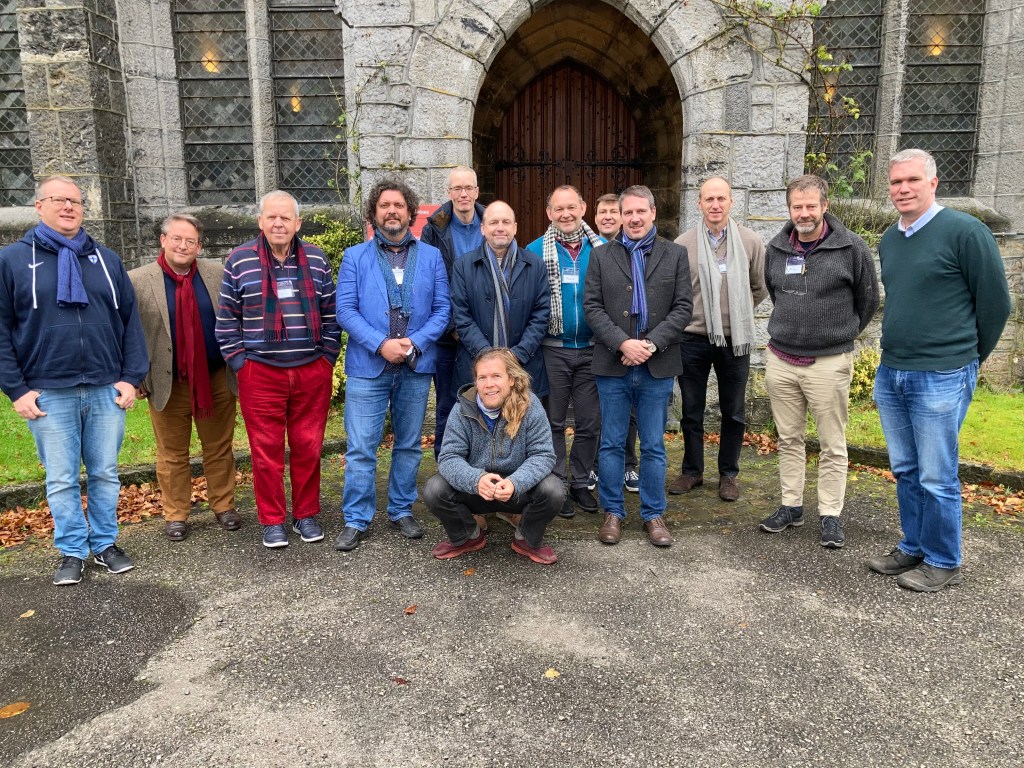
Men’s Retreat, Maredsous, 2021
Before and after retirement in the days before Advent I tried to fit in a few days in Venice. Usually on my own. Staying at the Hotel da Bruno just along the street from the Rialto bridge. Most of the time I would simply wander around the city from one church to another. But I usually included a trip out to Torcello, to wonder at the cathedral. [Many years ago my younger brother planned to do a measured drawing of it for his Architecture course at Oxford. But in the event he settled on a Thomas Archer building closer to home in Roehampton.] After Torcello I would usually have a coffee stop on Burano, and then walk across the bridge to the market garden island of Mazzorbo to have lunch at the trattoria near the vaporetto stop.
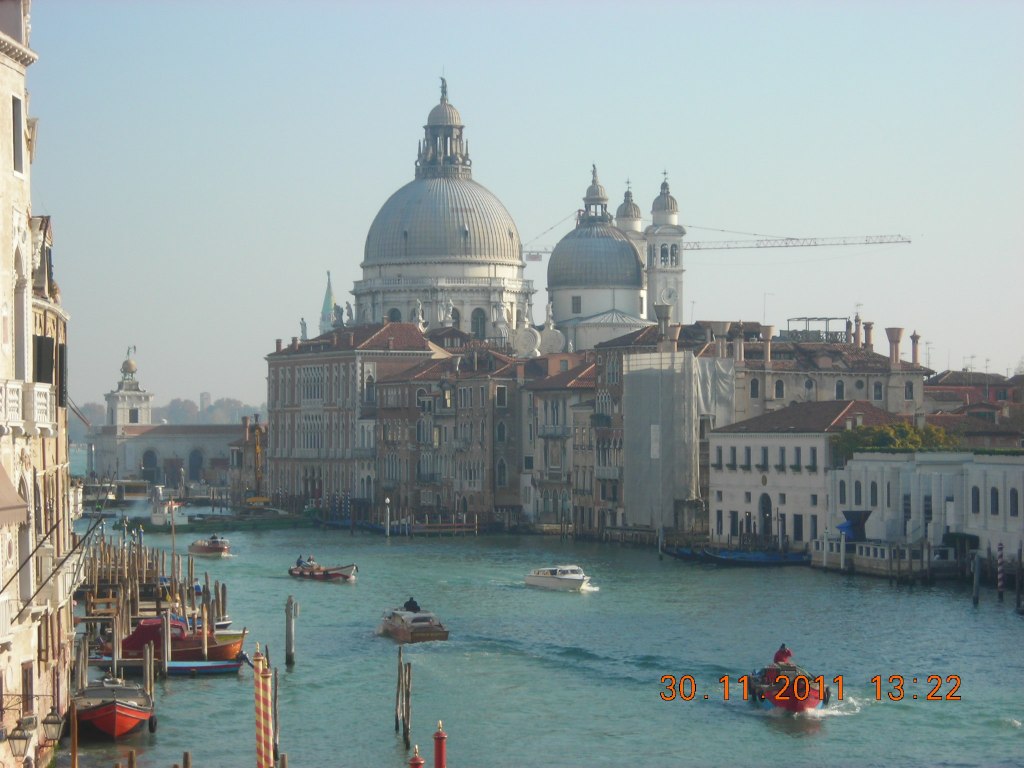
S. Maria della Salute, Venice, 2011
This year the furthest I have been from home was a day trip across the Fife to Kirkcaldy to deliver Susie for her hip operation in late July. But if the promised sunshine materialises we may take a bus out to Dunbar for lunch and a short walk by the sea.
Meanwhile I am falling in love [Susie thinks] with my renal consultant, the encouraging and engaging Dr Ian McIntyre. Whom I saw again at the Royal Infirmary last week. What is there in my life other than NHS appointments ? On Tuesdays Susie and I attend a triple-decker event at St Peter’s, Lutton Place. We start with Morning Prayer at 11 o’clock, continue with a Bible study at 12 o’clock, and then Nick Wills, the Rector, cooks us all an excellent two-course lunch at 1 o’clock. In the absence this week of Sue Whitehouse, I led the Bible study on John 4, the story of Jesus’s encounter with the Samaritan woman at the well at Sychar. It would make a wonderfully humorous sketch as Jesus and the woman continue to talk across each other.
As I recall, Eugene Peterson points to an interesting parallel between this meeting and Jesus’s encounter with Nicodemus in the previous chapter. The first story is about a man; the second story about a woman. The first story takes place in a sophisticated city; the second on the outskirts of a small country town. The man, Nicodemus, is a respected, and respectable, member of the sect of the Pharisees; the woman is a member of the despised sect of the Samaritans, and she has a dubious reputation. The man is named; the woman is unnamed. Nicodemus opens with a question about religion; the woman is not at all religious. In both stories reputations are put at risk. Nicodemus risks his reputation by being seen with Jesus. Jesus risks his reputation by being seen talking to the Samaritan woman.
In both conversations, Jesus is the primary figure. In both cases ‘spirit‘ is the pivotal word. In the first conversation the Spirit gives birth. In the second conversation, God is Spirit; and we are to worship him in spirit and truth. In both cases lives are changed.
Sophy Roberts
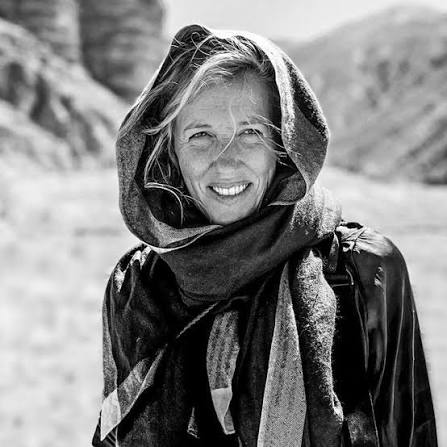
Sophy Roberts is my big discovery of the summer.[Though I’m aware that I may be a bit behind a lot of other people.] She is a journalist and travel-writer, whose journalism includes an occasional column in the Financial Times. Her first two degrees were from Oxford, after which she did a a Master’s degree in journalism at Columbia University, New York. Her writing career began when she worked as researcher for Jessica Treuhaft [née Mitford], the most leftwing of the celebrated Mitford sisters and the author of the best-selling 1960s memoir Hons and Rebels.
The Lost Pianos of Siberia
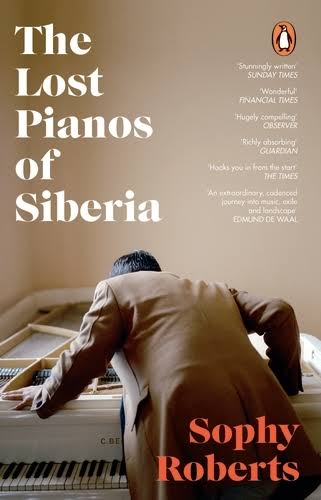
Roberts describes herself as a journalist with a special interest in travel, conservation, history, and literature. Her first book, The Lost Pianos of Siberia, was published in 2020 and named Sunday Times Book of the Year. The book stems from Roberts’ interest in the history of political repression in Russia, in the Tsarist system of internal exile, and Stalin’s Gulag. The presenting theme of this book which recounts the story of three years of travelling across the vast territory of Siberia is historic pianos. During the late 18th century and for much of the 19th century the possession of a [grand] piano was both a status symbol and a sign of wealth and breeding. Of an artistic temperament. In consequence a huge number of expensive pianos were shipped to all the major outlying cities, to Omsk and Tomsk, to Ekaterinburg and to Vladivostok. As Roberts goes in search of these pianos she find a safe space to excavate people’s memories as they recount a host of stories, speaking often of displacement and suffering.
A Training School for Elephants
In Roberts’ second book she also embraces a wide canvas. The overarching theme of the book is the effect of colonialism on native Africans as the European powers competed with each other in the ‘Grab for Africa’. She majors on the figure of King Leopold II of Belgium who owned what we now call the Congo and exploited its resources as his personal fiefdom. Ivory was an important and high profitable commodity, used for piano keys, billiard balls, and jewellery. But shipping was a problem. In 1879, in order to maximise his profits Leopold decides to import four Asian elephants and their mahouts. With a view to training up African elephants, which were hitherto thought to be untameable.
Roberts is not just a gifted writer. She is a historian and an indefatigable researcher. Her re-creation of Leopold’s expedition takes her to Belgium, Scotland, Ireland, Iraq, India, Tanzania, and the Democratic Republic of the Congo. Weaving both past and present Roberts and her companions follow in the expedition’s footsteps, travelling overland from Dar-es-Salaam to the shore of Lake Tanganyika and uncovering a story of cruelty and folly. The expedition serves as a symbol for the colonial conquest of Africa itself.
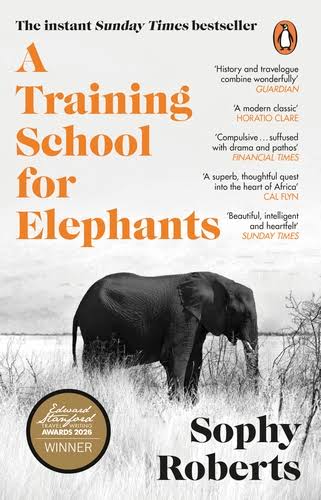
The book became a Sunday Times bestseller and won the 2026 Edward Stanford Travel Book of the Year award. “Luminous …”, wrote The Guardian reviewer, “Reflective, watchful, calm, Roberts is such a vivid travel writer that you forget what a brilliant historian she is. She has the water diviners’ gift for stories in unlikely places.And then, through research in the archives as well as on the ground, for uncovering sparky details that bring the story to life.”
The Emmaus Road story
Last night was the installation of a new minister, Dr MaryAnn Rennie, at Newington Trinity, in the former Mayfield Church. It was a significant occasion: new ministers don’t come along very often. There was a full church, the choir were in good voice, and there was a half decent sermon, well delivered by Scott Rennie, the Minister of St Giles. [He vaguely reminds me of Elton John.] He preached on the Emmaus Road story from Luke 24, stressing that Jesus walks with us in this world even when we are not aware of his presence. And encouraging us to look more carefully at the world around us and the ways and places in which God is at work.
I would have liked him to be a bit more challenging. As the story starts the couple, whom I assume to be Cleopas and his wife, are leaving Jerusalem to return to Emmaus. They are turning their backs on Jerusalem, the focal point of the Jewish religion. Does this mean that we have to turn our backs on the denominational headquarters [the Roman Curia ? the Episcopal office ? 121 George Street ?] if we are to encounter the risen Christ along the road ? “We had hoped …”, Cleopas tells the stranger; words that might be an epitaph for the Church of Scotland in the past generation.
As the story develops, I think the dominant theme is Opening Up. The couple open up their hearts, their hurting and their disappointment, to the stranger as they walk together. It reminds me of the way that we can find ourselves in strangely intimate conversations with people we don’t know on trains and planes. Then the stranger opens up the scriptures to the couple, carefully telling them that everything had happened as scripture had foretold. To the extent that their hearts were burning as they listened to him. Jesus must have been a wonderful expository preacher. When they arrive at their home the stranger does not impose on them, but makes as if to continue his journey. But the couple press him to stay and offer him a meal. They open up their home [for home, read life] to him. And then finally they recognise him in the breaking of the bread. I think the story tells us that, even if Jesus is walking with us unseen, we have to consciously invite him into our lives.
Envoi
If it’s fine, we are going to Dunbar tomorrow on the bus. It will be the furtherest that I’ve been from home for months. But we won’t go if it is raining.
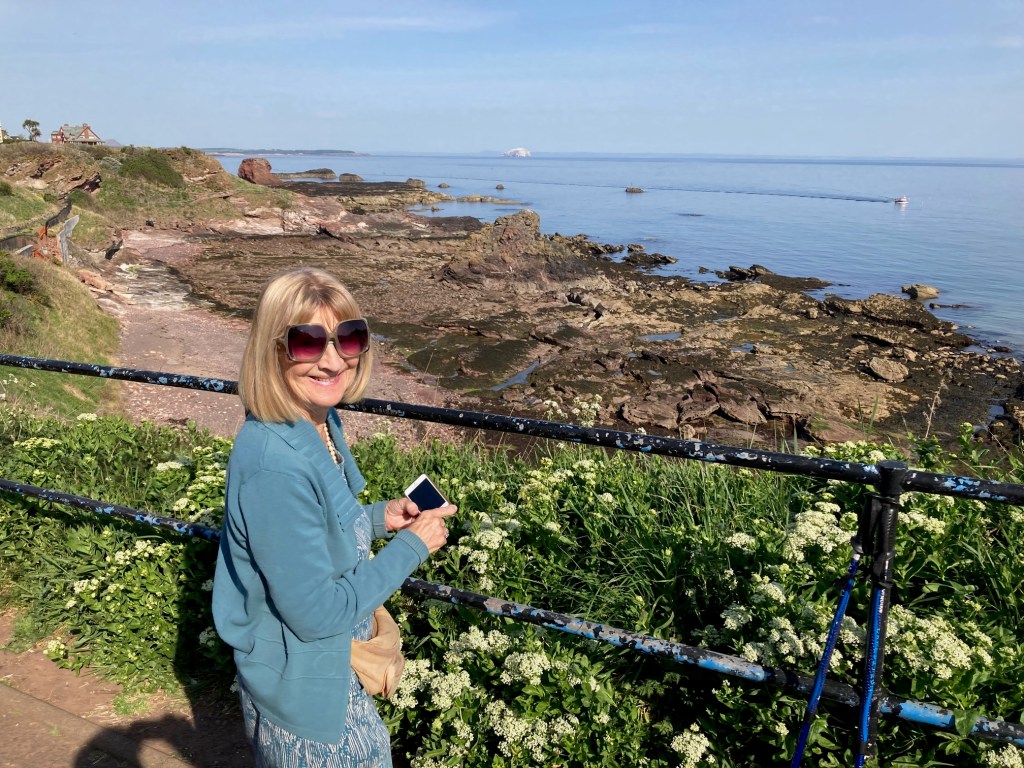
Susie at Dunbar, May 2025
October 2026


I shall buy the sophy roberts. lots of love. It is. Just my sort of thing. I’m basking
LikeLike