The BBC are pushing the boat out this week for the 80th anniversary of D-Day; the biggest opposed military landing in history. There are reconstructions every night this week, with live broadcasts from Portsmouth and from Normandy on Wednesday and Thursday. And a variety of D-Day films. My abiding memory of The Longest Day is of John Wayne being pushed around in a wheelbarrow behind Utah beach. It was less gruesome than the opening sequence, on Omaha beach, of Saving Private Ryan, which I saw with Jem in Edinburgh some 30 years ago. Sitting in the cinema was scary. For the troops landing on the beaches eighty years ago it must have been utterly terrifying.
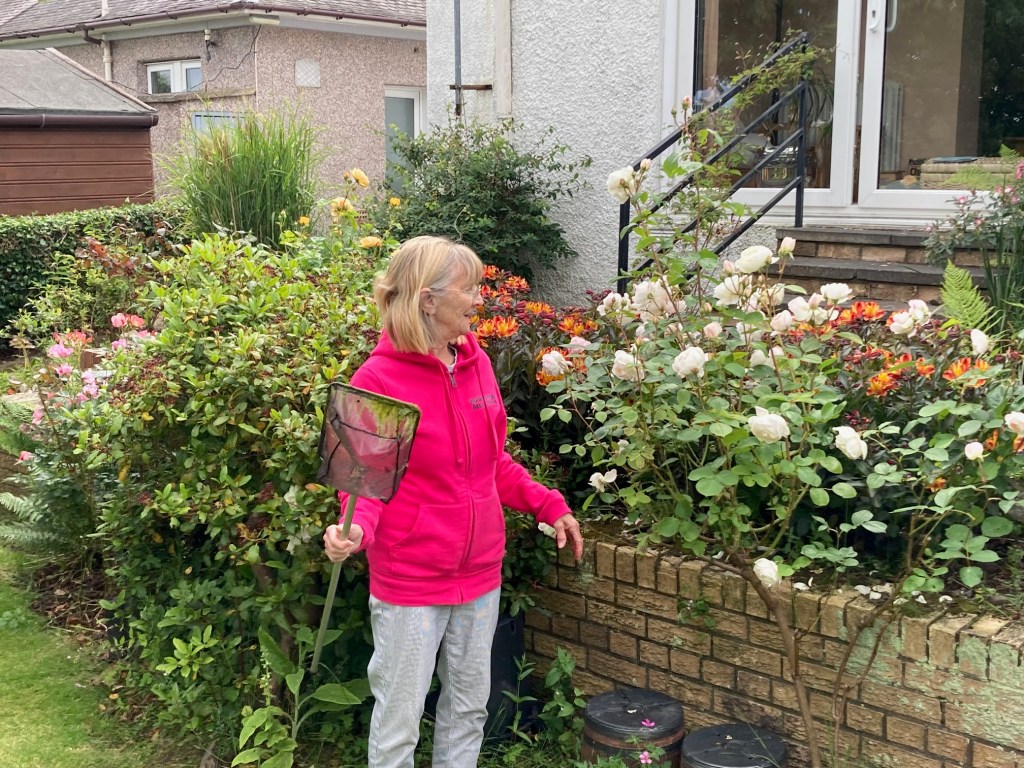
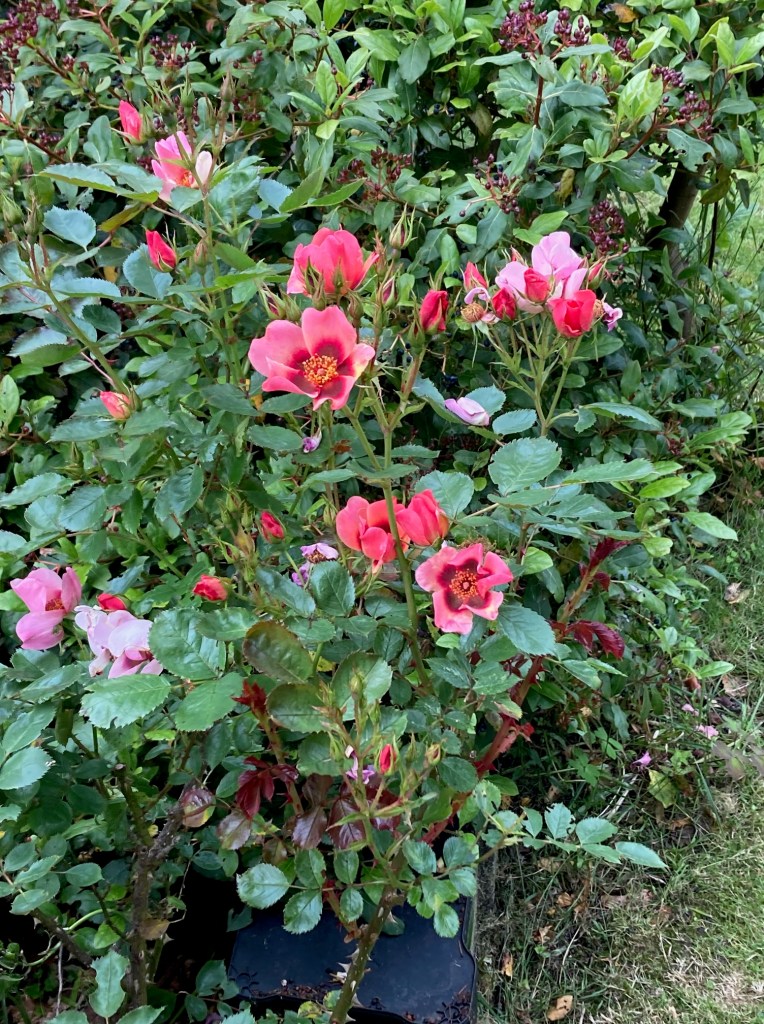
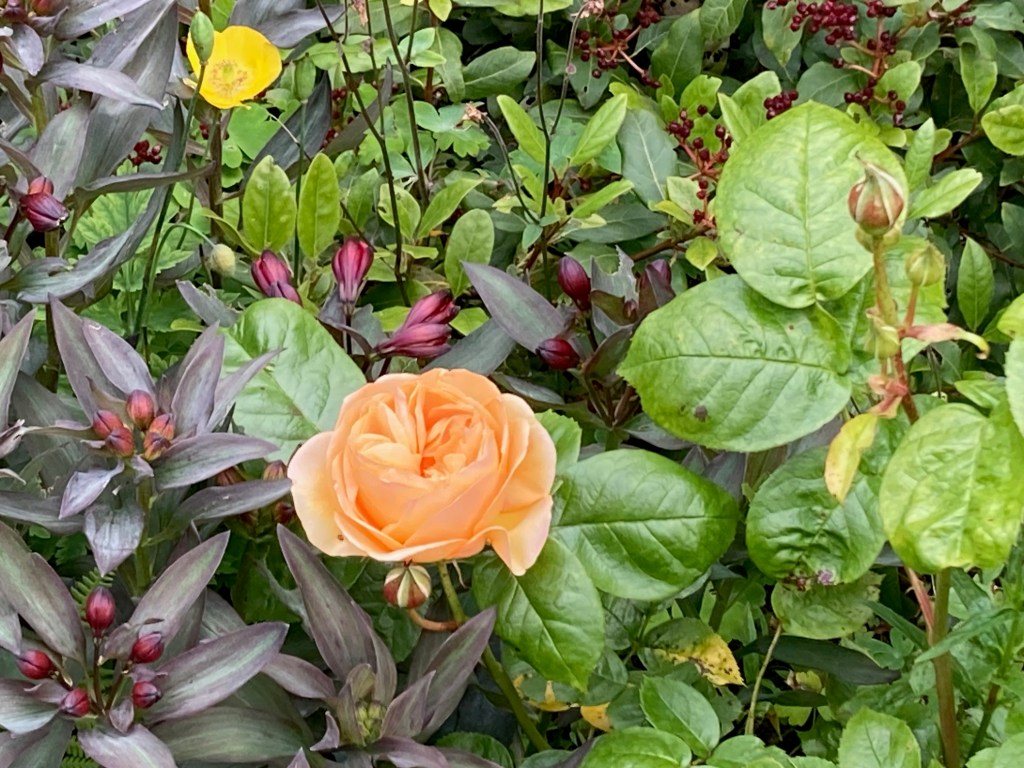
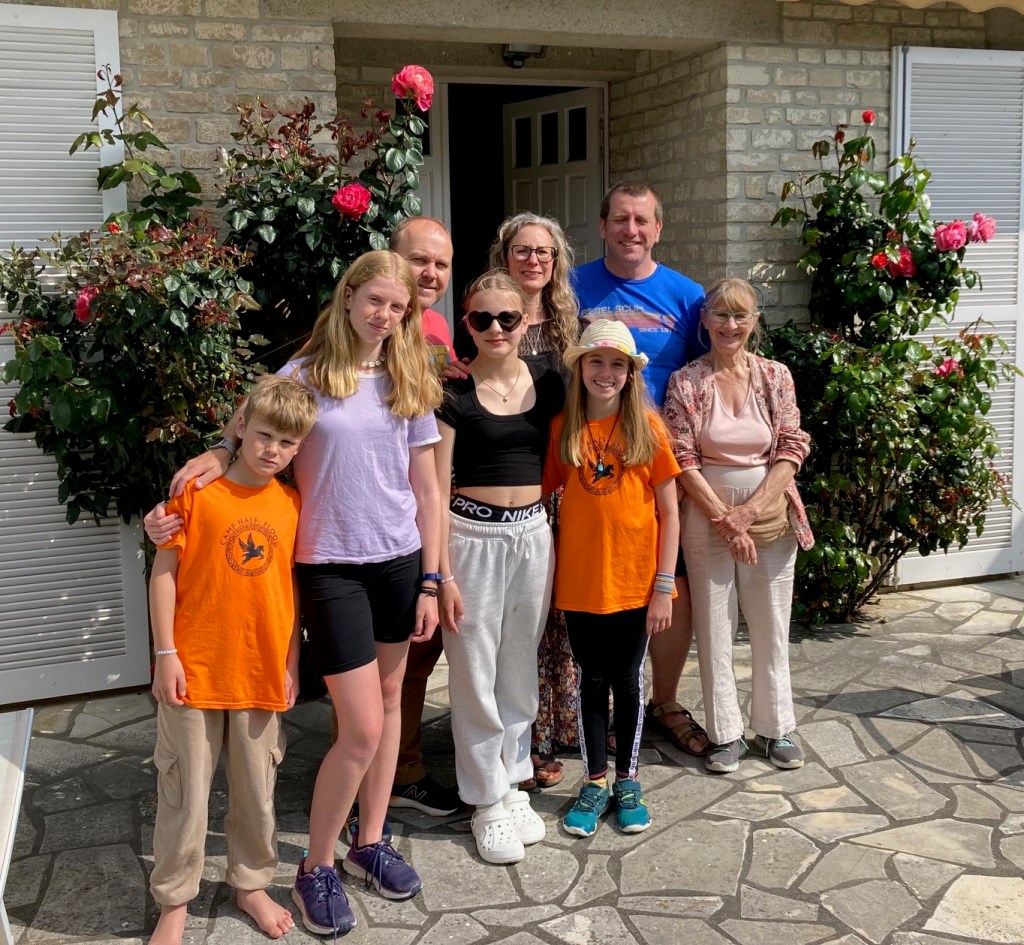
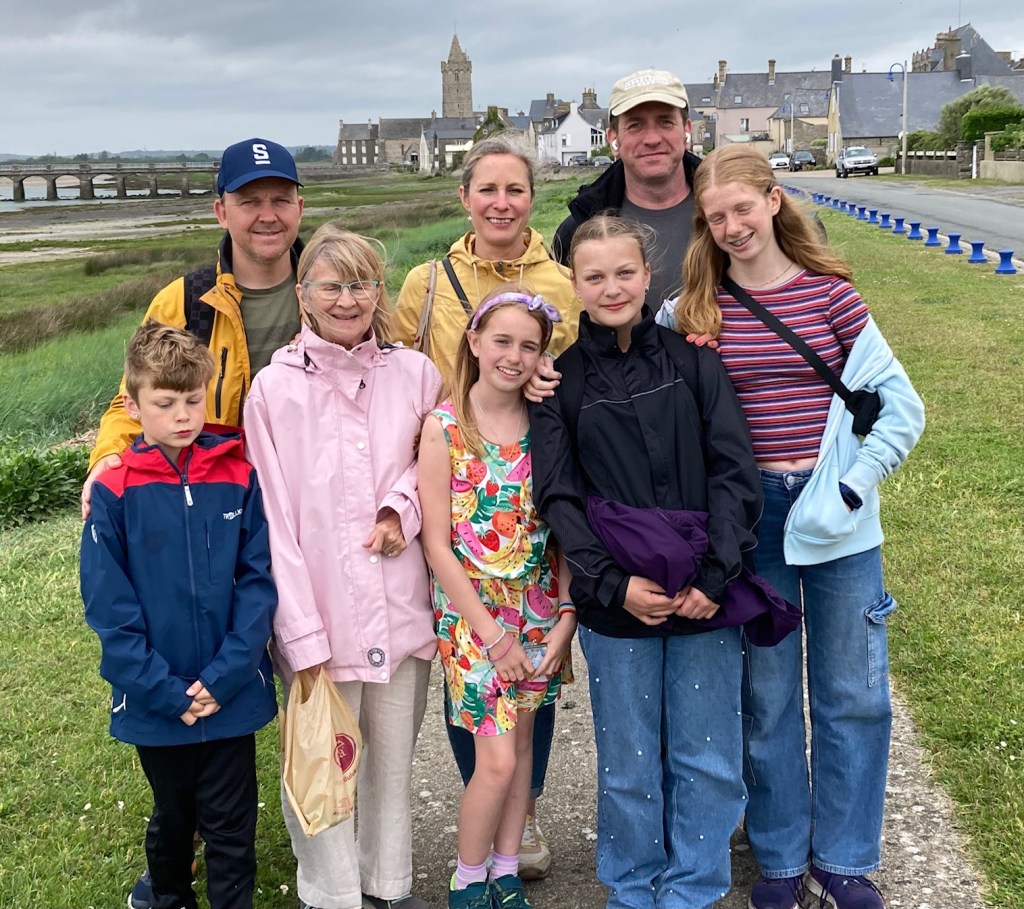
We enjoyed another three family holiday to Normandy for half-term. It was our third time there, with Craig and the girls, Amelia and Ellie, and Jem & Anna, Freya & Oskar. Joanna was of course conspicuous by her absence. We rented the same house as last year, close to the front at Carteret. It is a spacious house; with a big sitting room, a big kitchen, a bedroom and bathroom on the ground floor [for the grandparents]; and a further three or four bedrooms and two bathrooms upstairs. There is also an enormous garden; space for dining outside, a sufficiency of sun beds, and a giant trampoline, usually dominated by Oskar with a supporting cast of the other children. It is a good year for roses in Normandy. As in Edinburgh.
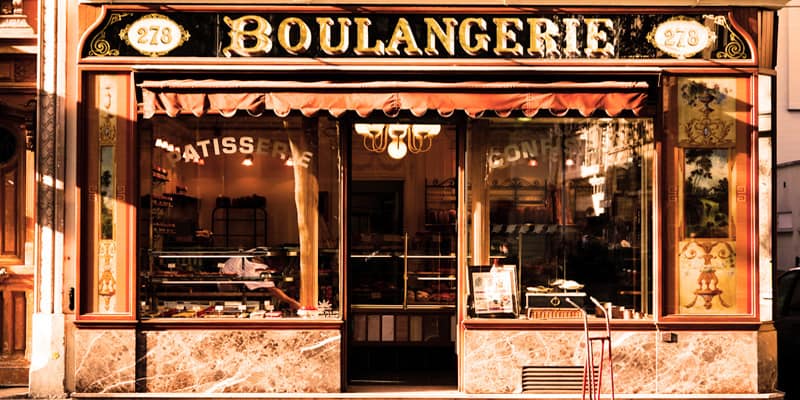
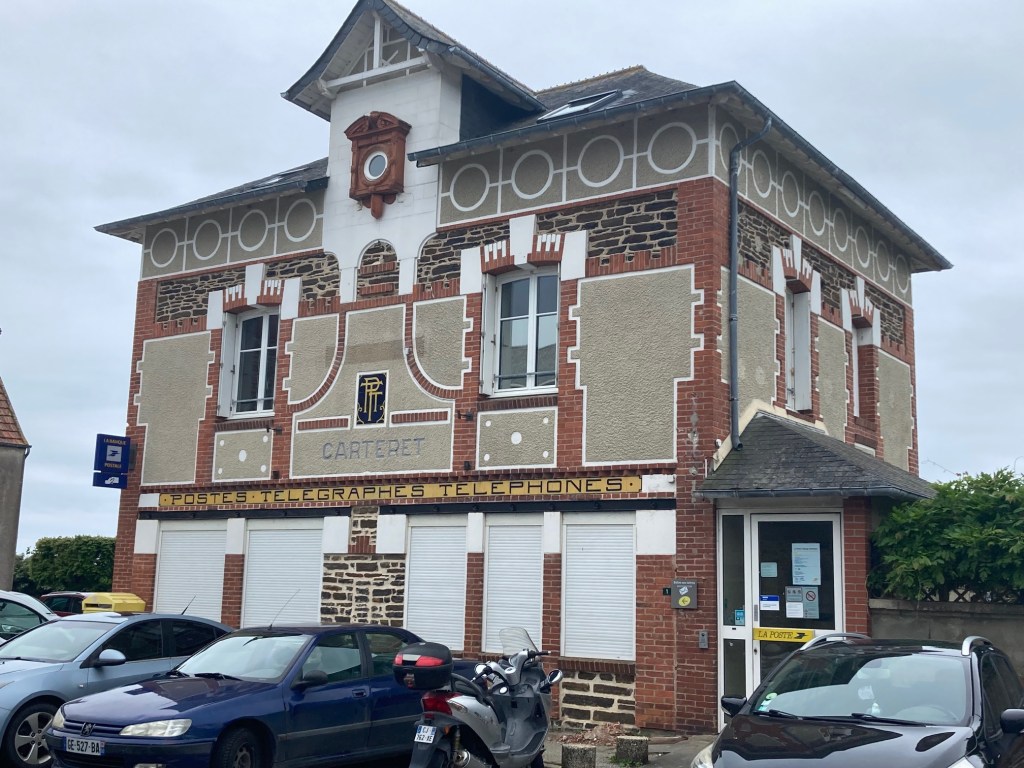
Carteret is a pleasing, old-fashioned kind of resort. The centre of town is a short street of shops. The bakery, which was threatening to close last year for lack of staff, is thankfully still there. A distinctly up-market épicerie. A new-ish, equally up-market cheese shop, whose range includes Shropshire Blue. A shop selling paintings and framed photos. Two shops that sell postcards and table-mats. At least two shops selling holiday gear, mainly sweaters and tee-shirts in Breton blue and white hoops. Two ice cream shops. And La Poste, a period building, set back on a side road.
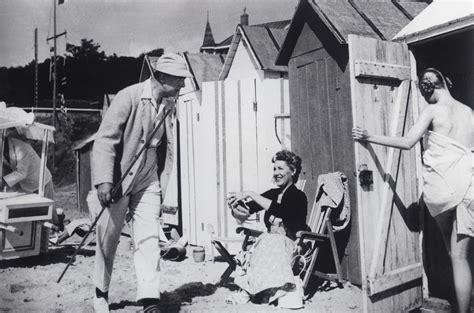
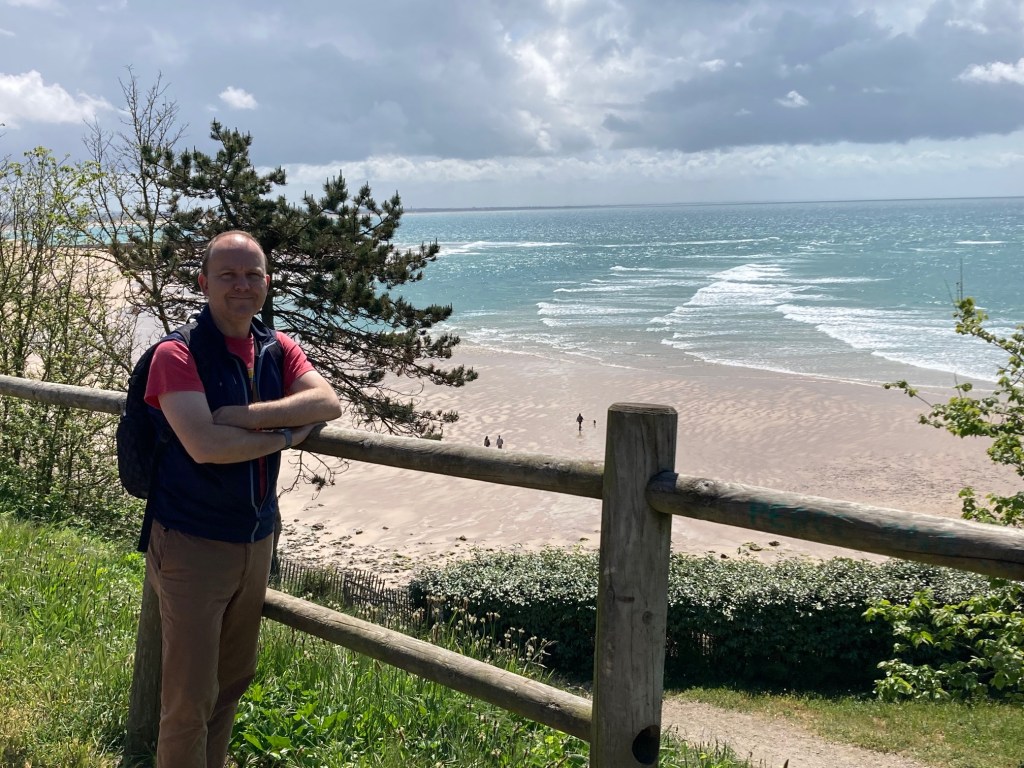
Beyond the shops, and beyond a board-walk, there is an enormous beach, backed by a row of colourful beach huts. And a decent cafe and restaurant called La Potinière. Where we ate on our last night. Above the beach there are assorted villas and a road that winds up to the lighthouse and the semaphore station. There is a second beach on the other side of the river, but this can only be accessed by driving a couple of kilometres to Barneville. The marina is set at the other end of the front. And back from the sea there is a railway station, now used only for tourist trains in the summer holidays. Also the pleasing St Louis of Carteret chapel , which was discarded when a new and ugly parish church was built. Neither of the churches currently offers any Sunday services.
The weather was mixed: hot sunshine, grey clouds, often windy, and one very wet day. The kids were happy to divide their time between the beach and the garden. On Monday Jem and I walked up the road, inland, to Hatouville, and then back across the dunes to the beach. Nether Jem nor I saw a golden salamander, nor a viper, as promised by the information board. But we did hear and fleetingly see a cuckoo.
On a damp Tuesday morning we drove a short distance to the market at Portbail. This is the village where my school-friend Clive holidayed for some twenty years. [Clive did French at school and at Oxford, and returned to Paris in 1968 as soon as he had finished his degree, initially teaching at the Université de Vincennes, alongside Christine Brooke-Rose and Jeff Kaplow. He spent all his life in Paris, acquiring two Master’s degrees, and died all too young of cancer.] The stall-holders in Portbail were damp and unenthusiastic. We had lunch in a Pizzeria/Creperie, and then walked along the side of the river to the stone pedestrian bridge on the way to Lindenbergh Plage.
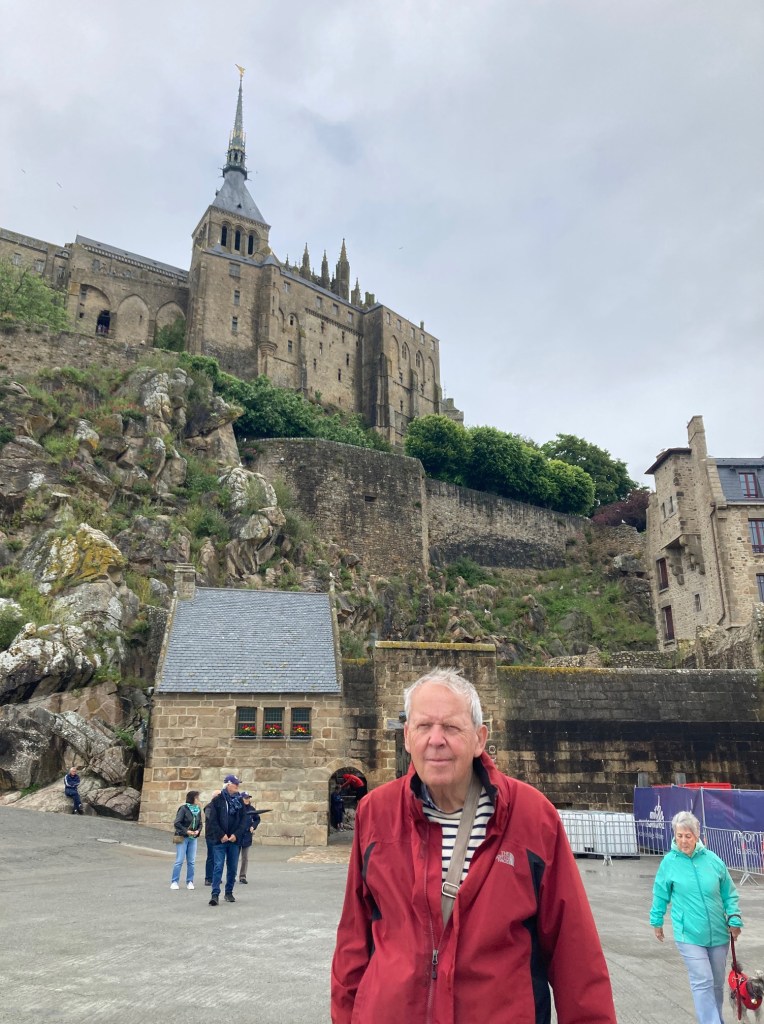
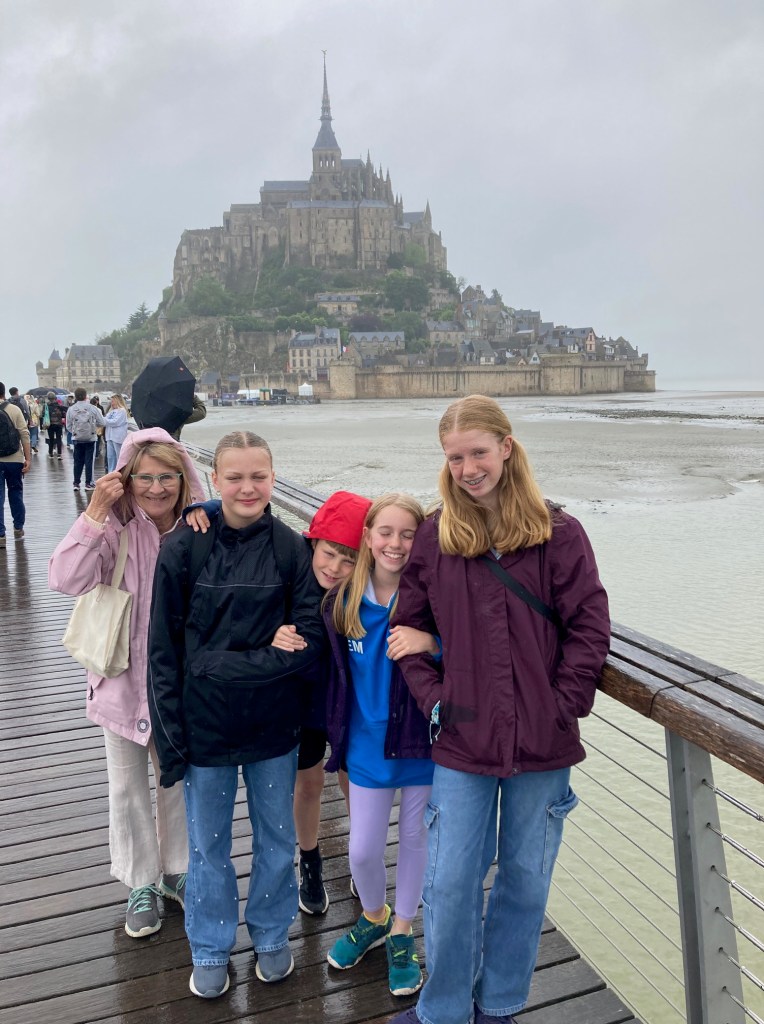
On a very wet Wednesday morning we ventured further afield to the Mont St Michel. I had only been there once before, an early morning visit in the summer of 1987, when we went camping as a family across France and down into Spain. On that occasion we parked our car on or close to a shingle causeway, and walked across into a relatively quiet main street. Now you park in a series of car-parks each the size of Murrayfield, and are transported by navette to the foot of the island. In spite of the rain we shared the visit with some four thousand Japanese tourists, all bristling with cameras and umbrellas. We had a decent lunch [poulet pays dAuge] in a busy restaurant on the main street. And I abandoned a planned trip up to the chapel in the face of crowds and slippery steps.
The sun returned on Thursday and Friday. And I returned to Hatainville which had become my daily walk. A few decades after the rest of the world, I have discovered the Health icon on my phone records my number of daily steps. I have set myself the quite arbitrary target of 10,000 steps a day. As of today I am averaging 11, 969 steps during the past week, 10, 015 steps during the past month.
We are greatly blessed with our children and grand-children. And it was good to spend time with them. Saturday was for tidying and packing up. Jem and family travelled back via Caen and Portsmouth. Susie and I were with Craig and the girls on the boat from Cherbourg to Poole. It took a little over an hour to clear the Borders Authorities, no doubt another consequence of BREXIT; and we were home to Wycombe just before midnight. Morning service at King’s Church, Wycombe, with a good sermon on Isaiah 11 by Rich Horne. Train down to London and home to Edinburgh on the 4.00pm from King’s Cross. Long enough to discover what a dreadful paper the Sunday Times now is. A whole troupe of ‘star’ columnists: Rod Liddle, Matthew Syed, Richard Coles, Jeremy Clarkson. Each of them worse than the last.
Now it is time to cut the grass. And look at the post. And catch up with the election. [Today’s news is that the self-obsessed clown Nigel Farage has swopped his customary pint for a banana milk-shake. After the election when Rishi disappears back to California, Farage will contest the leadership of the English Nationalist party [formerly known as the Conservatives] with Suella Braverman.]
And, more happily, to think about another short trip to the Hebrides.
PS
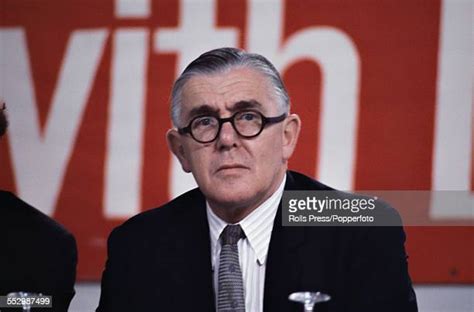
In case you think I didn’t read at all … I read 600 pages of A Life at the Centre in Normandy, Roy Jenkins’ 1991 autobiography. He was a good and civilised man, but very pleased with himself. And I started to read Flaubert’s Sentimental Education. Which is much shorter !
So, we are busy clearing stuff out in anticipation of selling the house and moving to a retirement apartment in Hexham. [Spoiler alert: We won’t move to Hexham, but it was the only thing that McCarthy and Stone could offer when I looked on their website for a retirement apartment in or around Edinburgh.] Susie has consulted the little girls about what stuffed animals we should retain. I am thinking of putting out a luminously pink shirt that I last wore to brother Peter’s Thanksgiving ceremony. The dress code was: pink and lime green. And I am thinking of another wardrobe cull to see what clothes can go to Edinburgh Direct Aid.
Yesterday’s men
On the bookshelves I found a copy of John Cole’s As it seemed to me: political memoirs [published in 1995]. It was a 50th birthday present from Mike and Wendy. And I hadn’t opened it for about thirty years.
John Cole was an Ulsterman, born in Belfast in 1927, a political journalist for some thirty years on The Guardian, before becoming deputy editor of The Observer in 1975. He is now best remembered as the BBC’s political correspondent from 1981 to 1992, and he wrote his political memoirs shortly after he retired. As a young reporter he recalls being sent to Belcoo on the Fermanagh border in the late 1940s to witness the arrival of the British Prime Minister. “When Clem Attlee arrived at the border, his wife was driving the car. There was no police escort. The biggest danger to the British Prime Minister was from his wife, who had a reputation as an eccentric driver, but the roads were blessedly empty … … the customs officials in Belcoo, no respecters of rank, required Mrs Attlee to open the suitcases in her car boot, presumably to ensure that she and Prime Minister were not making a killing out of imported nylon stockings, then in short supply”.
It all seems quite a long time ago. When politicians and journalists were able to enjoy close friendships, because of, or in spite of, political differences. Cole was an Ulster Protestant, a practising Christian, who specialised in labour relations and economic policy. As a young journalist he became friendly with George Woodcock, General Secretary of the TUC and a great admirer of John Maynard Keynes. Woodcock had come from a harsh industrial background, starting work in a Lancashire cotton mill when he was twelve. But he subsequently won a TUC scholarship to Oxford, where he took a First in PPE, and embarked on a long TUC career which stretched from the era of Keynes, Bevan, and Cripps to that of Macmillan and Wilson. One of his cherished ideas was that the government should maintain a high and stable level of employment. But within three years of his death in 1979, cooperation between government and unions was just a historical relic and 3 million people were unemployed.
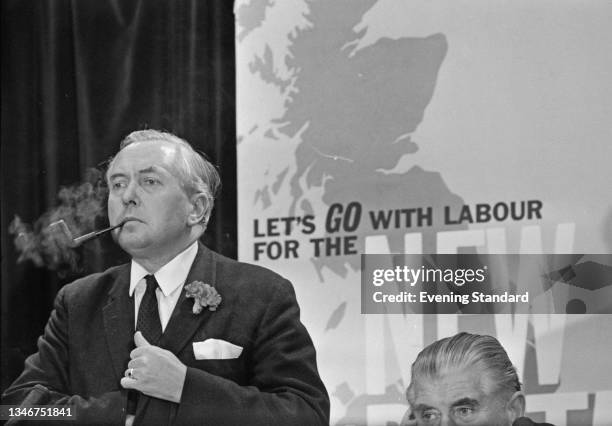
Cole also developed a friendship with Harold Wilson who became leader of the Labour Party following the early death of Hugh Gaitskell in January 1963. Wilson flattered Cole by declaring that they were both professional economists. But invariably added that he, Wilson, had obtained the only double-starred first in Economics at Oxford between the wars. With both Woodcock and Wilson, Cole wrestled with the perennial British problem of how to achieve economic growth without giving rise to wage inflation. A problem that successive chancellors of both parties failed to solve.
On the Conservative benches Cole became friends with Reginald Maudling whom he rated highly. It was Maudling who, reputedly, took no part in student politics at Oxford, but who then told Harold Nicholson that he was attracted by a career in politics and asked Nicholson which party he should join ! Maudling is now remembered mainly [by me] as a greedy man who got mixed up with John Poulson and other crooks, which eventually forced him out of front-line politics. He and his wife took to drink, and he died of alcoholic poisoning at the early age of 61. But during his political career Maudling had been successively Colonial Secretary, Chancellor of the Exchequer, Deputy Leader of the Tory Party and Home Secretary. And was twice a credible leadership candidate; first in October 1963 when there was talk of his succeeding Harold Macmillan, before the ‘emergence’ of Lord Home; and again in 1965 when Maudling lost narrowly to Edward Heath.
George Woodcock had felt that Maudling was a man with whom he could do business, but Heath’s victory marked the beginning os a reaction against the prevailing Keynsian economics and an end to what had become known as ‘Butskellism’, a broad consensus on economic policy that encouraged nationalisation, strong trade unions, heavy regulation, high taxes, and an extensive welfare state. What remained of this consensus disappeared with the arrival of Margaret Thatcher.
Cole is largely sympathetic to Wilson’s two premierships, both of which struggled with successive economic crises and the debilitating fear of devaluation of the pound. Which he suggests should have been voluntarily undertaken in 1964 rather than forced on the government in 1976. Wilson was a kind man, witty and generally good humoured, who had come into politics in order to improve the lot of his country and his fellow citizens. He exemplified the dictum [I forget whose it is] that the Labour party is best led from the Left of centre towards Right of centre policies. With hindsight, one of Wilson’s great achievements was to keep Britain out of Vietnam. But he was suspicious of plotters, and too aware of potential rivals within the party, which made for complicated relationships with Jim Callaghan and, more obviously, with Roy Jenkins. John Cole notes that Wilson had few Cabinet intimates; the unpredictable Dick Crossman, Barbara Castle, author of the much criticised In Place of Strife, and later Peter Shore. When Harold Wilson resigned in March 1976 [I was having dinner with two OUP authors in Le Havre], there were many fanciful stories about his being forced out by MI5 plotters. John Cole suggests a less dramatic explanation: he no longer believed that there was a simple solution to Britain’s problems within the timescale available to man of his age. And so he made way for [an older man, then aged 64] James Callaghan.
Something that John Cole omits, which my mother was pleased to tell people, is that she and James Callaghan had started work in the Inland Revenue on the same day in [I think] 1929. And that she had got a higher mark than him in the Civil Service entrance exam. Callaghan is one of the few politicians who was successively Chancellor of the Exchequer, Home Secretary, Foreign Secretary, and then Prime Minister. Later on in life my mother always sent him a birthday card, and was invariably delighted to get a friendly response.
Lost leaders
What John Cole hints at, if obliquely, is that Wilson, who had been elected leader in 1963 as the candidate of the Left, was initially reluctant to promote right wing Gaitskellites. Notably the brilliant but unpredictable George Brown; and more significantly both Roy Jenkins and Tony Crosland. Tensions between Left and Right persisted in the Labour Party. When Callaghan resigned as leader after losing the 1979 election, Michael Foot was persuaded to stand, disastrously for the party’s election prospects. Cole reflects on the gaggle of ‘lost leaders’.
Roy Jenkins
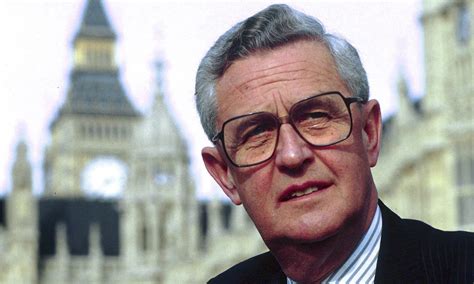
Roy Jenkins was one of the most accomplished politicians of the mid-20th century. He was born in south-east Wales, the son of a National Union of Mineworkers official; and was educated at Balliol College, Oxford, where his friends and contemporaries included Tony Crosland, with whom there was brief romantic attachment, Denis Healey, and Ted Heath. Towards the end of the war Jenkins worked briefly as a code-breaker at Bletchley Park, and was elected to the Commons at a by-election in 1948. He was the ‘Baby of the House’. With Labour in opposition during the 1950s Jenkins wrote well-received political biographies, including Sir Charles Dilke and H.H.Asquith. He also wrote The Labour Case in 1959, in which he set out a list of necessary progressive social reforms: the abolition of the death penalty, decriminalisation of homosexuality, the abolition of the Lord Chamberlain’s powers of theatre censorship, liberalisation of the licensing and betting laws, liberalisation of the divorce laws, legalisation of abortion, decriminalisation of suicide and more liberal immigration laws. It was a radical programme. But not necessarily a socialist one.
After the 1964 election Jenkins became Minister of Aviation, and then in 1965 Home Secretary, the youngest in that office since Churchill. He immediately embarked on a programme of liberal reform. He made space for David Steel’s bill on the legalisation of abortion. And he supported Leo Abse’s bill for the decriminalisation of homosexuality. By the end of 1966 Jenkins was the rising star of the Labour Party. The Guardian hailed him as “the best Home Secretary of the century”. And the Sunday Times called him “Wilson’s most likely successor”. [In later years Margaret Thatcher and Norman Tebbit blamed him for family breakdowns and the decline of respect for authority.]
Jenkins served in Wilson’s administrations as Chancellor of the Exchequer from 1967-70, and Shadow Chancellor and Deputy Leader from 1970, and then as Home Secretary for a second time. But he polled badly in the election for Wilson’s successor in March 1976, and his libertarian social views and his outspoken pro-European stance caused him to be increasingly out of step with the majority of Labour Party activists. [His insistence of having ‘a proper dinner’ and his impressive knowledge of claret probably didn’t help either !] From 1977 to 1981 Jenkins served in Brussels as the President of the European Commission. At the Commission he promoted closer economic and monetary union, which led to the coming of the single currency, the Euro, while conceding that this would involved the diminution of national sovereignty.
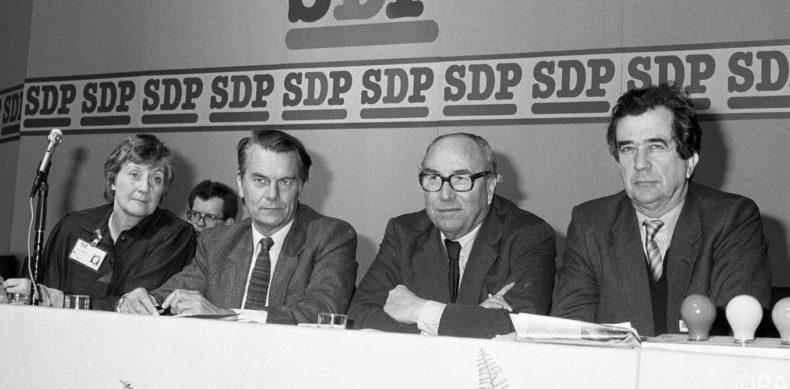
Towards the end of Jenkins’ time in Brussels, the Labour party formally adopted a unilateralist defence policy, called for further nationalisation, and for the withdrawal of Britain from the EEC. In March 1981 Jenkins joined David Owen, Bill Rodgers, and Shirley Williams, known as the Gang of Four, in issuing the Limehouse Declaration. Which brought into being the SDP. He was returned to the Commons in March 1982 at the Glasgow Hillhead by-election, but his somewhat portentous style led to frequent heckling from the Labour party’s ‘awkward squad’ [“Roy, your flies are open again …”]. I heard him speak at an SDP rally in Witney, Oxfordshire, in the early 1980s and his delivery was quite pompous, not helped by a slight lisp. During his days in Brussels he was known as ‘le roi Jean Quinze’. He died in 2003, aged 82, a life peer, Chancellor of Oxford University, Order of Merit etc etc.. He was a radical and a visionary and a social democrat. But he never led the party which he had served with distinction..
Tony Crosland
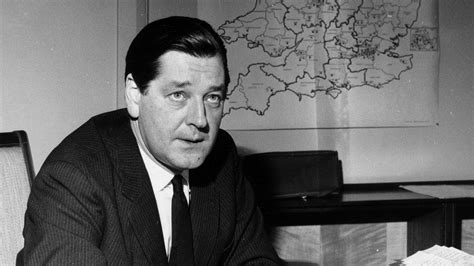
Tony Crosland was a different kettle of fish. His parents were members of the Plymouth Brethren. At Oxford he took degrees in both Greats and PPE, was President of the Union, and before becoming a member of parliament taught Economics at Oxford. His pupils included Tony Benn. As CAR Crosland he was the author of the influential book The Future of Socialism [published 1956], which marked him out as a moderate, a moderniser, and a Gaitskellite. The book rejected the idea of further nationalisation, and argued rather for promoting equality of opportunity, and prioritising social services and an end to poverty.
In the 1963 leadership election, Crosland declared it was a “choice between a crook [Wilson] and a drunk [George Brown]; voting first for James Callaghan and then, reluctantly for Brown. Under Wilson Crosland served in a variety of Cabinet jobs. But he was disappointed not to become Chancellor in the 1967 reshuffle. It went to Roy Jenkins. In 1970, on the eve of the election, John Cole wrote an article urging Wilson to make Tony Crosland Chancellor of the Exchequer. But when Ted Heath won his unexpected victory, blamed on England’s losing to Germany in the World Cup in Brazil, it didn’t happen. And Labour went back into opposition.
When Labour returned to power in 1974 he became Secretary for the Environment. After Wilson’s resignation Crosland supported James Callaghan, again, and was rewarded by becoming Foreign Secretary. in April 1976. His time at the Foreign Office was taken up with the Cod War and relations with Rhodesia. in February 1977 he died very suddenly of a brain haemorrhage, aged 58.
John Cole writes: “His early death has inevitably cast around him a penumbra of ’what might have been’, like that which envelops the memory of Iain Macleod among a generation of Tories. In each case. death caused huge loss to the causes they served. Each generation in politics produces too few leaders of the highest qualities in mind and character that we can accept phlegmatically their disappearance from the scene.”
Denis Healey
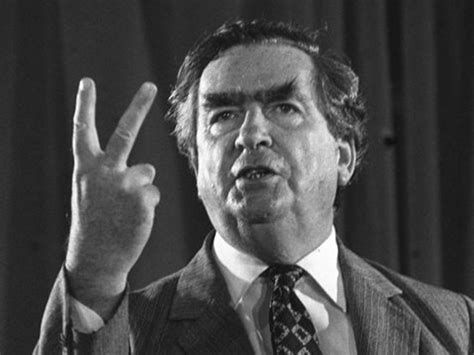
Healey had a slightly different trajectory. He was at Balliol with Ted Heath, whom he succeeded as President of the JCR, and Jenkins, to whom he was never close. He joined the Communist Party at Oxford, but left again a few years later. During the Second War he served in the Royal Engineers in North Africa and Sicily, was a beach-master at the Anzio landings, and was twice mentioned in dispatches. After the war he turned his back on a prospective academic career.
From 1945 Healey became foreign policy advisor and International Secretary of the Labour Party, a role which brought him into contact with a whole generation of European socialists. He was elected to the House of Commons in 1952, becoming a friend and supporter of Hugh Gaitskell. After Gaitskell’s death, he voted first for James Callaghan and then for Harold Wilson.
In Wilson’s first administration Healey became Secretary of State for Defence. He oversaw Britain’s withdrawal from East of Suez, reduced spending on overseas commitments, but prioritised a commitment to NATO. The government sold arms to South Africa, a policy which he later regretted.
In Wilson’s second administration Healey became Chancellor of the Exchequer, and continued in that role under James Callaghan. When Callaghan stood down in 1980, Healey was the favourite to win the leadership election. In September 1980 an opinion poll had suggested that Healey would make a better prime minister than Margaret Thatcher [45% to 39%]. He was the obvious successor to Callaghan. But in the event he lost to Michael Foot, proposed by Neil Kinnock as the candidate of the Left. Healey served under the unelectable Foot as Deputy Leader and as Shadow Foreign Secretary. In 1992 he stood down as an MP after 40 years in the Commons, and became Baron Healey of Riddlesden in West Yorkshire. His bushy eyebrows and piercing wit made him popular with the general public. He swam 20 lengths every morning in his outdoor swimming pool in Sussex, and died in his sleep in 2015 at the age of 98. Many people in the Labour Party thought he was “the best prime minister they never had”. And I think they are right.
Envoi
I shouldn’t really be wandering down memory lane. I should be outside working in the garden.
John Cole says that Jenkins and Healey were both gifted men, and hard-working when engaged on something they thought worthy of their talents. He reflects briefly on the ‘what might have been’ if the Gang of Four had stayed and fought within the Labour Party as opposed to creating the SDP. All schoolboys like picking imaginary ‘best ever’ cricket teams. In the same vein, I like to imagine a Labour government of, say, 1983, with Denis Healey as Prime Minister, Jenkins at the Foreign Office, Tony Crosland as Chancellor, Shirley Williams at the Home Office, with David Owen and Roy Hattersley and John Smith and others waiting in the wings. It would have been a formidable collection of political talent. And a striking contrast to the Commons today, which seems to be populated largely by juvenile leads and never-wazzers, by populists and chancers and demagogues.
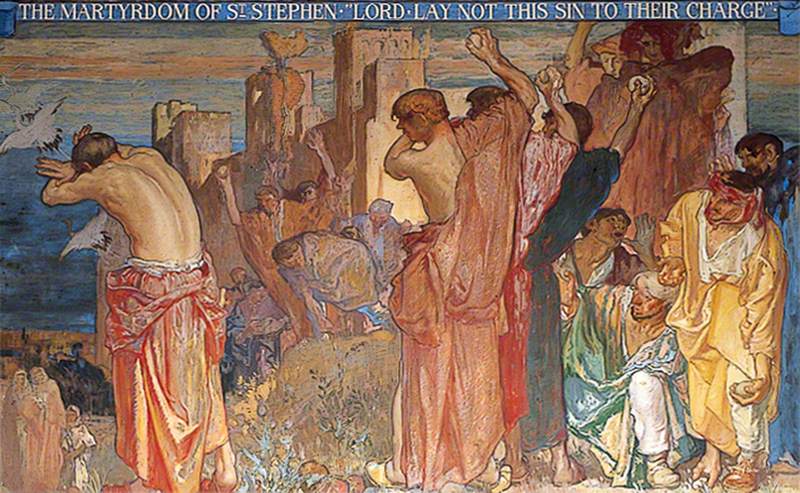
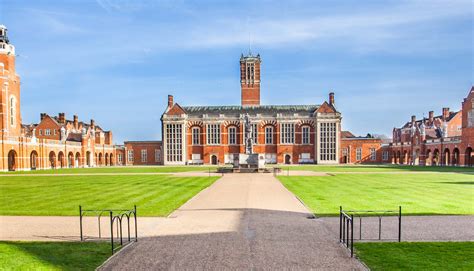
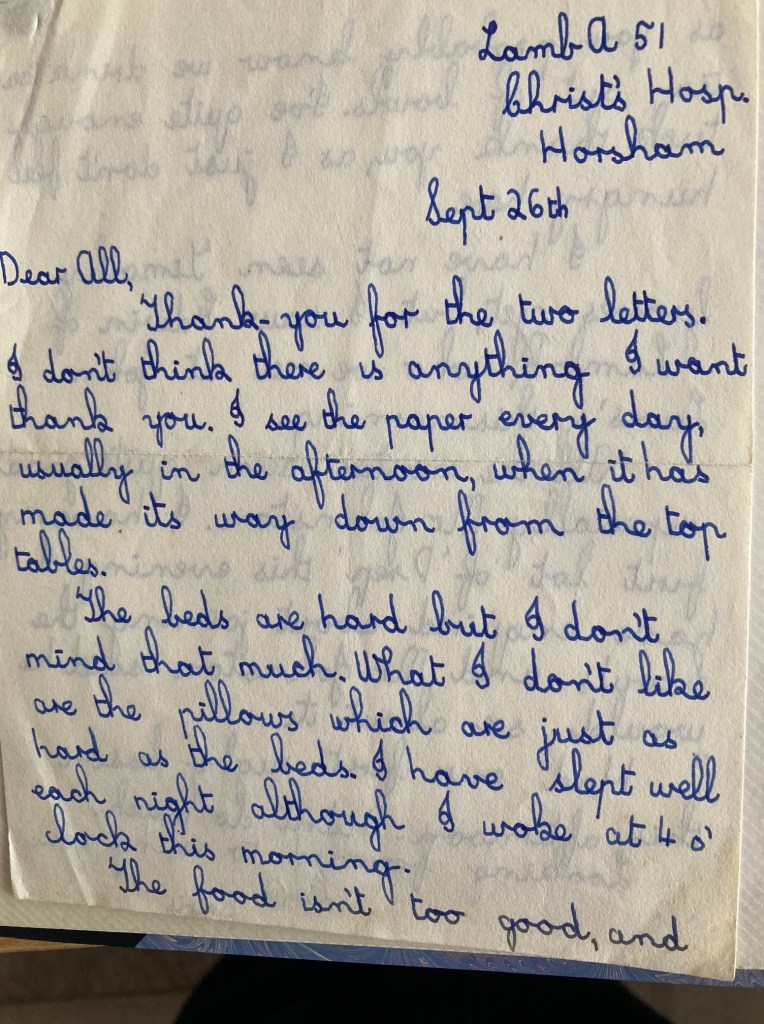
With hindsight I may have over-invested in the 60 Years On reunion down at CH. It was a long way down and back on the train, and involved two nights in a modest but friendly hotel in Horsham. For what was in truth a modest event: mid-morning gathering for coffee; a visit to a boarding house, Coleridge A to be precise; a visit to the CH museum, housed on the top floor of what used to be ‘the sicker’; Dinner Parade in the sunshine, visually impressive and the most nostalgic moment of the day; and a lunch that was incomparably better than the food I remember. And the [short] day was finished with a service in the CH chapel, dominated by the Brangwyn cartoons. And led by a young, ex-military chaplain wearing [what I thought was] a frilly cotta.
Nervous about finding no-one I knew, I had been in touch with four friends beforehand that I was looking forward to meeting up with. Walter was a ‘no show’, prevented from coming up from Chichester by a medical emergency of his sister. And Pete, whom we see from time to time here in Edinburgh, was a bit overcome – I’m not sure why, and disappeared after an hour. But I was pleased to talk to John, who had driven down from near Malvern. And to have a long talk with Mick, whom I last saw in 1967. Both Pete and Mick were fellow History Grecians, but both opted out of the Oxford route, possibly seduced by the more obvious attractions of London in the early 1960s. Sex and drugs and rock and roll. Loosely speaking.
Going down on the train I re-read Bryan Magee’s Growing Up in a Time of War. Magee was an LCC scholarship boy from Hoxton, who was at CH in the 1940s before going on to a career as an academic philosopher and writer and broadcaster. The book records Magee’s appreciation of ‘Daddy’ Roberts and others. But it also highlights the sadistic tendency of other masters, who clearly derived sexual pleasure from administering beatings. I think by the time I was at CH, a decade later, he was probably on the black list, definitely persona non grata.
Magee incidentally spent a few weeks as a Grecian on an exchange programme with the Lycée Hôche in Versailles. School exchanges are out of fashion these days and notoriously difficult to arrange. But, following a chance conversation down at CH, I’ve just written to the senior Modern Language teacher, asking if they would be interested in developing a link with the Institut les Chartreux in Lyon. If so, I’d be pleased to put them in touch with Jean-Bernard Plessy.On the way back I thought a bit about my time at CH. In the 1950s-60s it was certainly an elitist school; geared towards preparing candidates for Oxbridge, and with a strong bias towards Classics, Mathematics, and History. I certainly learnt a lot of Greek verbs and medieval history. Without CH I wouldn’t have gone on to Balliol. And the school inculcated a distinct set of values [or prejudices]; intellectual curiosity, a willingness to question authority, a concern for books, a set of broadly left-wing attitudes. In favour of economic redistribution and of closer ties with Europe. But, curiously, in spite of, or possibly because of, a dose of daily chapel services, the school did nothing whatever to help me develop a spiritual life. And that was before chaplains with cottas ! Walter, who was the ‘no show’ last week is the only school friend who got ordained; serving in the west edge of the Hereford Diocese, in Kilvert country, and then in Huntingdon, before becoming Canon Residentiary and Vice Dean at Chelmsford.
The trivial round
We have been back from Grenoble for just over three weeks. It seems longer. When we got home the house was cold and the boiler had stopped working. Which is mercifully now fixed. And there have been a number of overdue appointments. A meeting with the diabetic nurse. Which usually means advice to shed a few kilos. An appointment with the dentist. I’ve been going to the same dentist in Musselburgh since 1988. But he has now retired, and the practice is no longer going to accept National Health Service patients. So that looks like another monthly standing order.
And two appointments with the optician. I already knew that I have an incipient cataract in my left eye. [The right eye was done twenty-plus years ago.] I’ve been on the waiting list for about 17 months now, so I’m not holding my breath. This week there is also the possibility of incipient glaucoma. So I’m going on another waiting list to get a second opinion at the Eye Pavilion. As I said to my very nice Chinese optician from Kuala Lumpur, I may not live that long.
Looking ahead
Susie has been known to complain that this blog spends too much time looking backwards. So – let me say that we have decided to downsize into a [retirement] apartment in five years time. Which means that she is already staying awake at night worrying about how to dispose of all our junk. It isn’t all junk, of course. But we do have more than thirty soft animals. For when the grand-children come to stay, not for us. And I have an awful lot of socks. And probably enough books to last me for another twenty years.
I’m currently reading The Man who was Smiley, a biography of John Bingham, the 7th Earl of Clanmorris, a journalist and author, who was also an agent-runner for MI5.He wasn’t a very exciting man; slightly podgy, with very thick glasses, who was instantly lost in a crowd. He wrote crime fiction and espionage novels, and although his early books attracted good reviews they didn’t sell very well. But he was a onetime colleague of John le Carré in MI5 and seemingly the model for George Smiley. Like Smiley he was a skilled interrogator, and he seems to have been the product of an old-fashioned and more sedate world. Apparently he cleaned his glasses with the fat end of his tie. Something that Alec Guinness did in the [superb] television productions of Tinker, Tailor, Soldier, Spy and of Smiley’s People. It seems that Bingham’s wife was violently jealous of le Carre because of his success as a writer. But Bingham seems to have been unperturbed by it.
And I’m nervously eyeing up Touching Cloth by Fergus Butler-Gallie. Nervously because his previous book, A Field Guide to the English Clergy, was extraordinarily bad; arch, unoriginal, and unfunny. I’ve been given this new one. And I want to believe that it might be better.
Meanwhile there are jobs to be done in the garden. And circuits of Arthur’s Seat. And a decision to be made about private dentistry. After which we are going back to Normandy for a week with the children and grand-children. Back to Barneville-Carteret. Followed in June by what might be our last road trip up north; to Arisaig, across to Skye, on to Harris and Lewis, and back from Stornaway to Ullapool. The friendly garage in Dalkeith have decided, suitably apologetically, that this might be the last year that they will let us hire a car.
We have been back from Grenoble for some ten days. It has rained steadily each day, and the boiler has gone on the blink. In the garden the ground is sodden, and I am wondering whether to allow the pond to overflow and turn it into a boating lake. The only good thing is that the little girls passed through, and Jem & Ann and the children came to stay. Which was excellent. Freya wrote in the Visitors’ Book that staying here might have prepared her for an expedition to the Antarctic.
Going back to school
I left school, Christ’s Hospital, 60 years ago at Christmas. At the end of the Michaelmas Term 1963. The unchanging school leaving service was undiluted sentiment: the Headmaster, ‘George’ Seaman, reading [very slowly] from Philippians 4: “Rejoice in the Lord always, and again I say, Rejoice … Whatsoever things are of good report, think ye on these things”; and the Nunc Dimittis; and singing a hymn, possibly The day thou gavest, Lord, is over, with three slurs to the line [there may be a more technical term for this]; and the Leaving Charge, again read by the Headmaster: “I charge you never to forget the great benefits that you have received in this place, and in time to come, according to your means, to do all that you can to enable others to enjoy the same advantage. And remember that you carry with you, wherever you go, the good name of Christ’s Hospital.” And the giving to each leaver of a black leather-bound Bible, the RV I think.
After the service leavers would dash round saying Good-bye to selected masters. Or gather for a surreptitious fag down in the Tube or on the roof of the bogs in the car park. Or possibly both.
I spent nearly seven years of my life at CH, going there at the age of 11 in the summer of 1956. None of my family had ever dreamed of going to boarding school. And the very little I knew about such schools came from readingThe Fifth Form at St Dominic’s, [pub 1881] by Talbot Baines Reed, originally written for the Boy’s Own Paper. And published by the Religious Tract Society. I guess I must have found an elderly copy in my grandparents’ house. And from reading the Jennings books by Anthony Buckeridge. On balance the latter books were probably more helpful. [The author himself was at school at Seaford College, and later taught at St Lawrence, Ramsgate.]
Life as very different in the mid-50s. Pop music, transistor radios, mobile phones, colour television, foreign travel, the Internet, and girls had not yet been invented. At least not in my world. The first several years at CH seem in retrospect to consist largely of a lot of school work, a lot of running around in wet games clothes, and of marching into meals three times a day in the enormous Dining Hall. At primary school we had done little other than arithmetic and English, and play football. At CH a host of things were new to me. I quite enjoyed Latin and History and Geography [I won a Geography prize at the end of my first year], though the geography lessons rarely got beyond the Weald; I was easily intimidated by French; and bored by Physics [one teacher still spelled Cathode with a K] and Chemistry, which largely consisted of heating things up in test tubes; and even more bored by Mathematics. Especially when simple arithmetic and problem-solving morphed into algebra and geometry and trigonometry. After the first two years I gave up on Geography and embarked on classical Greek. Which I really enjoyed.
Outwith the classroom there were games every afternoon. Most often rugby in the winter. Followed by splashing in muddy water in a communal trough. Other afternoons we ran round bits of the local countryside for an hour or more. In extremely bad weather we played ‘heartyball’ in the muddiest patch the monitor could find. I was hopeless at gym, which took up one afternoon a week. While contemporaries swung on ropes and walked on their hands, I could never manage more than a simple vault over a pommel horse. I was better at cricket, which took an enormous amount of time in the summer. We practised on Mondays, Tuesdays, and Thursdays, and played competitive house matches on Wednesdays and Saturdays. I was an accurate, if the world’s slowest, bowler, and an erratic batsman; but I captained the house second leagues team for a season.
We lived in boarding houses of some 50 boys each. The houses were named after famous Old Blues. My house was Lamb A, named after Charles Lamb – of whom I had at least heard ! And Coleridge too. Middleton was, I think, an obscure bishop; and Maine possibly an academic lawyer. Each house had a big day room, in which we lived for much of the time, and two dormitories each heated by a single radiator. The day room contained four long narrow tables, at which we did our prep, and on which we played table tennis. Our games clothes were kept in communal, house changing rooms, from which things regularly disappeared. My swimming trunks disappeared my first summer term, and I had to swim in the altogether for several weeks. Like one of the characters in a Jonathan Coe book. It’s a wonder I’m not still in therapy.
My house master, Johnny, taught modern languages. He had been educated at the Royal Masonic School, Bushey, and then at Downing College, Cambridge; and had spent the war as an interpreter with Polish troops. We suspected that his red complexion came from eating too much bortsch. He invariably wore an old tweed sports jacket and grey flannels and brown shoes. He was a bachelor, and a philistine, and a bigot, who exhibited many of the less attractive characteristics of public school- masters of his generation. His all-purpose put-down was ‘Bolshy’, which incorporated everything from would-be intellectuals to modern poetry to socialist politicians to pop music.
The other masters were a mixed bunch. Many of the senior house-masters were much like Johnny; bachelors, instinctively conservative in their politics and their social attitudes, ill at ease with women, and apparently happy to stay in their posts until death or retirement whichever came first. [The pattern is well portrayed in TC Worsley’s Flannelled Fool, a book about the author’s experience of teaching at Wellington in the 1930s, a book that I didn’t discover for another six or seven years.] Several of these masters, like Arthur Rider and ‘Pongo’ Littlefield, had served in the war, and then returned to the familiarity of teaching as the only thing that they knew.
The setting
CH was a ‘religious, royal, and ancient foundation’, which had celebrated its quatercentenary in 1953. It had in origin been a charitable foundation in the City of London, in Newgate Street, which had relocated to Sussex, to West Horsham, very early in the twentieth century. The foundation bought 1,200 acres of land from a bankrupt dairy company, and engaged Sir Aston Webb, the architect of the Queen Victoria Memorial and the facade of Buckingham Palace, and of County Hall, all in London, and of much of the University of Birmingham, to design the buildings. These include 8 boarding houses arranged along a central avenue, all built in a distinctive yellow-red brick [bought at a discounted price], an enormous quadrangle flanked by colonnades, the chapel, and the dining hall, which is dominated by an 86-foot-long painting by Antonio Verrio which depicts the foundation of the Royal Mathematical School by King Charles II in 1673.
The complex of buildings is ‘ringed by downs and woodlands fair’, according to one of the school hymns. More prosaically it is surrounded by a patchwork of rugby and cricket pitches, including the First XI square which was reputed to be the best cricket wicket in Sussex. The southern region trains to Worthing and to Brighton are hidden from sight in railway cuttings, beyond which lie Shelley Wood [no known connections to the poet] and the gently sloping Sharpenhurst. It was and is a delightful setting, though many trees were lost in the Great Storm of 1987.
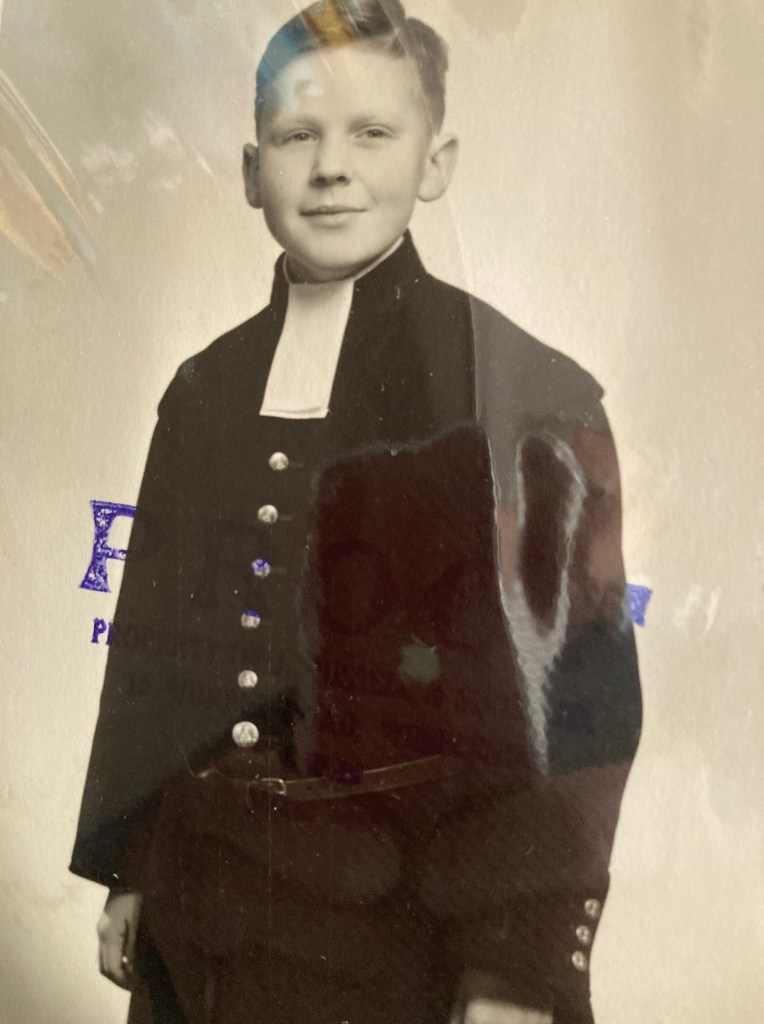
The school uniform, worn day in and day out, was knee breeches with silver buttons, yellow knee socks, clerical bands at the neck, and a blue full length coat, worn with a leather girdle and again with silver buttons. Hence the common name ‘the Bluecoat school’. It sounds odd, and maybe looks a bit odd, but since we all wore the same thing it seemed perfect normal. Not quite the same thing. ‘Button Grecians’, an academic distinction, wore blue coats with velvet collar and cuffs and with more, noticeably bigger, buttons.
History Grecians
The first 4 years at CH are a bit of a blur. After GCE O-levels [I took 7 O levels; did best in classical Greek; worst in Physics-with-Chemistry] in 1960, we were free to specialise. I became a History Grecian, and spent the next 3-plus years doing mainly medieval English and European history, without ever getting much beyond 1215. Apart from history, we did some Latin and French, concentrating on reading skills; and some token Divinity, which comprised a very dull and leisurely look at John’s Gospel, taught by the Headmaster, ‘George’ Seaman. It was a skeletal timetable, which left plenty of time for sitting in the Library or sun-bathing in the Garden Quad.
The history master was Michael Cherniavsky, from a White Russian family, educated at Westminster and Balliol. He had a big forehead, wiry greying hair, a slight lisp, and a penchant for wearing double-breasted suits, often enough with the jacket not matching the trousers. Physically he seemed a bit lob-sided. But he was very widely well-read, had strong liberal views, and a balanced intellect. Which enabled him to grade our essays with fine distinction between, say, AB/BA and B++?+.
History Grecians as a race were independent minded, generally favoured left-wing views and causes, and were sceptical about authority. All things which Johnnie hated ! Two History Grecians in Lamb A a few years ahead of me were Alan Ryan, who subsequently became an academic philosopher, an authority on John Stuart Mill, and Warden of New College, Oxford; and Stuart Holland, who went from Balliol to St Antony’s, worked as an economist in the Cabinet Office, and became for a few years the [Bennite] Labour MP for Vauxhall.
As Michael’s pupils we wrote essays on Charlemagne, and Otto I and Otto III, and on Pope Innocent IV, and on Franciscans and Dominicans; and, closer to home, on King Alfred, and the Norman Conquest, and the intricacies of feudalism, and on the civil war between Stephen and Matilda. In between I was encouraged by Michael to work on a project on ‘Anti-Fascism in the English Public Schools, 1933-39’. Which brought me into contact with the Spanish Civil War, and dinner in the National Liberal Club with Sydney Carter [the hymn-writer], and lunchtime drinking with Philip Toynbee in a pub off Fleet Street.
We were all children of promise once … The expectation was that we would all win awards at Oxford and go on to academic distinction. Sadly, it didn’t quite turn out like that. But next week I am going down to CH, for a 60 Years On Leavers’ Reunion, and I’ll be meeting a small group of people some of whom I haven’t seen for 50 years. In a slightly perverse way, I find that I’m looking forward to it
For Good Friday evening we had a Tenebrae service in the smaller chapel in the Centre St Marc. About twenty people came, for a service largely put together by David Bailey. It was a sober, thoughtful time in the semi-darkness, a selection of short readings and music culminating with Allegri’s Miserere. On Saturday morning, our penultimate day, Susie and I went out to breakfast again at Pain et Cie, which is all wooden tables and non-matching chairs in the pedestrian quarter.
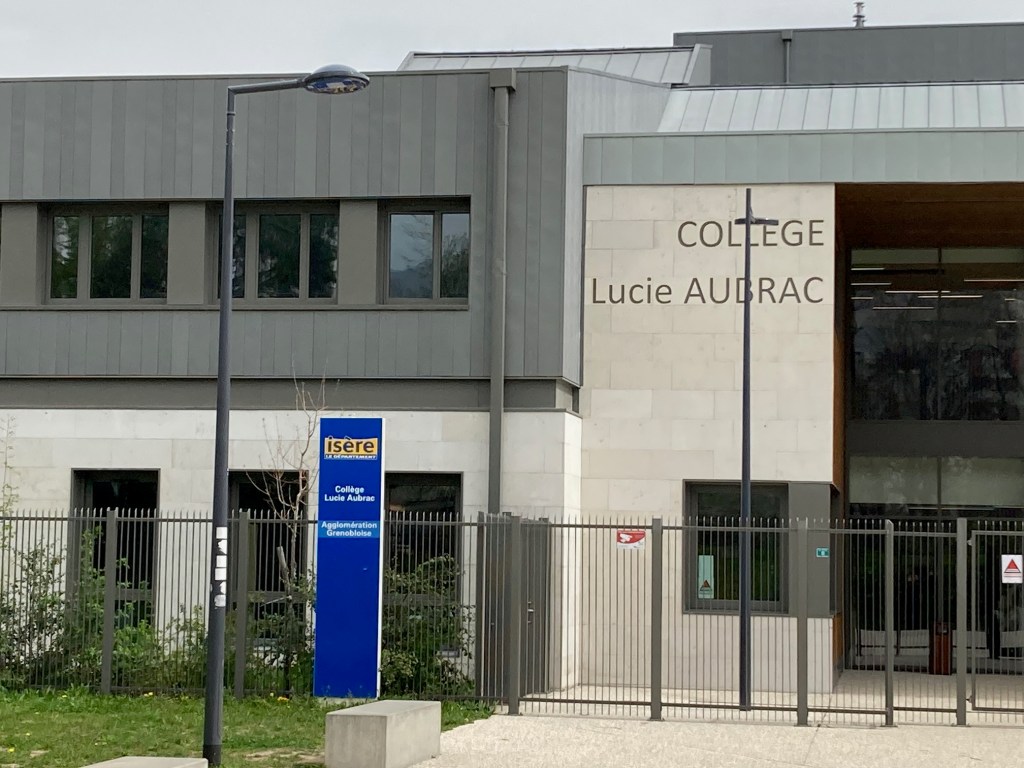
The clocks changed on Saturday night, so we were very thin on the ground at 10.45am on Sunday morning. But people trickled in, and we ended with a decent crowd as we thought about The Empty Tomb and celebrated the good news of Jesus’s resurrection. After lunch I walked round Villeneuve for a last time. Past the Collège Lucie Aubrac. She was a great heroine of the French Resistance, a militant Communist, who took part in a number of dramatic resistance exploits, and was much praised by President Sarkozy when she died in 2007. She was married to Raymond Samuel [who took the name Aubrac during the war to conceal his Jewish origins], and she famously rescued him from Gestapo custody in a commando operation in 1943.
In his riveting book War in the Shadows: Resistance, Deception, and Betrayal in Occupied France [pub. 2020]which I was reading in Grenoble, Patrick Marnham suggests that the Aubracs may have collaborated with the Germans, to the extent that Raymond Aubrac may have betrayed Jean Moulin at the much written about meeting at the house of Dr. Dugoujon in Caluire in June 1943. [Moulin was arrested, severely tortured by Klaus Barbie, and died very shortly afterwards.] Feelings run high about resistance history, but the facts are difficult, and probably now impossible, to establish.
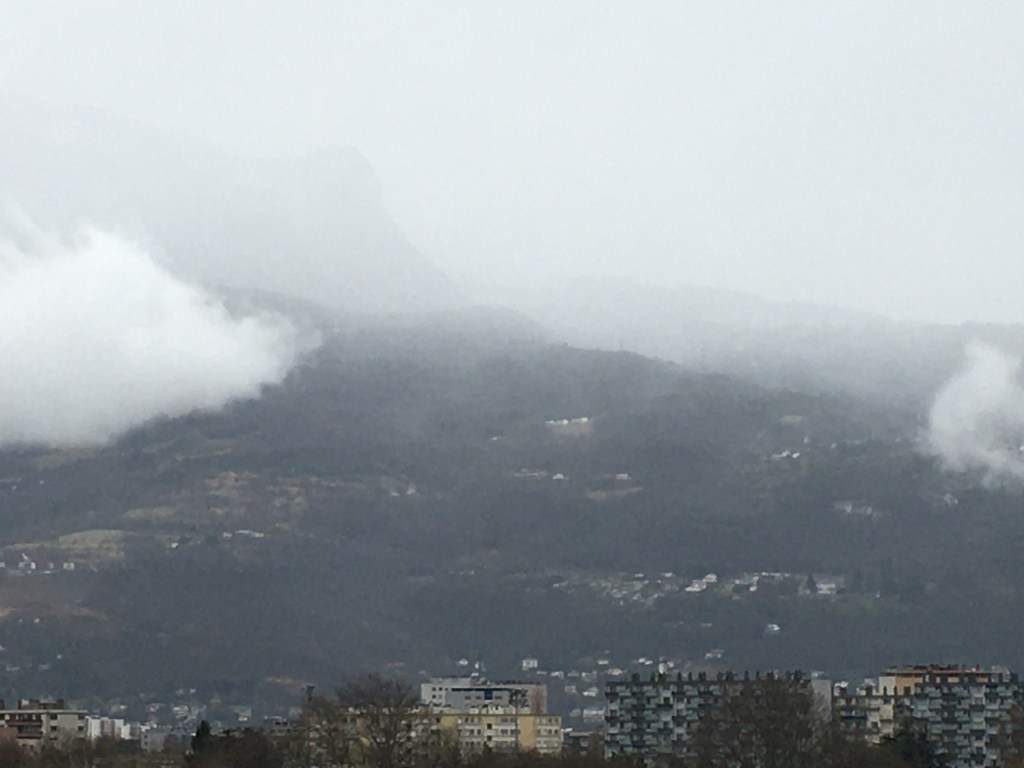
Naomi kindly gave us a lift to the bus station. Dark clouds loomed over the north-west corner of the Vercors as we enjoyed the sièges panoramiques on the Flixbus. The flight was uneventful. Our taxi driver in Edinburgh was from Jordan, and we took it in turns to share strong views about Israel’s unacceptable behaviour in the Gaza strip and America’s continuing willingness to supply them with military weapons and hardware. Back in the house a fuse had tripped in the garage putting the boiler out of action. It was a cold house and a cold, rather short night.
Back in Edinburgh
We’ve been away a lot in the past six months. It has been raining since we arrived back, and the daytime temperature here peaked today at 8ºC. I sometimes wonder why we live in Edinburgh. According to my MacBook it will go on raining for the next two weeks. Which puts an end to my plans to cut the grass. In a fit of catching up, I had an appointment with Mary, the diabetic nurse, this morning; I have an appointment for a check-up with the dentist in Musselburgh next Monday; and I am going for an annual eye test next Wednesday. Every year I wonder whether it is time to get some prescription glasses. But for the moment I am still living with off the peg reading glasses from HEMA, in a variety of colours.
Amelia and Ellie are coming across from Fife for lunch tomorrow. It will be very good to see them. And it will be very good to see Jem and Anna, and Freya and Oskar, who are driving up from Watlington and who should arrive late tomorrow evening. Sadly it doesn’t look like weather for going out to Gullane or North Berwick. Or even walking on Arthur’s Seat. More like a visit to the Museum. Which could be crowded during the school holidays.
The following week I am going down to Sussex, for a 60th anniversary Leavers’ Reunion at Christ’s Hospital. It seems a long way to go for quite a short time. But CH had a big influence on my life. Of which more another time. And I have been in touch with one or two friends whom I look forward to seeing there. [There’s nothing much worse than going to a reunion and not knowing anyone.]
From Cross to Resurrection
With the help of an orange marker pencil, I have got to the end of Alan E Lewis’s magnum opus, Between Cross and Resurrection a theology of Holy Saturday. It is a big book. Which gives the impression of being written and rewritten over a long period of time, before the author died at the age of 50. [The book was published posthumously in 2001.] Perhaps in consequence I wasn’t sure that the different parts of the book hung together as well as I would have liked.
Part III of the book deals with Living the Story; in world history, and in contemporary society, and in personal life. Lewis asks: How does the gospel nurture hope in times of crisis ? His answer: “The only victory in life is won by going beyond … the expansive magnitude of death.” The early Church faced persecution and martyrdom. But the delay in the Parousia, the end of persecution, and the adoption of the Christian faith by the Roman emperor, Constantine, made the church more comfortable in the world and more optimistic about the future. After the Enlightenment, a secular version of Augustine’s optimism took hold: a belief in progress, and the certain triumph of human power, knowledge, and creativity.
This view of history died with the Great War; in the gas-filled, blood-soaked trenches of the Somme and Passchendaele. The twentieth century descended into chaos and catastrophe. Easter Saturday teaches us that the God of Jesus Christ does not [always] intervene to prevent catastrophe and rupture. While the Holocaust and Hiroshima show what wickedness humanity is capable of, Chernobyl exposes the fatal depths of our carelessness and inattention. Does God approve of what we have done; it is our destiny. Does God disapprove; yet is powerless.
For many people, only despair and pessimism remain to fill the gap left by the collapse of confidence. Against that view, Lewis insists: “this word of the raising of the crucified and buried God, … … might now address the multiple terminal crises of word history.” Theologians like Barth, Moltmann, and Jüngel all speak of divine self-fulfilment through suffering and self-negation. And the doctrine of the Trinity is the key.”The Spirit who unites the Father and the Son through their separation also holds together humanity and God, the Creator and the creatures.”
There are a lot of long words, many of them abstract. But some sections leap off the page in a timely way:
The death that unites humanity and deity must also reconcile Jew and Gentile in one body before God. Centuries of Christian pride, animosity, and anti-Semitism must be ended. Ethnic, racial, and religious animosity is most intransigent and most menacing in the Middle East. And in the relations between Israel and its Arab neighbours.
“If true solidarity can be founded on the similarity of Jews and Christians that can only be a critical solidarity, a willingness, on the basis of firmly established mutual respect, to cajole, criticise and prod each other … … This might mean that churches, and nations still subject to Christian public opinion, adopt a critical stance towards the government of Israel with respect to the treatment and the future of the Palestinians, insisting that the latter need no less an end to their own displacement and disenfranchisement than did European Jewry for far too many centuries.”
The final section of the book is moving and personal.
The author discloses his own situation: he has been undergoing high-dose chemotherapy following a cancer diagnosis. How could he write this book [he asks retrospectively] without having known an Easter Saturday experience himself ? The truth about human beings is that we shall all die. But central to the Easter story is that death does not have the last word. Lying in a hospital bed teaches us the ‘stature of waiting’.
God’s victory over death is not a matter of mere survival; but a new life and a new reality. The gospel promises that the lives we lived before death shall not be lost to God … “but that our identities and lives shall be gathered into God’s own life”.
Easter Saturday determines how we handle our own mortality. “To be mature is not just to live authentically with decay, disease, and bodily death, but to be a person who at any age or stage has died already and so been raised to life anew”. Lewis deplores the fact that being ‘born again’ has been appropriated by one narrow church faction. When Christian regeneration, he insists, should be basic church teaching, common to all traditions and denominations.
Baptism is “the seal of our repentance and rebirth, our death with Christ and union with his resurrection, which is our new identity”. To be baptised is to have an Easter Saturday identity.
“Easter Saturday, God’s day of burial, becomes for all who are baptised the event and sign of their old lives’ termination and the beginning of the new”.
It wasn’t an easy read. But I am glad to have persevered, while ignoring the footnotes which are many and various. And the book has certainly give me a bigger and deeper understanding of the whole Easter event.
Our time here in Grenoble is already drawing to a close. Susie returns to Edinburgh later this week, on Thursday morning. Craig and the girls will arrive in Edinburgh late on [Good] Friday, in time for the memorial event for Craig’s sister, Linsey, which will be held over in Fife on Saturday afternoon. I will be here for the Tenebrae service on Friday evening, held in one of the smaller rooms in St Mark’s Ecumenical Centre; and for the Easter celebration on Sunday morning. And will fly back to Edinburgh, from Lyon airport, later that evening.
We haven’t done everything that we had intended to do. But we have enjoyed our time here, and have been largely blessed with sunshine and blue skies. The French television news, on TF1, bangs on about severe flooding in, mainly, western France, and about an increased avalanche risk. But neither of those things has impacted us here in Grenoble. The worst that has happened is that Susie fell asleep one afternoon on our balcony and woke up with mild sunburn !
For someone who sometimes describes himself, a bit tongue in cheek, as ‘an elderly recluse’, we have spent time with a lot of people. Early on we were invited to lunch by Elizabeth and Jean-Claude, up at Villard-en-Lans, making the journey fearlessly [almost !] on the bus via Sassenage and the Gorge d’Engins. Since then we were invited to lunch by Penny and Jean-Philippe, both world champion rowers, eating outside on their balcony in the sunshine. And this evening we are invited for a meal with Naomi and Cliff, two tram rides away on the north side of the city.
One day we had lunch in town, at Chez Marius, with Cyrille, who was up from Orange visiting a friend. Yesterday I had a return visit to the Musée de la Resistance et de la Déportation, gruelling but very informative; and then we had lunch in la Préf with David, a small restaurant just off the Place de Verdun that was new to all of us.
Here in the apartment Malcolm and Dot came to lunch one day, driving up from Romans-sur-Isère, We first met them in Paris nearly 50 years ago, when Malcolm was attached to the Eglise Reformée in the rue de l’Ouest in the 14ème. Joanna was baptised in that church in the summer of 1977, and Dot was Joanna’s faithful down the years and much appreciated god-mother. It was good too to see Shona who drove over from Lyon with Diana, – Roy had a bug; and we caught up a bit with news from Trinity Church, Lyon. Finally, in what sounds like a long list of convivial eating, Tul and family came to lunch last Saturday, taking the train down from Lyon. We have known Tul since early days in Lyon, when he arrived in church as a refugee, sans papiers and SDF, from Bhutan. He came with Nanymaya, his wife, and their four children of whom he is rightly proud. The eldest, Sara, is already in deuxième, speaks good English, and is thinking about university.
Church life
It is not all meals with friends ! We are here primarily to pastor the St Mark’s congregation. It is invariably difficult for churches when they are without permanent chaplain and have to run with a succession of locum clergy. Without a permanent chaplain it is easy for Sunday attendance to shrink a little, and that has a knock-on effect on church finances. Which enter into a downward spiral. Which then raises questions about the viability of returning to the recruitment and employment of a full-time, stipendiary chaplain.
In addition there is a further issue regarding the changing demography of many congregations in the Diocese in Europe. The number of expat managers, working for British or American multinationals and paid international salaries, has substantially declined. There are significantly fewer families with one or two employed adults and accompanying children. Church attendance figures may have kept up in many chaplaincies, but with a far higher proportion of international students and refugees. And these groups, which bring cultural diversity and a variety of gifts, have only limited financial resources. For Grenoble the arrival of Nick and Julia as a post-retirement, non-stipendiary, [notionally part-time] chaplain was a great blessing.
On Sunday mornings we have felt that the Spirit is moving. Attendance is holding up, even if the time-keeping of many people is a bit random. Clergy are generally unreliable with numbers. I guess there are about 70 adults in church on Sunday morning, at least by the time we finish, and a further 20 or so children. Two Sundays ago there were celebrations and much photography as we celebrated Alan’s 95th and Nell’s 90th birthdays. This past Sunday we celebrated Palm Sunday with an All Age service. Zaz sourced a donkey, which would have been great – but the donkey wouldn’t get into the van. In the absence of the donkey, we marched enthusiastically around the building waving palm [to be precise, laurel] branches. Funmi and Ernest encouraged the Sunday School to share their thoughts with us, and they then taught us a song. And we were entertained by a succession of Palm Sunday Voices: a disciple of Jesus, the owner of the donkey, a senior Jerusalem police officer, a house-proud Jerusalem housewife, and Graham Kendrick.
Outwith Sunday mornings there are prayer meetings on Zoom on Tuesday mornings and lent bible studies, Living with the Psalmist, on Wednesday evenings. Both events were initiated by Roger Simpson, onetime Rector of Ps&Gs, Edinburgh, during his spell as locum. Numbers are quite small. But it has been good to pray for the future shape of ministry here. And also longingly for the awfulness of the situation in the Gaza Strip and the profitless stalemate in Ukraine.
Between Cross and Resurrection
I had intended this blog to be about Alan Lewis’s book Between Cross and Resurrection: a theology of Holy Saturday. His magnum opus published posthumously in 2001. This was to be my ‘serious reading’ for Lent. But in spite of good intentions and an orange marker pencil I have only got to p.261. About halfway through the book.
I embarked on this book because of the references to it in David Smith’s 2020 book,Stumbling towards Zion: Rediscovering the Biblical Tradition of Lament. Alan Lewis reflects on the meaning of Holy Saturday, the hiatus between Good Friday and Easter Sunday when Jesus lay dead in his tomb and his disciples experience the absence of God. For Lewis, the second day [Saturday] provides a buffer against the premature encroachment of the resurrection on the cross. The Westminster Confession and the Apostles Creed both speak of an interval between the cross and Easter. “Christ was not only crucified but dead; not only dead but buried”. Easter Saturday is the boundary between the humiliation of the crucified Christ and the glorious exaltation of Easter Day.
Lewis encourages us “ to make the effort to examine the Cross of Christ from the second day … a story of universal human failure; leaving Jesus alone and isolated, despised and rejected [Isa 55.3]”Jesus is no hero, saviour, or redeemer. He is dead, convicted as a sinner, a rebel, and a blasphemer. Stoning was the Jewish punishment for blasphemy; crucifixion was the Roman punishment for sedition. With unseeing eyes, the Romans had perceived a radical and dangerous subversion.
From here Lewis moves on to the question of identity. Who is this person ? Is he really from God ? Was he mistaken in claiming to be the regent of God’s Kingdom. Is the absence of God in Jesus’ death the failure of divine love ? Subjecting him to unmerited judgement and suffering. Or is it the failure of divine power ? Helpless in the face of evil. In the death cry of Jesus there resonates the ageless, universal protest of human suffering.
Lewis points to the enormous contrast between Good Friday and Easter Day. On Friday Jesus’ cross and burial seem to be the end of everything; the end of hope in God’s justice, power and love. The glory of Easter Day signals the end of darkness and death; the arrival of the kingdom.
In Part II of the book, Thinking the Story, Lewis describes how it became necessary to formalise a summary of the faith inherited from the apostles. Doctrine was necessary to keep the narrative of salvation alive. The precise relationship between Jesus and God the Father was much debated by the early Church, culminating in the Trinitarian formula of the Nicean Creed. But modern theology has complained that patristic theology did not sufficiently acknowledge the humanity of Jesus.
Lewis’s survey of the evolution of Christology brings him to the kenotic theology of two British theologians, PT Forsyth and HR Mackintosh, and thence to Barth and his followers. For Lewis, Eberhard Jüngel, a colleague of Moltmann, is the theologian par excellence of the grave of Jesus Christ. He identifies Easter Saturday as theology’s foundational, defining moment. He majors on the retroactive implication of the resurrection. The empty tomb confirms that it was indeed God on the cross and in the tomb. Easter Sunday establishes the shocking story of the Saturday. God’s whole being is contained in his becoming human, majestic in that very lowliness. So – this is the shocking conclusion of the survey: “that on Easter Saturday in the tomb of Jesus of Nazareth between his crucifying and his raising, God lay dead” [Lewis, p.255]
So what does it mean to live this story in a world threatened by death, and captive still too often to evil and to injustice … … … ? For an answer, watch this space. I have found this book challenging, and often heavy going. Especially the profuse footnotes, which I am learning to ignore. On the back cover of the book, Thomas F. Torrance declares: “this is the most remarkable and moving book that I have ever read”. I hope to finish reading it back in Edinburgh.
Envoi: a prayer request
Getting away from books, Susie has been telling me about her conversation with Z -, who has been doing some cleaning for us these past three weeks. She is a refugee from Armenia. She is delightful, musical, and a Christian. It is always difficult to understand the full story on limited acquaintance. What Susie understood her to say was that she and her husband were forced out of Armenia for reasons that were not clear, that they fled initially to Russia, and have been here in France for at least a decade. Neither she nor her husband have papers, nor any regular employment. They live in a two roomed flat with her daughter, their son-in-law, and grandchild. Her husband is struggling, understandably, with depression. The [limited] good news is that they are being supported by a small community of French réligieuses, with whom they will be spending Easter Day. We pray for them, and for many in similar situations, who find it difficult to see the way forwards, that Easter may bring some hope and some encouragement.
We have been in Grenoble for two weeks. Grenoble is a most attractive city in south east France, at the foot of the French Alps, where the river Drac joins the Isère. It is surrounded by three glorious massifs, and is closer to mountains than any city in Europe, with the possible exception of Innsbruck. “At the end of every street, there’s a mountain,” the writer Stendhal famously said about his hometown.
From the chaplaincy apartment, you can see the Vercors mountains. the site of a disastrous uprising in summer 1944. Curiously, the city centre is the flattest city in France. It is a historic city, initially named Cularo by the Romans, and later Gratianopolis; and subsequently became part of the Burgundian kingdom and then of the Holy Roman Empire.The author Stendhal was born here. The city’s services and status were greatly improved when it hosted the Xth Winter Olympics in 1968. Grenoble is now one of France’s leading cities for business and industry, and it boasts a student population of over 60,000, drawn from all over the world
A tour of the historical centre is an easy stroll. I started at the Gallo-Roman enclosure in the rue Lafayette. Between 286 and 293 AD a circular wall with some 39 towers was built by the Emperor Diocletian. But little remains today. Round the corner, Stendhal was born in 1763 at no. 14 rue Jean-Jacques Rousseau.
The nearby Place Grenette was the place for cattle and livestock markets from the 17th century. The rue de Bonne leads to the Place Victor Hugo, an elegant square, created in 1885, with its original chestnut trees and late 19th century facades.
A short walk brings you to the old Trois Dauphins inn, where Napoleon stayed for two nights in March 1815 after his escape from Elba. Across the road is the Jardin de Ville, laid out in 1719. From here a cable car, known as les Oeufs or les Bulles, for its egg-shaped, transparent cabins, whisks passengers across the river Isère and up 260 metres to the Bastille and the Vauban Belvedere. [Not me ! I haven’t been on a cable-car since our scary, unconsidered trip at la Clusaz, when we were on our honeymoon at Annecy in 1975. We subsequently walked back down the mountain.]
From across the river, on the Quai Perrière, there are magnificent views south back across the city to the Vercors and the Bellledonne massifs.
A pedestrian bridge across the river brings you back to the old town, to the Place aux Herbes, where there is a local producers’ market every weekday morning. From where I hurried back to the Place Grenette where I was meeting Susie for coffee. Leaving for another time the 13th century collegiate church of St Andre, with the mausoleum of the Chevalier Bayard. And the Place Notre-Dame with the Notre-Dame cathedral, and the adjacent Musée de l’Ancien Evêché, currently housing an exhibition of mountain photography. Although the weather forecast constantly tells us that rain and snow are on the way, it was a glorious bright, cold day with winter sunshine and brilliant blue skies.
St Marc’s, Grenoble
Susie and I are doing a locum chaplaincy at St Marc’s [Anglican] English-speaking church. We are staying in the church apartment, some 35 minutes walk, or six tram stops. south of the historic centre. St Marc’s is one of the fifty or so Anglican congregations in the Archdeaconry of France. It used to be a joint chaplaincy with Lyon but became independent in 1993. The congregation was financially self-supporting for many years, but struggled after the planting of an American-led ‘International Church’ about fifteen years ago. Finances became very difficult and the last permanent chaplain left in about 2018, since when worship has been sustained by a succession of locum clergy, mainly retired. Susie and I were last here. again as locums, before COVID in May and June 2019.
It was not our first contact with St Marc’s. Our daughter, Joanna, was a member here when she was a student in Grenoble in 1997-98. [She would have been 47 tomorrow, it is her birthday.] She had a good year here; studying at the Institut d’Etudes Politiques, and as part of Round Twenty, an active youth group at St Marc’s with good friends here from Edinburgh and from St Andrews. She lived in the rue Hector Berlioz, just off the Jardin de Ville, with an everyday view of les oeufs rising steadily towards the Bastille.
Both the church and the apartment are on the edge of Villeneuve, an ambitious piece of urban planning, designed by the architect Maurice Novarina and largely built between 1970 and 1983. Mixed housing is arranged around a central park with well-planted trees. Sunday worship is in an ecumenical centre which is shared with the Roman Catholic and, in earlier days, French Protestant churches. It was the earliest such ecumenical centre in France, built I think by the local authority, and is the only one still functioning. It is a spartan concrete building. Word is that ministry in the Roman Catholic section of the building will shortly be taken over by Chemin Neuf, and the first floor will be converted to house the ministry team.
The service is projected on PowerPoint onto the rear wall, and the singing is led by one or other of their two music groups. Many of the hard-working church leaders are English, who have been there for a long time, but the congregation is ethnically and culturally diverse. More than half the congregation are Nigerians, most of them refugees and asylum seekers. They are faithful attenders, but have very limited resources. The cultural and confessional diversity of the congregation is a delight after the predominant monoculture of church life in Edinburgh. But there has been no permanent chaplain here for several years, and however energetic locum clergy may be the consequence is usually a decline in church attendance and in church finances. The prayerful desire at the moment is for a five-year budget which will enable the church to advertise for a permanent, if part-time and part-stipendiary, chaplain. And that in this process the Archdeacon may be more of a help than a hindrance !
In between Sundays
Outwith Sundays, Susie and I have joined a Tuesday morning prayer meeting on Zoom. And have been hosting and leading a Wednesday evening group Living with the Psalmist. We have also been up to Lans en Vercors for a most enjoyable lunch with Elizabeth and Jean-Claude; preceded by forty minutes on the bus up from Sassenage while I try and fight down an attack of acrophobia. [The alternative bus route looks to my nervous eye too vertiginous to attempt.]
And there is the Six Nations. And friends from Lyon and elsewhere are coming to lunch. And I am reading a hair-raising book about the SOE in Albania 1943-45; and a serious theological book by Alan E. Lewis, Between Cross and Resurrection, of which perhaps more another time.
Tories want war chalked on the brickwork of a railway bridge is my first ‘political’ memory. The bridge was opposite Southfields station on the London Underground. It was probably the 1950 election. And the war reference may [or may not] have related to Korea.
That memory is triggered by the launch of a new Conservative Party group known as the [deeply Un]Popular Conservatives. Or Pop-Cons for short. The nominal leader is Mark Littlewood, lately Director of the libertarian, free-market Institute of Economic Affairs [the IEA]. Prominent members include the unspeakable Liz Truss, the equally unspeakable Jacob Rees-Mogg, ex-Tory party deputy chairman Lee Anderson, ex-Home Secretary Priti Patel, and ex-BREXIT negotiator and whisky salesman Lord Frost. And Nigel Farage, attending as a journalist, but hailed by Rees-Mogg as a fellow Conservative. The group’s declared aim to to “lobby the government on culture war issues” [sic], and to give the public back “freedom over their own lives”. To that end they are deeply suspicious of faceless organisations, by which they mean judges, quangos, and human rights organisations. Their other declared concerns are to “cut taxes” and to “stop the boats”.
Cutting taxes in the present economic climate is a mark of insanity. Or greed. There is a well-rehearsed list of public concerns in the UK: the state of the NHS, with particular reference to hospital waiting lists and mental health provision; declining educational standards in schools, alongside a steady increase in classroom violence; the release of sewage into our rivers and seashores on an industrial scale; the lack of dentists; the poor quality of many of our urban roads; grossly overcrowded prisons; crumbling dams and other infrastructure; dirty rolling stock and poor time-keeping on our main railway lines. Dealing with these issues requires a government that will prioritise such concerns. And it will cost an awful lot of money. But the Tory party is obsessed with tax cuts. Presumably because most MPs do not themselves use the services on which many of their constituents rely. Tax cuts serve to make the rich richer. And society more unequal.
It is more than a decade since Richard Wilkinson and Kate Pickett wrote The Spirit Level [pub 2009].. Why do we mistrust people more in the UK than the Japanese do ? Why do Americans have higher rates of teenage pregnancy than the French ? What makes the Swedes thinner than the Australians ? The authors demonstrate, based on years of research, that almost everything is affected not by how wealthy a country is, but by how equal it is. Tory politicians bleat on about wanting to make the UK a “high growth, low tax economy”. But the truth is that societies with a bigger gap between rich and poor are bad for everyone – including the well-off.
‘Stopping the boats’ is another Tory party mantra. The infamous BREXIT campaign trumpeted ‘Take control of our borders’. The truth is that the number of immigrants crossing the Channel in small boats has gone up dramatically in recent years. And leaving the European Union means that we are less well-placed to participate in European initiatives to respond to unprecedented people movements. The boat people are anyway far fewer in number than overseas students and Hong Kong passport holders. Both of whom are allowed free access. And no politician seems willing to ask why the UK economy is unable to function [from Windrush onwards] without a steady influx of immigrants. Or what we might do about it.
Culture wars
I’ve been depressing myself these cold January days by reading James O’Brien’s book How they broke Britain. which Craig gave me for Christmas. O’Brien [b.1952], of whom I’d never heard, is a radio presenter, podcaster, and tabloid journalist; a Roman Catholic, educated at Ampleforth and the LSE. For two decades O’Brien has been a full-time presenter on LBC, in which role he has clashed with a number of people including Frank Lampard, and Ian Duncan-Smith, and Nigel Farage. In How They Broke Britain [published in 2023] O’Brien “reveals the shady network of influence that has created a broken Britain of strikes, shortages and scandals“. Each chapter focuses on a “particular person complicit in the downfall”. The targets are, I guess, predictable: media men, Rupert Murdoch and Paul Dacre; political fixers, Matthew Elliott and Dominic Cummings; Nigel Farage; and former UK prime ministers, David Cameron, Boris Johnson, and Liz Truss. The book is essentially a charge sheet; a compendium of bad behaviour and bad people. It is, in O’Brien’s words: “a tale of loss and betrayal; … of unbridled arrogance and unchallenged ignorance … of personal impunity, warped ideology, and political incompetence”.
Much of this stuff is familiar. The lies over BREXIT and the incompetence over the COVID epidemic are well known. But I was interested in what O’Brien says about ‘culture wars’. [A phrase I still don’t really understand.] Paul Dacre, editor of the Daily Mail for 26 years, is a key figure here. Back in January 2007, when he gave the Hugh Cudlipp memorial lecture, he claimed: “The BBC exercises a kind of cultural Marxism in which it tries to undermine conservative society by turning all its values on their heads”. Under Dacre’s editorship, the Mail displayed an increasing obsession with the BBC, with progressiveness, and with foreigners. A succession of blatant lies in its coverage of the BREXIT debate caused the editors of Wikipedia to vote overwhelmingly to ban it as a trusted source for the website. In the run-up to the BREXIT referendum in May-June 2017, Dacre elected to put immigration scaremongering on the front page of the Mail on 17 of the 23 weekdays leading up to the referendum. Featuring “EU killers and rapists we’ve failed to deport” and the “one-legged Albanian double killer”.
In the months following the referendum the Mail launched a campaign [enthusiastically taken up by a Tory whip, Chris Heaton-Harris] to uncover the names of academics teaching European affairs who had voted Remain. Dacre’s own values are unclear. In November 2008 he described a judge, Mr Justice Eady, as ‘amoral’ because “he rejected the idea that adultery was a proper cause for public condemnation”. Fifteen years later Johnson, the sexually incontinent serial adulterer, was on his payroll, reportedly being paid £500,000 a year. Dacre is the anti-Establishment figure who craved a seat in the House of Lords and sent both his sons to Eton. He is a sworn enemy of the EU, who was happy to take at least £400,000 in EU subsidies for his hunting and shooting estate in the Scottish Highlands. He is the scourge of the quangocrats who tried hard to chair the quango Ofcom.
Lessons from China
I seem to have spent quite a lot of January walking round the hill, and trying to keep warm, and worrying about our gas bill. [Our energy supplier, Octopus, produce a monthly bill for electricity, but only quarterly for gas.] As a happy change from reading about shady journalists and corrupt politicians, Susie and I went to a workshop at the University of Edinburgh on Saturday in the Playfair Library. It was organised by the Eric Liddell 100 committee as one of a series of events marking the centenary of Liddell’s gold medal in the Paris Olympics of 1924. Which made him a popular hero among his fellow students who carried him through the streets of Edinburgh in triumph. Susie’s maternal grand-father, GP Littlewood, was a missionary in China for nearly 30 years; and at some point Eric Liddell organised children’s sports and activities for a group that included Susie’s mother and her twin sister.Successive speakers spoke about Liddell’s subsequent missionary time in China [humanly speaking it was a low-key, downward spiral; he died in a Japanese internment camp in 1945]; about the Christian history of the Chinese diaspora in Scotland; and about [the growth of] Christianity in China in recent years.
The workshop operated under Chatham House rules, so I can’t identify the speakers. But it was said by one of them that there are today somewhere between 40 million and 120 million Protestant Christians in China. [The Catholics are counted separately, it seems.] The Chinese were suspicious of Christian missionary activity which they saw as being linked to Western imperialism. And thus contrary to ‘Chinese values’. The dramatic numerical growth came after the the missionary period. And is almost entirely happening in indigenous churches with indigenous leaders. Which raises interesting questions about church life, and about the enculturation of the gospel, in the west against a background of continuing church decline.
When a speaker was asked how he explained the dramatic numerical growth of the church in China,he suggested that the three main attractors are: a search for peace; a search for healing; and a search for community. My experience of church life in the Diocese in Europe suggests that the situation here is not very different. That belonging is at least as important as, and may well precede, belief. That many people are looking for others that they can trust, and places where they feel loved. Here the Church of Scotland is busy re-organising itself for missional activity, with an emphasis on pioneer ministry. [Even if they/we are not quite sure what that means !] Lots of church leaders are seeking in different ways to ‘grow their churches’. I think that encouraging people to love one other may well be of more value than Alpha or any other course of apologetics.
We got home from Chantilly, but only just. Air France asked us to check in the day before we left, and download our boarding passes. Their website told us to scan our passports and a QR code. Which I couldn’t do. I am old enough to think that scanning is about putting your hand over your eyes and peering at the horizon, possibly searching for enemy soldiers. It took a phone call to Air France customer services in York, in the UK, and a conversation with a helpful Indian woman to get sorted out. She simply told us to ignore the instruction. And she was right.
It was a 9.40am flight, and Keith and Janet very kindly took us to the airport. I stupidly hadn’t checked which terminal, and they dropped us at Terminal 2B. The woman at Easyjet [who were also flying to Edinburgh at much the same time] directed us to Terminal 2E. Which is about 15 minutes walk away. There was more scanning to be done as we deposited our luggage. Three attendant Air France staff, who preferred to talk to each other, were as much use as a chocolate teapot. There was an interminable and slow-moving queue for passport control. Followed by a shorter but equally slow-moving queue for baggage control. We rushed to Gate K 33. Where we were told by an Air France woman that the gate was closed, that we had missed our flight. And that our bags had been unloaded. I shouted at her, and then at her more senior colleague. Even Susie nearly shouted at her ! They spoke to ‘the Commandant’, the flight was running ten minutes late, and we boarded. Except for Susie’s suitcase, which arrived after numerous text messages the next day. The cabin crew were excellent. Trying to persuade me that my cellophane-wrapped Breton galette was really eggs, bacon, and mushrooms. It wasn’t Air France’s finest hour. But it was partly our fault.
Home on the range
Edinburgh feels cold. The temperature is much the same as Chantilly, but it is damper and feels colder, especially in the wind. The heating in the house hasn’t been on for six weeks. Which makes a difference. Thursday was our 49th wedding anniversary. It was a distinct low point last year, when we were in different countries mourning the loss of Joanna. This year we went out to breakfast. The cafe I had in mind didn’t really suit us, so we ended up in a Turkish cafe just off the Royal Mile. And came home via the trusty OXFAM bookshop, where I bought volume 2 of Martin Stannard’s life of Evelyn Waugh. All I have to do now is to find a copy of volume 1. In the evening Susie went to band practice with No Strings Attached; while I went to the Priestfield prayer meeting.
The wider world
TF1, the French television channel on which we relied for news in Chantilly, is extraordinarily parochial; the evening news rarely got much beyond severe floods in the Pas de Calais and the increase in French rail fares. Back at home we are catching up with the news from elsewhere. The suffering in the Gaza Strip seems to go on getting worse. And the constant bombardment of the Palestinians by the Israeli military looks very like a war crime to me. Even Lord ‘call me Dave’ Cameron seems to think that too many Palestinians are being killed. Well spotted!
Equally the struggle against the Russian troops in the Ukraine seems to have ground to a stalemate. It is two years since we were in Kiev, and two years next month since the Russians invaded. It’s not clear to me that a visit from Rishi Sunak will help them much. But this is very much a year of elections and photo-opportunities. Whether military support for Ukraine will survive the coming election in the States [and elsewhere] is one more thing to pray about.
The state of the nation
On the domestic front the big news story is the Great Post Office scandal. The appalling story has [re]surfaced as a result of a four-part drama on ITV. The most influential tv drama since Cathy Come Home in the mid-sixties. It seems clear that the Post Office continued to hound and prosecute sub-postmasters for more than a decade after they had been told that their Horizon computer system was faulty. And that they concealed the fact that hundreds of prosecutions were taking place. While individual sub-postmasters were given the impression that their’s was an isolated case. Furthermore it seems likely that during this period the Post Office were substantially underpaying their tax liabilities and substantially overpaying their own executives.
Two little facts have emerged. According to a report in the Church Times, Ms Paula Vennells, the former CEO of the Post Office, and an ordained priest in the Church of England, was on the short-list of candidates to become the Bishop of London when the Rt Revd Richard Chartres retired. ‘Dim’ and ‘over-promoted’ is an [anonymous] friend’s comment in today’s press. Meanwhile Fujitsu, the Japanese company responsible for developing the Horizon system, have to date been deafeningly silent. But they continue to hoover up tens of millions of pounds worth of contracts from the British government. And their former CEO is married to a Tory MP, who is currently Minister for Education.
Not quite relatedly, we are also reading a lot about Baroness Mone, aka Baroness Bra, ennobled by David Cameron, who used her parliamentary connections to secure a £200-plus million contract for PPE during the COVID crisis. The contract gave her and her children a £67 million profit, and much of the material supplied was below standard and passed directly into landfill sites. Which speaks volumes about Cameron’s chumocracy. Very sadly, there is something rotten about the way this country is governed.
Looking ahead
We will go south for the grand-children’s half-term next month. And after that we will go [back] to Grenoble to do another locum spell over Lent and Easter. Before that I must get back into walking round the hill [Arthur’s Seat] every day. Photos of today’s circuit are above and below. And I’m going to enjoy re-reading Evelyn Waugh’s Men at Arms trilogy. And to look at a 2001 book by the American theologian Alan E. Lewis: Between Cross and Resurrection: a theology of Holy Saturday.
A day in Paris always seems like a journey into the past. This was my first visit since I went down to take some photos for Joanna almost exactly a year ago. On Thursday Susie and I went down from Chantilly for the day to meet up with Craig and the girls. There was a very slow-moving queue of people at the ticket office at the station, and one of the guichets shut up shop when we arrived. So we got on the train without tickets, and found seats with difficulty in a very crowded carriage. I remembered my first trip to France with Paul back in 1961. We were hitch-hiking, and ran out of money in the south of France; travelled without tickets [and without seats] on a very crowded train up from Marseille – France had just mobilised its reservists after some trouble in Berlin. And made a dash for it at the ticket barrier at the Gare de Lyon. Chantilly to Paris this time was less dramatic.
Big railway stations are noisy and sometimes unsafe. We threaded our way through the gang of cigarette sellers at the east end of the Gare du Nord, and found our way onto a balcony vert constructed between the rue d’Alsace and Platform 1 of the Gare de l’ Est. A conscious attempt by the city to smarten up a run-down bit of Paris. This is a smaller version of the better known Promenade Plantée, in the 12ème. This garden is named after a Brazilian feminist activist.
The Gare de l’Est is a handsome station, less confusing than the Gare du Nord. We had coffee at the big brasserie across the street. And then made our way on towards the Canal St Martin. This is one of my favourite corners of [not too touristy] Paris. For my twenty-first birthday I was given a cheap print of Buffet’s Canal St Martin, and it was years before I actually visited the canal. The print hangs today in our dining room in Edinburgh. We walked a block or two up the canal, and watched a black duck deal inefficiently with a large-ish fish. The fish was not enjoying it ! And we sat for ten minutes in the Jardin Villemin, in the rue Recollets. It is a gem of an open space between the Gare de l’Est and the Canal St Martin; laid out on the site of a former military hospital.
We met Craig and the girls for lunch at Bouillon Chartier. Which now has two additional branches in Paris other than in the Faubourg Montmartre. A new experience for the girls [Amelia’s preferred Chez Janou was closed] and a sentimental return for us. Just after 12.30pm the sizeable restaurant was almost full, the waiters working hard. Yellow wash walls, period advertisements and posters, big wall mirrors, paper tablecloths, bent-wood chairs. I had a generous portion of céleri remoulade. Followed by a pièce du boucher, which I felt had been cooking since Christmas Eve. Almost redeemed by a pepper sauce and chips. Followed by an excellent pruneaux au vin with vanilla ice-cream. The waiter did the addition on the table-cloth, and the bill was extremely modest.
After lunch Susie and I took a 48 bus across town, down to Chatelet and across the river and up the boul’ Mich. After some indecision we got off at Denfert Rochereau and walked a bit along the now pedestrianised rue Daguerre. This is one of Paris’s great shopping streets. Which is where we shopped occasionally when we lived in the 14ème in the mid-1970s. With a very young Joanna, born not far away, in her push-chair. Which is much the same time that Agnès Varda made her 1974-75 documentary Daguerréotypes. Cheese shops, fruit and veg shops, a butcher, a florist, a high-class bakers, a clock repairman, and a handful of eating places. And then back to the Gare du Nord to wrestle with the ticket machine. Which wanted my e-mail address and my mobile phone number, and my grandmother’s blood group, as well as my credit card. And so comfortably home to Chantilly. While Susie slept on the train.
The Quest for Queen Mary
I have greatly enjoyed turning the pages of James Pope-Hennessy’s The Quest for Queen Mary , edited by Hugo Vickers, another chance find at the OXFAM bookshop in Edinburgh. It is the last book that I will read in 2023, and undoubtedly one of the funniest. Queen Mary [of Teck], the widow of George V, died at, the age of 85, at Marlborough House in March 1953. A few months before the coronation of Queen Elizabeth, her grand-daughter. I dimly remember an old lady in a hat who died while I was at primary school. And I gather from more recent reading, such as James Lees-Milne’s diaries, that Queen Mary was an enthusiastic art collector.And an inveterate kleptomaniac ! With a habit of pocketing pieces from the stately homes where she stayed.
James Pope-Hennessy, then aged 38, brother of John and daughter of Una, was chosen as her official biographer. Pope-Hennessy was a friend of James Lees-Milne, who describes him as a social butterfly, an unreliable friend, and a rampant homosexual. During 1955-58 he interviewed a host of people who had known Queen Mary, including an asylum-load of minor European royalty. He kept extensive notes on the interviews. Which demonstrate very clearly that royalty are not the same as you and me. These are in effect the offcuts, which didn’t make the finished [much praised] biography; bizarre and endlessly amusing. There is a hilarious episode where Lees-Milne goes, rather nervously, to stay for the weekend with Prince Henry [of Gloucester], military man and onetime Governor of Australia. And another scene where the Queen passes dog biscuits for the corgis to an elderly and deaf relative. Who puts them in his mouth and eats them. You’ll have to read it for yourself to get the full flavour of the book.
St Peter’s, Chantilly
We are coming to the end of our six weeks here. The congregation have been tolerant and very welcoming; offering lunches, a double duvet and duvet cover, tea towels, champagne, home-made honey, chocolates, and home-made chocolate brownies. There were more people than I was expecting in church this morning; including Emily and Simon and family visiting from Milan, three visitors from Ohio, and two couples whom I didn’t recognise.
The gospel reading this morning was from Matthew 25, Jesus’s very challenging parable about the Sheep and the Goats. This is the last recorded teaching of Jesus in Matthew’s Gospel. We are dealing with judgement. And Jesus apparently says: ‘Forget everything else. If you failed togive to those in need, if you failed to offer hospitality to the homeless,then you are to be condemned to eternal punishment’.
Does that mean that: Your years of faithful church membership will be of no merit; your discipline of daily prayer and Bible reading will be of no avail; your years of service on the Church Council will not help you; your ALPHA course will have been in vain ? That you will stand condemned on the strength of failing to give money to the person begging at the traffic lights ? Even if that person is controlled by Eastern Europe mafia ?
Well, up to a post [Lord Copper]. But: Jesus’s words underline the important truth that – to love God means to love other members of God’s family. ‘And the second commandment is this: Love your neighbour as yourself.’ Meaning that we have a commitment to support and to pray for those members of the family who are in need.
It is a sad truth that churches are too often fractious and schismatic. I bought a book at last year’s big Advent Sale here in Chantilly, The Way of St Benedict by Rowan Williams. It took me a few months to get round to reading it. Rowan Williams points up the influence of the rule of St Benedict in the history of Western Europe. He says it is not exactly a rule; but rather a set of agreed guidelines for promoting common-or-garden faithfulness in community life. The key principles are: the monk must be transparent; the monk must be a peacemaker; and the monk must be accountable. The common life must be right before there can be any thought of any higher spiritual calling. We need to learn to become communities that outsiders want to join.
I think there is an important lesson there for the church; both globally and at a local level. Our common life, our relations with each other within the family, within the congregation, must be right before we can share our faith with the community we serve.
That might be the basis of a New Year Resolution for 2024.